









Austin Light Rail Update 2026: Voter-Approved Project Connect Reaches Federal Milestone, Construction Timeline Takes Shape
When transportation leaders gathered at St. Edward’s University on February 4 for Movability’s annual breakfast, the message was clear: Austin Light Rail is advancing, and the next phase of Project Connect is coming into focus.
Movability, Central Texas’ transportation management association, hosted the event to spotlight regional mobility efforts aimed at reducing congestion, improving safety, protecting air quality and sustaining the Austin region’s economic vitality.
The highlight of the morning was a conversation between CapMetro President and CEO Dottie Watkins and Austin Transit Partnership (ATP) Executive Vice President Jennifer Pyne, moderated by Movability Executive Director Lonny Stern. Together, they outlined the current status of Project Connect — the voter-approved plan to build Austin’s first light rail system and expand public transit options across the city.
A Voter-Mandated Vision Takes Shape
In 2020, 58% of Austin voters approved funding for a new light rail system. Shortly after, Austin Transit Partnership was established to plan, design, construct and implement that system.
ATP’s team includes public transit professionals from Austin and around the world, combining local knowledge with experience delivering large-scale infrastructure projects. The light rail system will be the first of its kind in Austin.
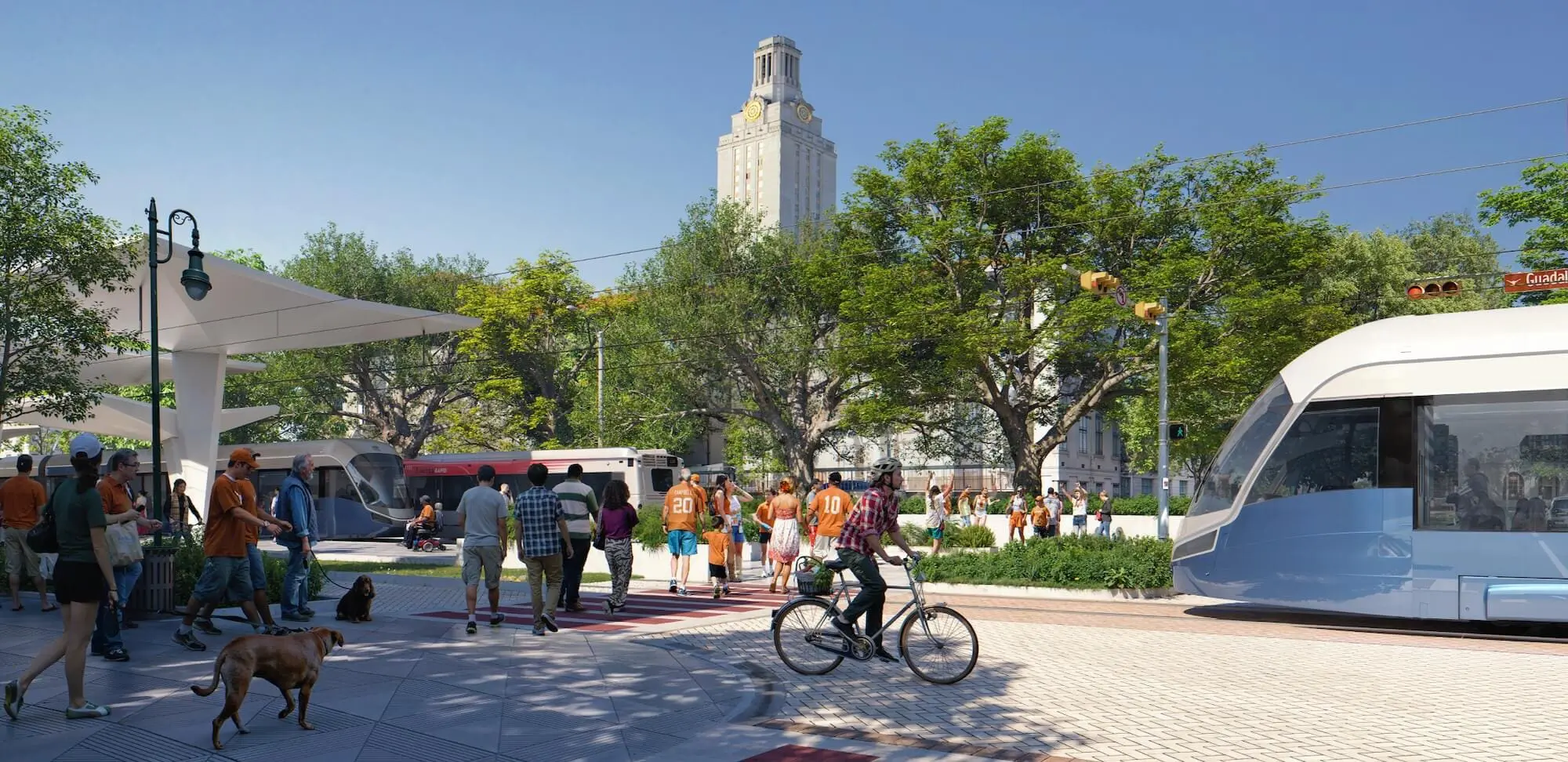
Light rail is an electric-powered train system that runs on its own dedicated railway and provides direct street-level access. Found in major metropolitan areas nationwide, it offers frequent, dependable service and is designed to help riders move efficiently through dense urban corridors.
For Austin, Phase 1 of the project will include 9.8 miles of track and 15 stops, stretching from 38th Street to Oltorf and east from Downtown to East Riverside. The line will connect key destinations such as UT, Downtown, the Hike-and-Bike Trail, East Riverside and South Congress.
Plans also include:
- A new bridge across Lady Bird Lake with a dedicated pedestrian and cyclist path
- Expanded transit infrastructure along East Riverside, including shaded walk and bike paths lined with native Texas plants
- Integration with buses, cars, trains and other modes of transportation
- Trains running every 5–10 minutes on a dedicated track, reducing travel times through the city’s core
The project is expected to create 10,000 jobs during construction and provide access to more than 200,000 jobs once operational. Leaders have also emphasized its role in connecting residents to affordable housing and reducing commuting costs.

Record of Decision Marks Key Federal Step
At the Movability breakfast, Pyne shared that the Federal Transit Administration recently issued a Record of Decision for Austin Light Rail’s Final Environmental Impact Statement (FEIS), formally affirming compliance with the National Environmental Policy Act (NEPA). Signed into law in 1970, NEPA requires federal agencies to evaluate the environmental, social and economic impacts of major projects and provide opportunities for public review before moving forward.
“The Austin Light Rail Project received a Record of Decision just a couple weeks ago, which is a huge milestone for us,” Pyne said.
The Record of Decision marks the conclusion of the environmental review process required for federal funding and allows ATP to continue advancing through the Federal Transit Administration’s New Starts program — a multi-year funding pathway for major transit investments.
Completion of the FEIS and Record of Decision was achieved in under two years, aligning with federal goals to streamline large infrastructure projects. According to ATP, similar projects elsewhere have often taken five to seven years — and sometimes longer — to move through the NEPA process.
The decision allows ATP to advance more detailed design work and begin early construction activities such as utility relocation.
Construction Timeline and Next Steps
Project Connect follows a multi-phase timeline:
- 2020–2021: Voter approval and establishment of ATP
- 2022–2023: Community-driven scope development and Light Rail Implementation Plan
- 2023–2026: Planning, preliminary engineering, environmental review and federal funding requirements
- 2026–2027: Detailed engineering and permitting
- 2027–2033: Construction and testing
- 2033: Open for service
Pyne told attendees that ATP expects to begin some construction activities in 2027. Major solicitations are underway this year, including contracts for final design and construction teams — one focused on track, systems and stations, and another on operations and maintenance facilities. ATP is also soliciting railcar builders, with contract awards expected in the first half of 2026.
ATP is scheduled to reach another milestone soon with a construction contract award that will help shape and build the transitway, tracks, systems, stations, bridges, utilities and streetscape elements.
Integrating Rail With Austin’s Existing Transit Network
Watkins emphasized that while ATP is leading development, CapMetro will operate the system — and integration is critical.
“CapMetro has been working hand-in-glove with ATP this whole time to get us through the process,” Watkins said.
She stressed that light rail must function seamlessly with the existing bus network. CapMetro’s Transit Plan 2035, approved last fall, is the agency’s first plan to fully incorporate light rail integration into long-term transit strategy.
Airport Extension and Community Priorities
Watkins said two priority extensions are under consideration: north from 38th Street to Crestview and east from Yellowjacket Lane to the airport.
“It has become glaringly obvious that the community preference is the airport,” Watkins said.
Pyne added that extending to the airport presents potential funding opportunities and coordination advantages with ongoing airport expansion work. Transit Plan 2035 also includes plans to upgrade Route 350 into a high-frequency route serving the airport.
Rapid Routes 800 and 837 Near Full Service
Project Connect improvements are not limited to rail. CapMetro Rapid Routes 800 and 837 launched initial service last year.
“We didn't want to wait for perfection,” Watkins said, explaining that service began even before full infrastructure buildout.
Park-and-ride facilities and charging infrastructure for battery electric buses are expected to be completed by mid-year, by the end of the summer. Once complete, both routes are expected to operate at their full 10-minute frequencies.
Supporting Local Businesses During Construction
As large-scale construction approaches, leaders addressed concerns about impacts to local businesses.
“Absolutely,” Pyne said when asked whether ATP would work with local businesses to help them navigate construction impacts.
ATP is conducting a needs assessment to tailor support programs specifically for Austin. The agency has also studied approaches in other cities and is engaging with local stakeholders to shape its strategy.
Movability, as part of the federal Climate Pollution Reduction Grant partnership led by the City of Austin, is working with employers to help keep customers and employees moving during construction. The organization offers customized consulting at no cost and can help subsidize certain multimodal services.
A Long-Term Transformation
Austin Light Rail is one of the largest transit infrastructure projects currently underway in the United States and the first of its kind in Austin’s history. While leaders acknowledge the process will be long and complex, the project remains on track within its phased timeline.
With federal environmental approval secured and major design and construction contracts in motion, Project Connect continues advancing toward its goal: delivering Austin’s first light rail system and reshaping how residents and visitors move through the city.
For more information about Project Connect milestones and updates, visit atptx.org. To learn more about Movability and employer mobility programs, visit movabilitytx.org.

 Tiffany Krenek has been on the My Neighborhood News team since August 2021. She is passionate about curating and sharing content that enriches the lives of our readers in a personal, meaningful way. A loving mother and wife, Tiffany and her family live in the West Houston/Cypress region.
Local business spotlight
Grow your business
where trust already lives.
Let’s introduce your business to the neighbors nearby.
Have a local favorite?
Let’s make an introduction.
Leave your email and our team will reach out with ways to promote your business.
Give a local favorite a little love.
Know a business your neighbors should discover? Tell us who they are.
We couldn’t send that just yet. Please try again.