







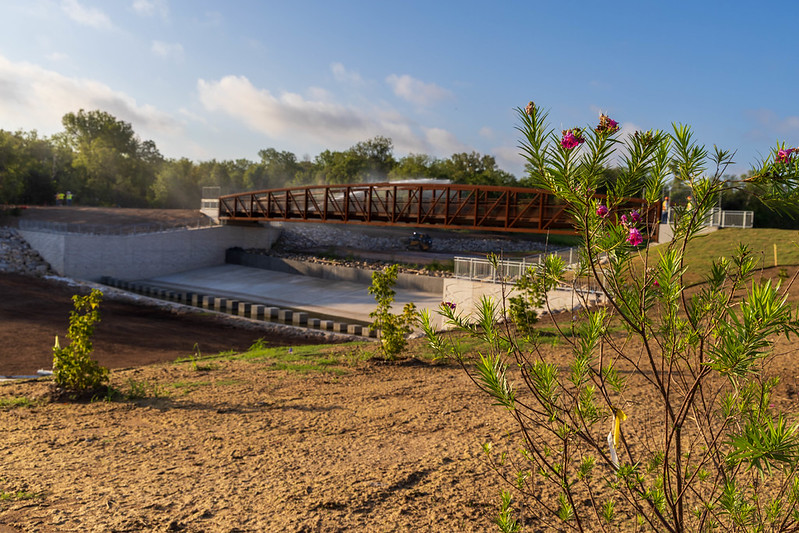
Austin Completes $28.5 Million Erosion Control Project at Roy G. Guerrero Park, Reopens Flood-Resilient Pedestrian Bridge
After years of watching floodwaters carve deeper into the banks of Country Club West, Austinites can finally walk across a new pedestrian bridge at Roy G. Guerrero Colorado River Metropolitan Park with confidence.
The City of Austin has completed the Roy G. Guerrero Park Channel Stabilization project, a $28.5 million investment that officials say is the largest erosion control project in Austin’s history. The effort protects parkland, nearby homes, key infrastructure and beloved community spaces like Krieg Fields, while strengthening Austin’s long-term flood resilience along the Colorado River.
The project began in August 2022, but the story stretches back decades.
A Problem Years in the Making
The erosion along Country Club West traces back to the late 1970s, when an artificial drainage channel was partially constructed to divert floodwaters from Country Club Creek and support development along Riverside Drive. The channel was never completed, and over time, water carved its own path to the river—forming gullies that worsened year after year.
Severe flooding in 2015 marked a turning point. The pedestrian bridge collapsed. Flows that once split into two channels funneled into one, accelerating erosion across highly erodible sand that was once a Colorado River sandbar before the construction of Longhorn Dam. The damage threatened ball fields, trails, park roads, multi-family homes, water and wastewater infrastructure, and nearby bridges on Riverside Drive and Wickersham Lane.
In the years that followed, the City completed five temporary stabilization projects between 2017 and 2020 to slow the damage and protect critical assets—including ballfields 10 and 11, a wastewater main and park roads—while engineers worked toward a permanent solution.
What the $28.5 Million Project Includes
The completed erosion stabilization project replaces the failed pedestrian bridge and introduces long-term flood mitigation improvements designed to withstand major storm events.
Improvements include:
- Three large concrete grade-control structures that step stormwater safely down from the creek to the Colorado River
- A new pedestrian bridge built over one of those structures and designed to endure future flooding
- A naturalized channel bottom
- Rock stabilization and native grasses along the banks
- More than 40 newly planted trees, along with a $500,000 contribution toward planting additional trees throughout the park to offset the loss of hundreds of mature trees
Funding for the project came from a combination of Drainage Utility Funds, 2018 Bond Funds, General Funds and a FEMA Hazard Mitigation Grant.
Jorge Morales, Director of Austin Watershed Protection, said the project reflects lessons learned.
“This project shows how thoughtful engineering, collaboration and innovation can correct the mistakes of the past,” Morales said. “It protects our open spaces, improves park connectivity, enhances wildlife habitat, and helps build a more resilient Austin for the future.”
Austin Mayor Kirk Watson emphasized that the work goes beyond infrastructure.
"This project is about more than erosion control - it's about protecting homes, infrastructure, and natural spaces while strengthening Austin's flood resilience. Thanks to FEMA, Austin voters, and local partners, we've stabilized 35 acres of parkland and strengthened Austin's resilience to flooding. This success reflects the power of collaboration between our city, federal partners and our community," Watson said.
Statewide Recognition for Austin’s Flood Mitigation Efforts
The Roy G. Guerrero Park stabilization project has already earned statewide recognition. It was named the 2025 Project of the Year by the Texas chapter of the American Public Works Association in the Environmental Projects category for projects ranging from $25 million to $75 million.
For residents who use the trails, ball fields and green space near Riverside Drive, the recognition is meaningful—but the reopening of the pedestrian bridge may matter most.
The bridge reconnects parts of the park that had been separated for years, restoring safer access for walkers, cyclists and families who rely on the park for recreation and community gatherings.
The Role of Austin Watershed Protection
The project also highlights the work of Austin Watershed Protection, the department originally established in 1996 as the Drainage Utility. The department focuses on reducing the impacts of flooding, erosion and water pollution across Austin’s 850 miles of creeks, 1,100 miles of storm drains, 30,000 inlets and 1,000 stormwater ponds.
With a Fiscal Year 2025 budget of $122.4 million and 443 employees, the department is primarily funded through the drainage charge on Austin utility bills, along with bond and grant funding for major capital improvement projects.
In addition to building projects like the Roy G. Guerrero Park Channel Stabilization effort, Austin Watershed Protection monitors rainfall and flood gauges, barricades flooded roads during storms, removes debris from channel crossings and helps maintain the health of Lady Bird Lake.
The department works closely with Austin’s Environmental Commission, whose volunteer members provide oversight and recommendations to City Council on key environmental issues.
A Broader City Effort
Austin Parks and Recreation partnered on the project to ensure the protection and restoration of parkland, urban forest and trails, while Austin Capital Delivery Services oversaw project development and construction.
Austin Capital Delivery Services—guided by its “One City, One Team, One Approach” philosophy—collaborates with engineers, architects, construction professionals and community stakeholders to deliver large-scale capital improvement projects that serve the public.
Together, city departments focused not only on erosion control but on preserving one of Austin’s most treasured green spaces along the Colorado River.
Looking Ahead
Capital improvement projects of this scale often take years to complete, moving through phases that include preliminary engineering, detailed design, permitting and bidding before construction begins.
Now finished, the Roy G. Guerrero erosion stabilization project represents a long-awaited milestone for residents who have watched the creek slowly consume portions of the park.

 Tiffany Krenek has been on the My Neighborhood News team since August 2021. She is passionate about curating and sharing content that enriches the lives of our readers in a personal, meaningful way. A loving mother and wife, Tiffany and her family live in the West Houston/Cypress region.