








Houston Rent Looks Cheaper Than Other Major Cities — But New Data Shows Why Many Renters Still Feel Squeezed
For years, Houston’s relatively low housing costs have been part of the city’s appeal. Compared with places such as New York City, Los Angeles and San Diego, renters can often find an apartment here for considerably less.
But for hundreds of thousands of Houston households, the more important number may be what is left after the rent is paid.
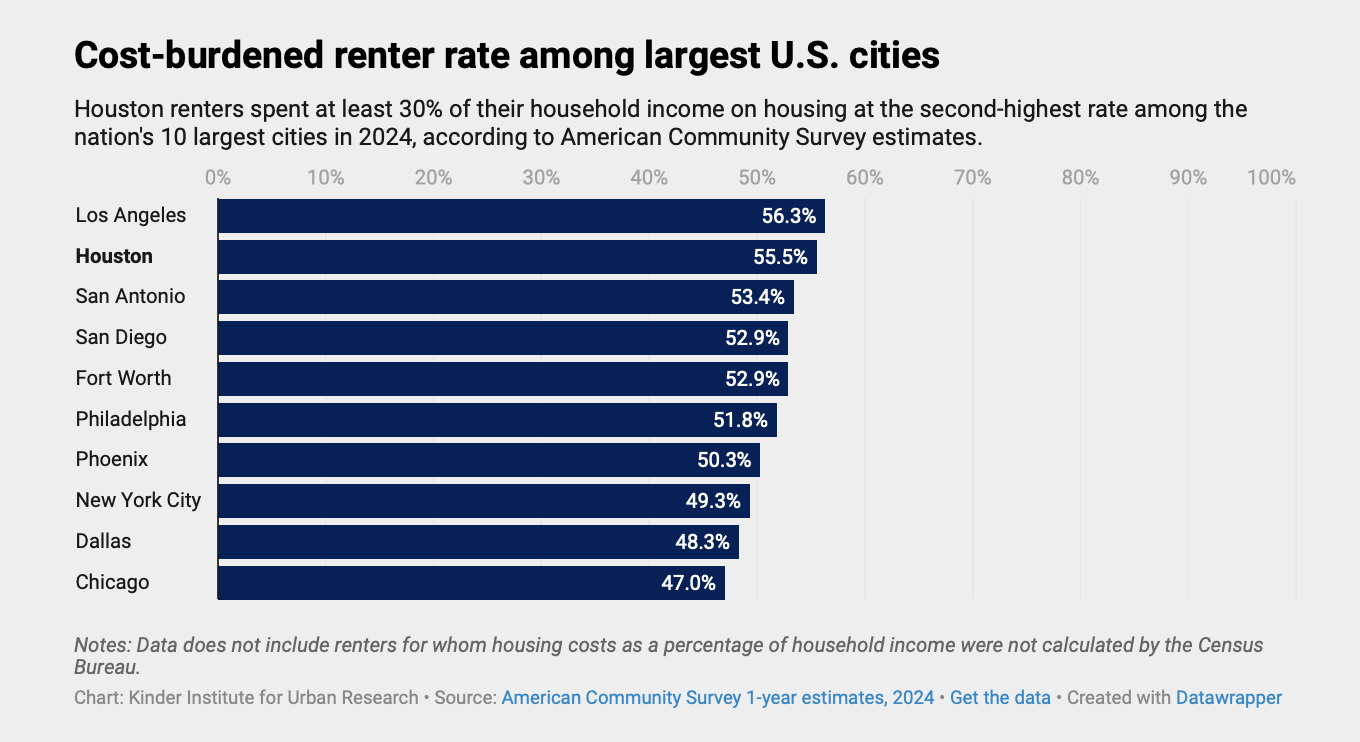
A new analysis from Rice University’s Kinder Institute for Urban Research, published Aug. 31, found that 55.5% of Houston renters whose housing-cost burden could be calculated spent at least 30% of their household income on housing in 2024. That was the second-highest rate among the nation’s 10 largest cities, trailing only Los Angeles at 56.3%. The Kinder Institute based its analysis on 2024 American Community Survey one-year estimates from the U.S. Census Bureau.
That translates to roughly 293,000 Houston renters considered cost-burdened, according to the institute — households for whom housing costs consume enough income that paying for groceries, transportation, health care, utilities and other everyday necessities can become increasingly difficult.
For Houston-area families weighing where they can afford to live, the findings add an important qualification to the familiar idea that Houston is a low-cost alternative to many large American cities: affordability depends not only on what housing costs, but also on what residents earn.
Houston Had Some of the Lowest Rent — and the Lowest Renter Income
On rent alone, Houston appears relatively inexpensive.
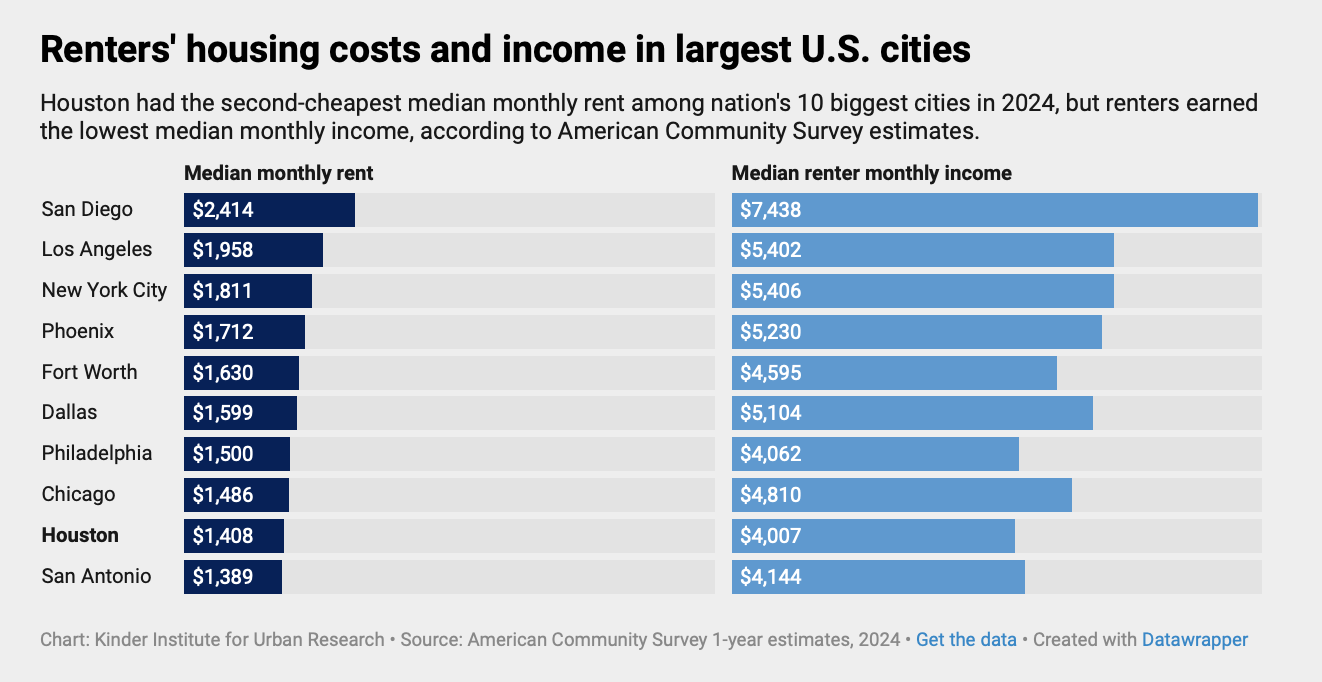
The Kinder Institute’s analysis of American Community Survey estimates placed Houston’s median monthly rent at $1,408 in 2024, lower than every city in the top 10 except San Antonio, where median rent was $1,389.
By comparison, median monthly rent was approximately:
- San Diego: $2,414
- Los Angeles: $1,958
- New York City: $1,811
- Phoenix: $1,712
- Fort Worth: $1,630
- Dallas: $1,599
- Philadelphia: $1,500
- Chicago: $1,486
- Houston: $1,408
- San Antonio: $1,389
But Houston also ranked at the bottom of those cities for renter income.
The same data showed median renter household income in Houston at about $4,007 per month, or roughly $48,100 annually. San Antonio renters had a slightly higher median monthly income of $4,144, while Dallas renters earned $5,104, New York City renters $5,406 and San Diego renters $7,438.
That gap between wages and housing costs helps explain why Houston renters can pay less in absolute dollars and still experience greater financial pressure.
Michelle Smirnova, director of the Kinder Institute’s Center for Housing and Neighborhoods, said Houston’s affordability reputation does not tell the complete story for households further down the income scale.
“There are a lot of advantages that we have in Houston, but that obscures the fact that we are doing really poorly for the poor, and increasingly for the middle class,” Smirnova said.
More Than Half of Houston Renters Are Cost-Burdened
The contrast becomes especially clear when Houston is compared with other major cities by the percentage of renters spending at least 30% of household income on housing.
According to the Kinder Institute analysis, the 2024 cost-burdened renter rates were:
- Los Angeles: 56.3%
- Houston: 55.5%
- San Antonio: 53.4%
- San Diego: 52.9%
- Fort Worth: 52.9%
- Philadelphia: 51.8%
- Phoenix: 50.3%
- New York City: 49.3%
- Dallas: 48.3%
- Chicago: 47.0%
That means Houston's cost-burden rate was more than eight percentage points higher than Chicago's, even though Chicago's median rent was higher.
The trend is also moving in the wrong direction for Houston renters. The Kinder Institute reported that the estimated share of cost-burdened renters increased from 50.9% in 2022 to 51.2% in 2023 and 55.5% in 2024.
That rise matters beyond the apartment market. When more of a household paycheck goes toward rent, there is less flexibility for child care, car repairs, medical bills, insurance, savings or an unexpected expense — the kinds of everyday costs that often determine whether a family feels financially secure.
Lower Wages Are Part of Houston’s Housing Affordability Equation
Houston is home to major employers in energy, medicine, engineering and other high-paying fields. But the regional economy also depends heavily on workers in industries where pay can be substantially lower, including food preparation, construction, transportation, maintenance and repair.
The Kinder Institute pointed to that employment mix as one contributor to Houston's rental affordability challenge. Texas cities also operate under the federal minimum wage of $7.25 per hour, while five of the nation's 10 largest cities are subject to state or local minimum wages above $15 per hour, according to the institute's analysis.
Smirnova said those differences can result in two very different experiences of the same city.
“Houston attracts people for oil and gas and healthcare, and it’s attractive and affordable to people at the higher income strata,” Smirnova said. “But we are such an unequal city that the experience of people at the bottom is dire, and increasingly there is no middle.”
The institute reported another sign of financial pressure in the 2024 figures: median household income among Houston renters fell by about $2,600 from the previous year, or 3.8%, while median rent for a two-bedroom apartment increased by roughly $26 per month, or 1.8%.
Houston Is Becoming More of a Renter City
The affordability discussion comes as renting is becoming an increasingly important part of Houston's housing landscape.
According to the Kinder Institute, the number of renters within the city increased by roughly 90,000 in 2024, a 7.5% increase from the previous year, while the number of homeowners declined by nearly 13,500, or 1.2%. The institute also reported a particularly steep decline in Black homeownership within the city during that period.
A broader Kinder Institute housing report released in June similarly found growing financial pressure across Houston and Harris County, with increasing housing costs leaving many households with less money available for food, transportation, health care and other necessities.
Those trends have implications well beyond apartment communities. A growing renter population can affect demand for multifamily development, affordable housing programs, schools, neighborhood services and transportation — while also changing the path families traditionally used to move from renting into homeownership.
Why Building More Apartments May Not Solve the Entire Problem
Houston is known nationally for its relatively flexible development environment, and the region continues to add housing. But researchers and affordable housing advocates say simply increasing the number of units may not be enough if existing lower-cost homes disappear or wages fail to keep pace.
Nicole Cassier, chief strategy officer for Houston affordable housing nonprofit Avenue, told the Kinder Institute that both new housing and preservation of existing affordable units will matter.
“We can’t just build our way out of the problem while simultaneously losing the affordable housing we already have,” Cassier said. “It is a production and a preservation problem.”
Houston also differs from some major cities in the level and structure of rental assistance and regulation. The Kinder Institute noted that New York City and Los Angeles have rent-control or rent-stabilization policies affecting large numbers of units, while Chicago and Philadelphia provide rental assistance through housing authorities to more residents than Houston. Critics of rent regulation, however, argue that restricting rent increases can discourage housing construction and place additional burdens on property owners — illustrating the policy tradeoffs cities face when addressing housing affordability.

The Cost of Housing Is More Than the Monthly Rent
For Houston residents, the debate is increasingly expanding beyond the advertised rent itself.
Utilities, transportation, insurance, property taxes passed through housing costs, disaster exposure and the expense of recovering from storms can all influence whether a household can realistically afford where it lives.
The Kinder Institute has partnered with the City of Houston and Harris County on a housing dashboard designed to track subsidized and unsubsidized housing available to households earning between 30% and 80% of area median income. Researchers say that information could help local leaders identify where new construction, tax incentives or mixed-income housing strategies may be most useful.
Smirnova said that broader definition of affordability is becoming increasingly important.
“We are really interested in understanding other factors that erode affordability, including utility costs, property taxes, insurance, the cost of climate disasters themselves and rebuilding — all of the invisible factors that may erode affordability, but really boil down to: What is the true cost of housing in Houston?” she said.
That question may resonate with renters throughout the Houston area because a lease price is only one piece of the household budget. A moderately priced apartment may provide little financial breathing room if wages, transportation expenses, utility bills and other necessities consume most of what remains.
What Houston Renters Should Take From the Numbers
There is an important geographic limitation to the new analysis: the rental affordability figures apply specifically to the City of Houston. They do not represent unincorporated Harris County, other cities within Harris County or neighboring counties such as Fort Bend and Montgomery. Rent levels, incomes and housing burdens can vary considerably across the broader Houston metropolitan area.
Still, the city-level numbers provide an important window into a housing challenge likely familiar to many households: Houston can simultaneously have comparatively inexpensive rent and a serious affordability problem.
The difference comes down to income.
For renters trying to build savings, eventually buy a home or simply keep enough money available for groceries, child care, transportation and emergencies, what matters is not whether Houston rent is cheaper than rent in Manhattan or San Diego. It is whether a Houston paycheck can comfortably cover a Houston life.
As Houston and surrounding communities continue to grow, housing supply, wages, rental assistance and preservation of existing affordable homes will remain closely watched pieces of that equation.
Source Note: Data and analysis cited in this article are primarily from John Brannen's Aug. 31, 2026 Urban Edge report for Rice University's Kinder Institute for Urban Research, using 2024 U.S. Census Bureau American Community Survey one-year estimates. Additional regional housing context comes from the Kinder Institute's 2026 State of Housing in Harris County and Houston.
Stay tuned to My Neighborhood News for continuing coverage of Houston and Harris County housing trends, development, cost of living and the issues affecting local families.

 Tiffany Krenek has been on the My Neighborhood News team since August 2021. She is passionate about curating and sharing content that enriches the lives of our readers in a personal, meaningful way. A loving mother and wife, Tiffany and her family live in the West Houston/Cypress region.
Local business spotlight
Grow your business
where trust already lives.
Let’s introduce your business to the neighbors nearby.
Have a local favorite?
Let’s make an introduction.
Leave your email and our team will reach out with ways to promote your business.
Give a local favorite a little love.
Know a business your neighbors should discover? Tell us who they are.
We couldn’t send that just yet. Please try again.