






When a Stranger Knocks in Cross Creek Ranch: How to Handle Solicitors Safely and Confidently
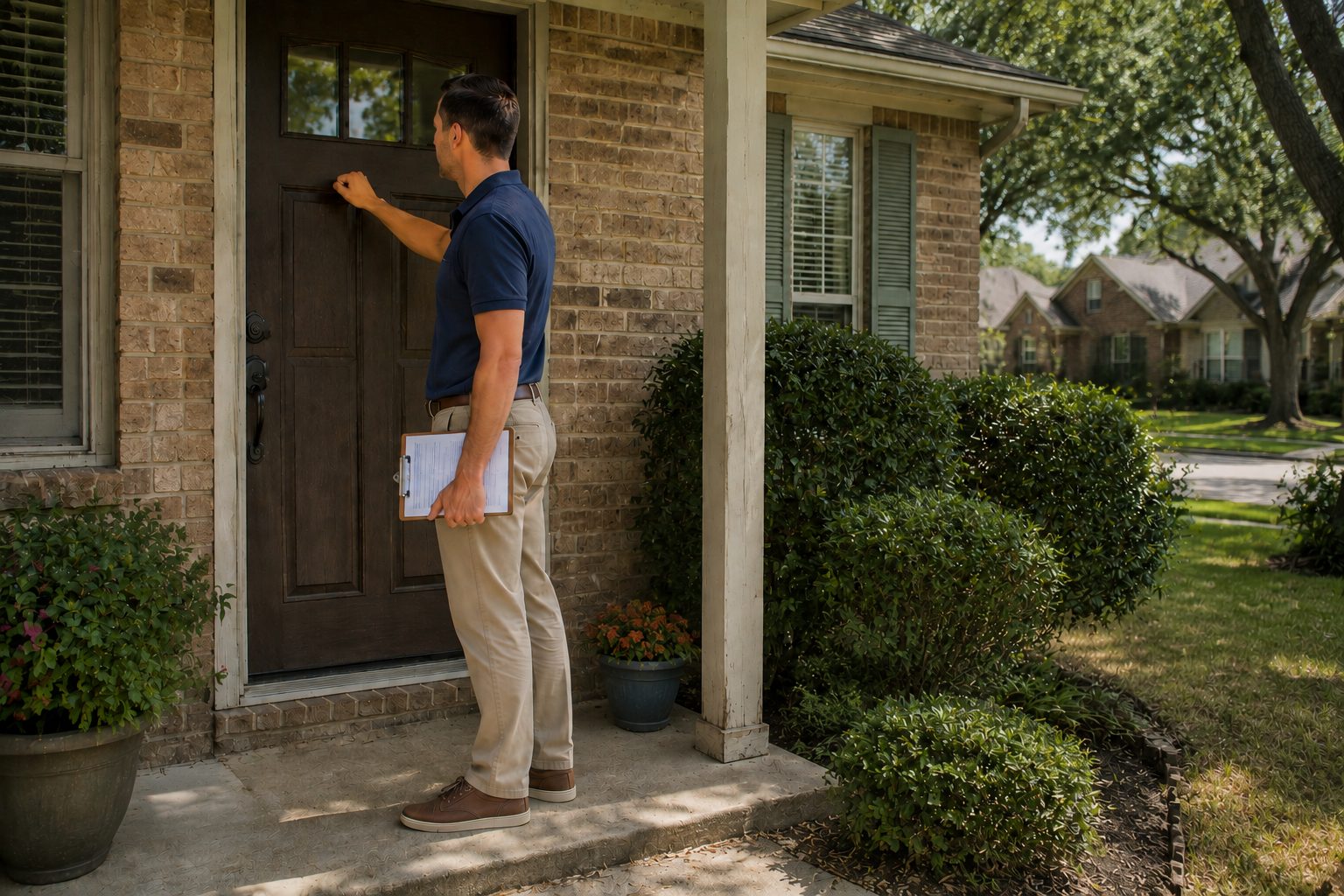
A doorbell rings in the middle of dinner. The person outside keeps knocking after no one answers, peers toward a window or launches into a fast-moving sales pitch the moment the door opens.
Door-to-door visits are nothing new, but they can leave residents wondering where ordinary solicitation ends and suspicious behavior begins. Warm-weather sales campaigns and post-storm repair work can bring roofing, solar, pest-control, landscaping and other representatives into neighborhoods. Most are trying to do a legitimate job. Others may use pressure, misrepresentation or an unexpected visit to gain money, personal information or access to a home.
There is another wrinkle: the person at the door may not be selling anything at all. Utility employees and authorized contractors sometimes visit homes to inspect equipment, investigate a reported problem, read or replace a meter, perform maintenance or communicate about work affecting the property.
The safest response is not necessarily to ignore every knock. Residents can acknowledge a visitor without opening the door, determine why the person is there and verify the claim independently before allowing access or sharing information.
You Can Answer Without Opening the Door
Residents do not have to unlock or open their door to speak with an unexpected visitor. A closed and locked door, doorbell camera or nearby window can provide a safe barrier while the resident asks:
- Who are you?
- What company or organization do you represent?
- Why are you visiting this address?
- Do you have identification or a local solicitation permit?
- Is there a phone number I can call to verify your visit?
Avoid announcing that you are home alone, and do not provide information about your household, schedule, security system, finances or utility account. A legitimate representative should understand why a resident wants to verify an unexpected visit.
If the person is selling something, a simple statement is enough: “I am not interested. Please leave the property.” There is no obligation to listen to the full presentation, explain the decision or continue answering questions.
A visitor who refuses to accept that answer, continues knocking, tries another door, looks through windows or will not leave deserves greater caution. Move away from the entrance, keep the door locked and call law enforcement. Use 911 when there is an immediate threat, attempted entry or other emergency; otherwise, contact the appropriate local law-enforcement agency through its non-emergency number.
Is the Visitor Really From a Utility Company?
Not everyone who appears to be soliciting is selling a product. Electric, natural gas, water, telecommunications and other utility representatives may need to reach equipment or alert a resident to work on or near the property.
That does not mean residents should accept a uniform, safety vest, vehicle logo or identification badge as proof on its own. Those details can be copied.
Ask the visitor to display identification through a window or hold it where a doorbell camera can capture it. Then contact the utility using the phone number printed on a recent bill, listed in the company’s official app or published on its verified website. Do not call a number supplied solely by the visitor.
For example, Entergy advises customers to request identification before allowing someone claiming to represent the company inside. Customers who remain uncomfortable can contact Entergy directly to verify an appointment or the presence of its personnel in the neighborhood.
A genuine utility worker should not object to reasonable verification. Be particularly cautious if someone:
- Demands an immediate payment at the door.
- Threatens an immediate shutoff unless payment is made.
- Requests a gift card, cryptocurrency, wire transfer or payment app.
- Asks for a Social Security number, banking information or account password.
- Insists on entering the home without explaining why.
- Pressures the resident not to call the utility for confirmation.
Residents should not simply dismiss every utility-related visit, especially when there may be an equipment problem, gas leak, water issue or active repair nearby. Instead, keep the physical barrier in place, verify the visitor independently and follow instructions received directly from the utility.
If someone reports a possible gas leak or another immediate hazard, move to a safe location and contact the appropriate utility emergency line or 911. Do not remain inside while trying to determine whether the visitor is legitimate.

Recognizing an Aggressive or Suspicious Solicitor
Enthusiasm alone does not make a salesperson dishonest. The concern is behavior that ignores boundaries or tries to prevent an informed decision.
Warning signs can include:
- Refusing to identify the company clearly.
- Claiming that “all your neighbors” have already signed up.
- Saying an offer is available only if the resident agrees immediately.
- Asking to enter the home to explain the offer.
- Requesting to see a utility bill or photograph account information.
- Insisting that a roof, driveway or other part of the home needs urgent work without a requested inspection.
- Asking when other household members will return.
- Remaining on the property after being told to leave.
- Photographing the home, looking into windows or testing gates and doors.
Residents who are interested in an offer can request written information and research the company later. They should independently confirm the company’s address, insurance, references, complaint history and any licensing or registration requirements that apply to the work.
Following a disaster or major weather event, the Texas Attorney General’s Office recommends obtaining multiple estimates, checking references, requesting proof of insurance, putting every term in writing and resisting pressure to sign immediately. It also warns against paying too much in advance or signing contracts containing blank spaces.
For certain sales made at a consumer’s home, the Federal Trade Commission's Cooling-Off Rule provides three business days to cancel. The rule has exceptions, however, so residents should not assume every door-to-door transaction can be reversed.
What Children Should Do When Someone Knocks
Families in Cross Creek Ranch should establish one simple rule before an unexpected visitor ever appears: children do not open the door for someone they do not personally know and expect.
Children who are home without an adult should not approach the entrance, announce that they are alone or engage in a long conversation through the door. Depending on their age and the family’s plan, they should:
- Keep every exterior door locked.
- Move to a secure area where they cannot be seen from outside.
- Contact a parent, guardian or designated nearby adult.
- Use a doorbell camera only if the family has taught them how to do so safely.
- Call 911 if someone attempts to enter, threatens them or creates an immediate danger.
Parents should explain that uniforms and badges do not automatically make a stranger trustworthy. Children should also know that real police officers, firefighters and utility workers will not expect a child who is alone to disregard family safety rules.
Practice the plan occasionally, just as the family might practice a fire drill. Make sure children know their address, how to call for help and which trusted neighbors they may contact.
How to Reduce Unwanted Solicitation
A clearly visible “No Soliciting” sign near the main entrance can discourage many commercial sales visits, although no sign will stop everyone. Residents should check their city or county regulations because permit requirements, allowable hours, exemptions and enforcement procedures vary among jurisdictions.
Additional steps include:
- Place the sign where visitors will see it before reaching the doorbell.
- Keep gates and exterior doors closed and locked.
- Use motion lighting or a doorbell camera when appropriate.
- Avoid posting publicly that the household is away or that children are home alone.
- Save clear video, photographs and descriptions of concerning behavior.
- Record the company name, vehicle description and license plate from a safe location.
- Report repeated violations to local code enforcement or law enforcement.
- Notify the HOA or community management team so neighbors can be made aware, while avoiding unsupported accusations on social media.
Political candidates, religious visitors, charitable canvassers and commercial salespeople may be treated differently under local ordinances and constitutional protections. An HOA rule or neighborhood sign also does not replace municipal law. Residents should consult their city’s official website or local law enforcement agency for the rules that apply to their address.
A Firm Boundary Is Not Impolite
The goal is not to treat every unfamiliar visitor as a criminal. It is to maintain control of the interaction.
A resident can speak through a locked door, decline a sales pitch, verify a utility employee, give a legitimate worker the information needed to address a problem and report behavior that crosses the line. No reputable company should require a homeowner to sacrifice personal safety in the name of politeness.
By discussing these expectations as a family and watching out for one another, residents of Cross Creek Ranch can respond to the next unexpected knock with caution, confidence and good judgment.

 Tiffany Krenek has been on the My Neighborhood News team since August 2021. She is passionate about curating and sharing content that enriches the lives of our readers in a personal, meaningful way. A loving mother and wife, Tiffany and her family live in the West Houston/Cypress region.
Local business spotlight
Grow your business
where trust already lives.
Let’s introduce your business to the neighbors nearby.
Have a local favorite?
Let’s make an introduction.
Leave your email and our team will reach out with ways to promote your business.
Give a local favorite a little love.
Know a business your neighbors should discover? Tell us who they are.
We couldn’t send that just yet. Please try again.