







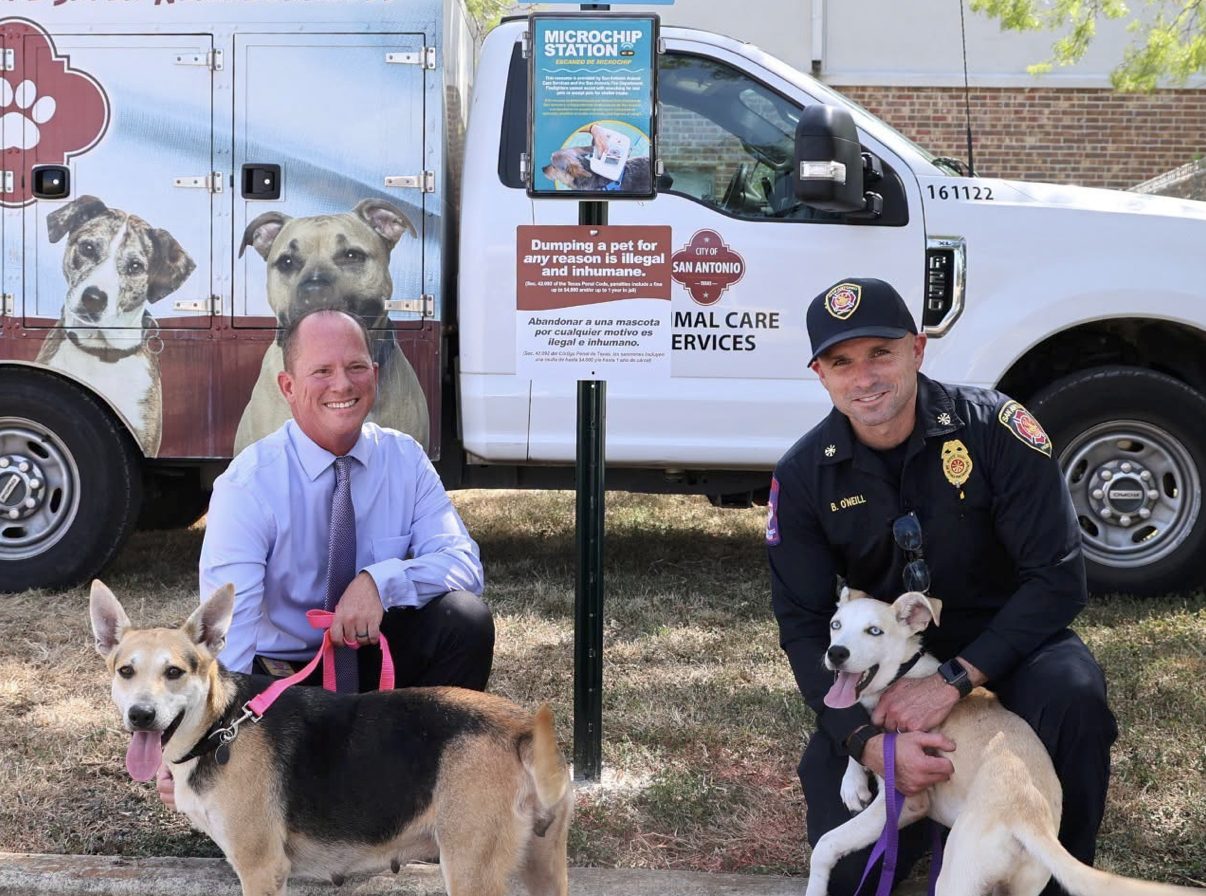
San Antonio Adds Free 24/7 Pet Microchip Scanners at Fire Stations to Help Lost Dogs and Cats Get Home
For San Antonio residents who have ever spotted a wandering dog late at night or found a frightened cat on a weekend, one of the hardest questions can be surprisingly simple: Who does this pet belong to?
A new citywide resource could make answering that question much easier.
San Antonio Animal Care Services and the San Antonio Fire Department are rolling out free, outdoor pet microchip scanning stations available 24 hours a day, seven days a week at 11 San Antonio fire stations and the Animal Care Services campus. The City announced the initiative Sept. 15, with the scanners being brought online over the following week.
The goal is to give neighbors who safely contain a lost dog or cat another way to reunite the animal with its family, particularly when veterinary clinics and shelters are closed.
And there is an important distinction residents should know: the fire stations are not pet drop-off locations, and firefighters are not there to scan animals for residents. The outdoor scanners are designed to be used by residents themselves.
How San Antonio's New Pet Microchip Scanners Work
Each participating location has a secured scanner outside the facility along with instructions explaining how to scan a found pet and what to do if a microchip is detected.
When a scan identifies a chip, residents can follow the instructions and use their smartphone to connect with the appropriate microchip registry. The registry can then help facilitate contact with the pet's registered owner.
Animal Care Services Director Jon Gary said the around-the-clock access can help shorten the time between finding a pet and getting that animal home.
“These scanners give residents round-the-clock tools to help found pets get home quickly while also reducing unnecessary shelter intake,” Gary said.
That can matter for more than convenience. A dog that slipped through an open gate or a cat that wandered away from home may live only a few streets from where it was found. Giving neighbors a way to identify that animal before taking it to a shelter could mean a much faster reunion.
What Exactly Is a Pet Microchip?
Despite the name, a pet microchip does not work like a GPS tracker.
A microchip is a tiny electronic identification device, approximately the size of a grain of rice, that is typically implanted beneath a pet's skin between the shoulder blades. A veterinarian or trained professional inserts the chip with a needle in a procedure similar to receiving an injection. Surgery and general anesthesia generally are not required.
The chip does not have its own battery and does not continuously transmit a pet's location.
Instead, a compatible microchip scanner activates the chip using radio-frequency technology. The scanner then displays the chip's unique identification number. That number can be checked against participating pet microchip registries to determine which registry may have the owner's contact information.
In other words, a microchip identifies a pet. It does not track a pet.
Registering a Microchip Is Just as Important as Getting One
Having a pet microchipped is only half of the process.
The unique microchip number must be connected to current owner information in a pet recovery registry. If a chip has never been registered, or if it still contains an old telephone number or address, finding the chip may not immediately lead a finder back to the family.
The American Animal Hospital Association recommends that pet owners update their microchip records whenever they move, change telephone numbers or email addresses, or take ownership of an animal that was previously registered to someone else.

Owners who do not remember which company manages their pet's chip can use the AAHA Microchip Registry Lookup Tool. By entering the microchip number, the tool can identify participating registries associated with that chip. It does not publicly display the owner's personal information.
Pet owners can also ask a veterinarian to scan their pet during a routine visit to confirm the chip can still be detected and to obtain the microchip number if they no longer have it in their records.
For San Antonio pet owners, keeping that information current carries additional importance. The City says its ordinance requires companion animals within San Antonio city limits to be microchipped and their registration information kept up to date.
Where to Find San Antonio's 24/7 Pet Microchip Scanners
The City's announced network includes one fire station serving each council district, with an additional shared location for Districts 5, 6 and 7, plus the Animal Care Services campus.
The locations listed by the City are:
-
District 1: Fire Station 19, 2307 Vance Jackson, San Antonio, TX (Google Map)
-
District 2: Fire Station 18, 1410 S. W.W. White Road, San Antonio, TX (Google Map)
-
District 3: Fire Station 22, 1100 March Avenue, San Antonio, TX (Google Map)
-
District 4: Fire Station 36, 5826 Ray Ellison Blvd., San Antonio, TX (Google Map)
-
District 5: Fire Station 16, 2110 Nogalitos St., San Antonio, TX (Google Map)
-
Districts 5, 6 and 7: Fire Station 26, 4140 Culebra Road, San Antonio, TX (Google Map)
-
District 6: Fire Station 44, 1351 Horal Drive, San Antonio, TX (Google Map)
-
District 7: Fire Station 27, 1538 Hillcrest, San Antonio, TX (Google Map)
-
District 8: Fire Station 32, 4839 Charles Katz Drive, San Antonio, TX (Google Map)
-
District 9: Fire Station 46, 1165 Evans Road, San Antonio, TX (Google Map)
-
District 10: Fire Station 39, 10750 Nacogdoches Road, San Antonio, TX (Google Map)
- San Antonio Animal Care Services: 4710 State Highway 151, San Antonio, TX (Google Map)
Because the stations were being activated during a phased rollout following the Sept. 15 announcement, residents may want to check the City's current Pet Scan map before heading to a location.
What Residents Should Not Do at a Fire Station
The scanners provide a new neighborhood resource, but the participating San Antonio fire stations have not become animal shelters or surrender facilities.
Residents should never leave a dog or cat unattended at a scanner, outside a fire station or anywhere on fire station property.
The program is intended for someone who has already safely contained a found pet and can safely handle the animal while using the scanner.
If an animal is injured, aggressive or cannot be safely handled, the City advises residents to contact 311 or 210-207-6000 rather than attempting to scan or restrain the animal themselves.
A Small Tool That Could Make a Big Difference for San Antonio Pets
For neighborhoods across San Antonio, the value of the program may ultimately come down to what happens in the hours immediately after a pet goes missing.
A collar and identification tag remain among the easiest ways for a neighbor to recognize a lost pet, and animal health experts recommend using visible identification alongside a microchip. Collars, however, can come off. A properly registered microchip provides another permanent form of identification beneath the skin.
The new 24-hour scanners add another piece to that safety net by putting microchip technology directly into neighborhoods instead of limiting access to shelter or veterinary business hours.
For a family searching the neighborhood for a missing dog, or a resident standing with a friendly stray wondering where it belongs, that access could turn a stressful night into a much quicker trip home.
Residents can check the City of San Antonio Animal Care Services website for the current scanner map and additional guidance on what to do after finding a lost pet.
Stay tuned to My Neighborhood News for more San Antonio neighborhood resources, pet safety information and community updates.

 Tiffany Krenek has been on the My Neighborhood News team since August 2021. She is passionate about curating and sharing content that enriches the lives of our readers in a personal, meaningful way. A loving mother and wife, Tiffany and her family live in the West Houston/Cypress region.
Local business spotlight
Grow your business
where trust already lives.
Let’s introduce your business to the neighbors nearby.
Have a local favorite?
Let’s make an introduction.
Leave your email and our team will reach out with ways to promote your business.
Give a local favorite a little love.
Know a business your neighbors should discover? Tell us who they are.
We couldn’t send that just yet. Please try again.