







Magnolia ISD Back-to-School Safety: What Magnolia Springs Drivers Need to Know Before Aug. 12
The return of school will quickly change the daily rhythm of Magnolia Springs.
Magnolia Independent School District begins the 2026-2027 school year on Wednesday, Aug. 12. School buses will once again travel through neighborhoods, children will gather near assigned stops and families will join campus car-rider lines beginning early in the morning.
For residents, including those without children attending Magnolia ISD, the safest response is straightforward: leave home a little earlier, slow down near schools and bus stops, put away the phone and expect children to move unpredictably.
A student may step from behind a parked truck, cross from the opposite side of a school bus or appear along a road without a sidewalk. A few extra seconds of patience can protect a child and spare a neighborhood family from a life-changing tragedy.
Magnolia ISD Traffic Will Begin Early and Continue Past 4 p.m.
Magnolia ISD’s staggered schedules mean school traffic will arrive in several waves throughout the morning and afternoon.
High school classes begin at 7:15 a.m. and dismiss at 2:30 p.m. Because district high school zone lights operate from 6:45 to 7:30 a.m., teenage drivers, buses and parent vehicles may be traveling before sunrise or during low-light morning conditions. Afternoon high school zone lights operate from 2:20 to 3 p.m.
Intermediate and junior high campuses open their doors at 7:15 a.m., begin classes at 8 a.m. and dismiss at 3:15 p.m.Their school zone lights operate from 7:30 to 8:15 a.m. and again from 3 to 3:45 p.m.
Prekindergarten and elementary campuses open at 7:55 a.m., begin classes at 8:40 a.m. and dismiss at 3:55 p.m. School zone lights operate from 8:10 to 8:50 a.m. and from 3:35 to 4:25 p.m.
For Magnolia Springs, that creates a school traffic cycle lasting nearly 10 hours. High school vehicles may begin appearing before 7 a.m., while elementary buses, children and family vehicles may remain on neighborhood roads after 4 p.m.
Drivers should also remember that school-zone lights represent specific enforcement windows, not the only times children may be present. Students may arrive early for childcare, activities or bus transportation and remain near campuses after dismissal.
Early-Morning Childcare Adds Another Traffic Window
Magnolia ISD offers early-morning childcare for elementary and intermediate students, bringing some family vehicles onto campus well before regular classes begin.
Elementary early-morning care accepts drop-offs from 6:30 to 7:45 a.m. Students arriving after 7:45 a.m. must use the regular car-rider line, which operates from 7:55 to 8:40 a.m.
Intermediate early-morning care also begins at 6:30 a.m., with designated drop-off continuing until 7:05 a.m. Students arriving later must enter through the car-rider line, which operates from 7:15 to 8 a.m.
That means streets near some Magnolia ISD campuses may become active as early as 6:30 a.m. Drivers should not assume that a dark campus or inactive school-zone light means students are not nearby.
Families using car-rider lines should follow the traffic pattern established by their individual campus rather than turning around, stopping or letting children out in undesignated areas.
When Must Texas Drivers Stop for a School Bus?
Texas law requires a driver approaching a stopped school bus from either direction to stop before reaching the bus when its required visual warning signal is operating.
The driver may not proceed until the school bus begins moving again, the bus driver signals motorists to continue or the visual signal is no longer operating.
The easiest way to remember the rule is:
Flashing yellow lights mean slow down and prepare to stop. Flashing red lights and an extended stop arm mean stop completely.
Yellow lights indicate that the school bus is preparing to load or unload children. Red lights and the extended stop arm mean the bus has stopped and students may be boarding, exiting or crossing the roadway.
Drivers must wait until the red lights stop flashing, the stop arm is withdrawn and the bus begins moving before proceeding.
A motorist should never pass simply because no child is immediately visible. A student may be crossing in front of the bus, approaching from the opposite side of the road or standing in an area hidden by the vehicle.
Does Traffic in Both Directions Have to Stop?
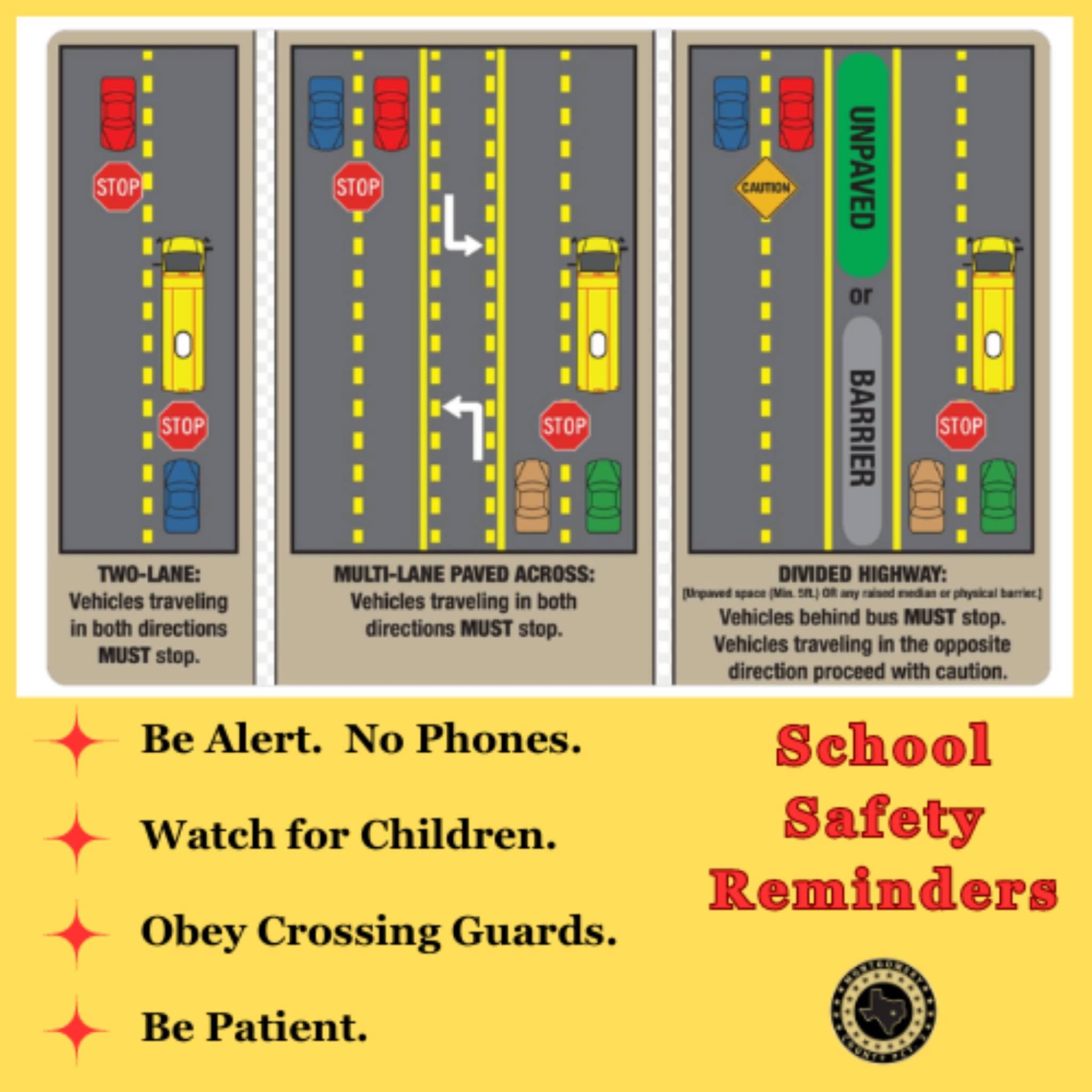
On a typical two-lane neighborhood road, traffic approaching a stopped school bus from both directions must stop when its visual signals are operating.
The same requirement generally applies on an undivided road with multiple lanes. Drivers behind the school bus must stop, and opposing traffic must also stop unless it is traveling on a separate roadway.
Texas law provides an exception when the highway is divided into separate roadways. A driver on the opposite roadway is not required to stop for a bus positioned on the other side of that physical separation.
A painted center line or shared turn lane should not automatically be treated as a divided highway. When there is no true intervening space or physical barrier separating the directions of travel, drivers should be prepared to stop on both sides.
That distinction can be especially important on the larger roads connecting Magnolia, Pinehurst, Stagecoach and surrounding Montgomery County communities.
When uncertain, stopping is the safer decision.
What Federal School Bus Rules Cover
There is no single federal roadway law that tells every motorist exactly when to stop for a school bus. Those traffic requirements are established primarily through state laws such as the Texas Transportation Code.
Federal regulations focus largely on how school buses are designed and equipped. School buses include safety features such as flashing warning lights, cross-view mirrors, stop-sign arms, protective seating and rollover protections.
Every state prohibits drivers from passing a stopped school bus from behind when its red lights are flashing and stop arm is deployed. Requirements for opposing traffic can vary depending on the roadway and state law.
In practical terms, federal standards help make the school bus safer, while Texas law determines what motorists in Magnolia Springs must do when the bus stops.

Children Face Their Greatest Risk Outside the Bus
School buses are designed to provide a high level of protection to students, but the moments before boarding and after exiting can be especially dangerous.
Children may need to cross a road, walk along an unpaved shoulder or stand near moving traffic. They can also be difficult to see behind mailboxes, landscaping, parked vehicles and large trucks.
Drivers should scan the entire area around a stopped or slowing bus rather than focusing only on the vehicle. NHTSA advises motorists to watch carefully for children in neighborhoods, school zones and bus-stop areas even when a bus’s warning lights are not flashing.
A backpack, bicycle wheel or pair of shoes visible beneath a parked vehicle may be the first sign that a student is nearby.
Magnolia ISD Bus Stop Safety Begins Before Pickup
Magnolia ISD asks parents to have children at their assigned bus stop five to 10 minutes before the scheduled pickup time. Students should form a single-file line along the side of the street, and the bus may not stop when no student is present.
Families can reduce first-day anxiety by visiting the stop before Aug. 12. Children should know where to stand, which direction the bus will approach and whether they will need to cross a road.
Magnolia ISD instructs students who must cross to remain on their side of the road until the bus has stopped, its lights have changed from amber to red and the driver has signaled that it is safe to cross. Students should check traffic in every direction and continue watching as they walk directly across the roadway.
The district advises children to walk approximately 15 feet, or 10 large steps, ahead of the bus before crossing. When leaving the bus, students should walk away from its right side, move approximately 15 feet in front and wait for the driver’s signal before entering the road.
Children should never assume that other drivers will stop simply because the law requires them to do so.
Parents Remain Responsible Before and After the Bus Arrives
Magnolia ISD states that parents and guardians are responsible for their children’s conduct and safety before the school bus arrives and after it leaves the assigned stop.
Parents should create a plan for what children should do if an adult is unexpectedly unavailable in the afternoon. That plan may include going to a trusted neighbor, contacting a family member or following another arrangement appropriate for the child’s age.
The district recommends that parents or caregivers arrive at the stop about five minutes before an elementary student’s expected drop-off.
A parent-designated caregiver, who may be an older sibling, must be at the bus stop to receive prekindergarten and kindergarten students. The caregiver should approach the front step of the bus to receive the child.
Magnolia ISD also requires an authorized person receiving a prekindergarten or kindergarten rider to be listed on the district’s permission-to-drop form. When no authorized person is present, the student will be returned to the elementary campus for parent pickup.
 (Source: Commissioner Charlie Riley - Montgomery County Precinct 2)
Drivers Should Watch for Students Along Rural and Neighborhood Roads
Magnolia ISD serves a mixture of subdivisions, wooded residential areas and roads where sidewalks may be limited or unavailable.
Students may walk along a shoulder, wait near a driveway or gather at a designated neighborhood stop rather than directly in front of their homes. Magnolia ISD assigns designated stops and does not generally provide house-by-house pickup and drop-off.
Drivers should become familiar with the active bus stops along their normal route and begin slowing before reaching them. This is particularly important on roads with curves, tree cover, narrow shoulders or higher speed limits.
Motorists backing out of driveways should pause before crossing a sidewalk or shoulder and look carefully for children, bicycles and scooters.
Residents should also consider whether parked vehicles, trash containers or landscaping are obstructing the view of children waiting for a bus.
Walking and Biking Students Need Space to Be Seen
Magnolia ISD high schools begin at 7:15 a.m., and early childcare begins at 6:30 a.m. That places some students on area roads during low-light conditions.
Children walking or biking should use sidewalks and designated crossings when they are available. Before entering a road, students should look left, right and left again while also watching for vehicles turning through an intersection.
Bright clothing, reflective materials and bicycle lights can help students remain visible during early morning travel. Phones and earbuds should stay put away while children are crossing roads.
NHTSA advises pedestrians to remain alert, cross at intersections or crosswalks when possible and wear bright or reflective materials when visibility is limited.
Drivers waiting in school traffic should keep sidewalks, crosswalks and driveway entrances clear. Blocking a pedestrian route may force a child into moving traffic or conceal the student from another driver.
Parents Can Help Reduce Car-Rider Congestion
Car-rider lines may move more slowly than usual during the first several days of school as families learn campus traffic patterns and staff members help students find their entrances.
Parents should follow the official line and avoid creating unofficial drop-off locations. Children should exit on the curb side whenever possible and should not be directed to run between parked or idling vehicles.
Families arriving after the early-childcare cutoff must use the designated car-rider line. Magnolia ISD specifically instructs all drivers in those lines to follow their school’s traffic pattern.
Drivers should avoid blocking neighborhood driveways, intersections, sidewalks and crosswalks while waiting for dismissal. Those areas may be needed by residents, pedestrians, buses or emergency vehicles.
Leaving home five or 10 minutes earlier can reduce the temptation to speed, make a sudden U-turn or let a child out in an unsafe location.

Teenage Drivers Need an Early-Morning Safety Reminder
For some Magnolia ISD high school students, Aug. 12 will be one of their first days driving to campus without an adult in the vehicle.
Teenagers may be traveling before 7 a.m., navigating darkness, school buses and lines of vehicles entering campus. They should review their route before leaving, allow extra time and maintain more following distance than usual.
Traffic can stop suddenly when a bus activates its warning lights, a crossing guard enters the roadway or a parent vehicle slows for a campus entrance.
Parents can help by discussing where their student should park, which driveway to use and what to do when running late. Arriving after the first bell is safer than speeding, texting or attempting an unsafe turn.
Teen drivers should also remember that school traffic continues after high schools dismiss at 2:30 p.m. Intermediate, junior high and elementary students will remain on buses and neighborhood roads through the afternoon.
Magnolia ISD Introduces a New Bus Information System
Magnolia ISD families will use updated transportation tools for the 2026-2027 school year.
The district’s Transportation webpage provides access to bus-route information through Versatrans e-Link. Parents log in with the student’s identification number as the username and the student’s eight-digit birthdate as the password.
The district is also using the Versatrans My Stop app, which allows families to view a bus’s location and estimated arrival time and receive notifications about delays. The system can be accessed through a phone, tablet, computer or web browser.
Families with more than one child should be able to view their students together through a drop-down menu in the application. Magnolia ISD advises users experiencing technical problems to reset or reinstall the app and make sure Magnolia ISD is selected as the school district.
Parents should confirm their child’s assigned route and stop before the first day rather than relying on the previous year’s transportation information.
Bus Changes and Alternate Routes Are Limited
Magnolia ISD does not allow daily bus passes. Students are generally expected to ride to and from the registered address on file with the school.
Families needing a student to use a different bus for a longer period because of approved after-school care may submit an alternate-route form. Approval depends in part on available seating and may take up to five business days.
The district recommends contacting Transportation when an emergency creates an unexpected need rather than sending a child to a different bus without approval.
For current routes, the Versatrans My Stop app, transportation forms and department guidance, families should visit the Magnolia ISD Transportation webpage.
First-Week Bus Delays Are Possible
School buses may run later than expected during the opening days as drivers adjust to traffic, construction, new riders and updated routes.
Magnolia ISD notes that traffic, road closures, weather, mechanical problems and delays on earlier routes may affect bus arrival times. Families are encouraged to contact Transportation after a bus is more than 15 minutes late.
Residents may also see buses remain stopped longer while younger children learn procedures or drivers confirm that an authorized caregiver is present.
A delayed or long-stopped school bus is never an invitation to drive around it. Extra time may be necessary to ensure that every student boards or exits safely.
A Safer School Year Begins on Neighborhood Roads
Back-to-school safety does not begin at the campus entrance. It begins in driveways, at subdivision corners and along the rural and residential roads children use to reach their buses.
For Magnolia Springs, the return of Magnolia ISD means a traffic cycle beginning around 6:30 a.m. and extending beyond 4 p.m.
The most helpful actions are simple: leave earlier, reduce speed, put away the phone, watch road shoulders, keep sidewalks and crossings clear, stop completely for school buses and give young or inexperienced drivers room to make careful decisions.
The first few mornings may take longer than residents would prefer. That extra patience helps neighborhood students arrive ready to learn and return safely to the people waiting for them.
Stay tuned to My Neighborhood News for additional Magnolia ISD updates, transportation information and community safety reminders throughout the 2026-2027 school year.

 Tiffany Krenek has been on the My Neighborhood News team since August 2021. She is passionate about curating and sharing content that enriches the lives of our readers in a personal, meaningful way. A loving mother and wife, Tiffany and her family live in the West Houston/Cypress region.
Local business spotlight
Grow your business
where trust already lives.
Let’s introduce your business to the neighbors nearby.
Have a local favorite?
Let’s make an introduction.
Leave your email and our team will reach out with ways to promote your business.
Give a local favorite a little love.
Know a business your neighbors should discover? Tell us who they are.
We couldn’t send that just yet. Please try again.