








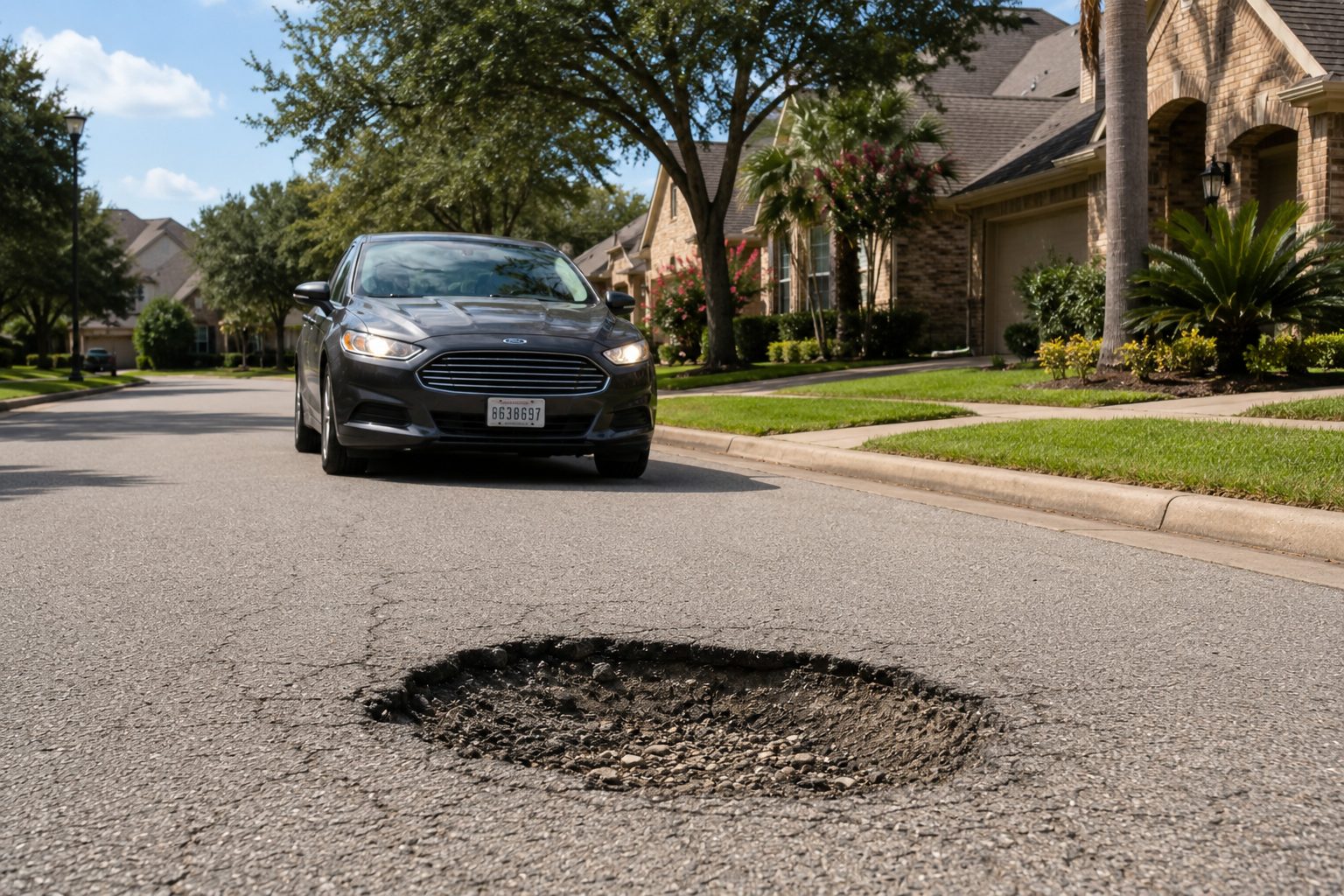
How Magnolia Springs Residents Can Report Potholes, Drainage Problems and Road Maintenance Needs in Montgomery County
A pothole that jars a vehicle, a ditch that stops carrying water or a tree limb blocking part of the roadway can quickly become a concern for an entire neighborhood. These problems may damage vehicles, restrict drainage and create hazards for drivers, pedestrians and cyclists.
For residents of Magnolia Springs, however, reporting the problem is not always as simple as calling one countywide road department. Montgomery County divides many road, bridge, drainage, park and right-of-way responsibilities among its four commissioner precincts.
The first step is identifying the correct precinct—and then giving that office enough information to locate and evaluate the problem.
What Montgomery County Maintains
Montgomery County is responsible for road and bridge maintenance in unincorporated areas, while the Commissioners Court oversees county road construction and broader financial decisions affecting public infrastructure. Each of the county’s four commissioners represents a geographic precinct and helps oversee road and maintenance operations within that area.
Depending on the location and ownership of the property, residents may contact their commissioner precinct about concerns involving:
- Potholes and damaged pavement
- Deteriorating county roads
- Roadside ditches and culverts
- Fallen trees or limbs obstructing a roadway
- Damaged or missing county road signs
- Vegetation affecting visibility
- Mowing along county-maintained rights-of-way
- Storm debris on county roads
- Bridge or guardrail damage
- Maintenance concerns at county parks or community facilities
Not every road located in Montgomery County is maintained by the county. Streets may instead belong to the City of Conroe, The Woodlands Township, another incorporated city, the Texas Department of Transportation, a municipal utility district, a homeowners association or a private property owner.
Start by Finding the Correct Commissioner Precinct
Because Montgomery County road maintenance is organized by commissioner precinct, residents should first determine whether they are in Precinct 1, 2, 3 or 4.
The county’s GIS website provides a Who Is My Commissioner? mapping tool that allows residents to look up their commissioner precinct by location. The county also maintains dedicated pages and mapping resources for each precinct.
Residents should be careful not to confuse a county commissioner precinct with a constable or justice of the peace precinct. The commissioner’s office is the appropriate starting point for county road, bridge, park and right-of-way maintenance concerns.

How to Contact the Four Montgomery County Precincts
Once the correct precinct has been identified, residents can report the concern directly to that commissioner’s office.
Montgomery County Precinct 1
Address: 510 Highway 75 North, Willis
Phone: 936-539-7815
Precinct 1 is represented by Commissioner Robert C. Walker.
Montgomery County Precinct 2
Address: 19110 Unity Park Drive, Magnolia
Phone: 281-259-6492 or 936-442-7766
Precinct 2 is represented by Commissioner Charlie Riley.
Montgomery County Precinct 3
Address: 1130 Pruitt Road, Spring
Phone: 936-522-9300
Precinct 3 is represented by Commissioner Ritch Wheeler.
Montgomery County Precinct 4
Address: 23628 Roberts Road, New Caney
Phone: 936-537-4444
Precinct 4 is represented by Commissioner Matt Gray.
Montgomery County’s Parks Department similarly directs questions about county parks to the corresponding commissioner’s office, reinforcing the precinct-based structure residents encounter when reporting many local maintenance needs.
What Information Should Residents Provide?
A detailed report can help county employees find the problem without repeatedly contacting the resident for clarification.
The report should include:
- The street name and closest address
- The nearest intersection or subdivision entrance
- The commissioner precinct, when known
- The direction of travel
- The lane or side of the roadway
- A description of the damage
- The approximate size or extent of the problem
- How long the condition has existed
- Photographs taken from a safe location
- Whether the problem is creating an immediate hazard
Rather than saying there is “a pothole somewhere near the entrance,” a resident could report “a deep pothole in the northbound lane approximately 75 feet south of the main subdivision entrance.”
Residents should never stand in moving traffic, enter floodwater or approach unstable trees, downed electrical lines or other dangerous conditions to take a photograph.
When Should a Pothole Be Reported?
Potholes can begin as small pavement failures and grow as rainwater reaches the underlying road material. Continued traffic can loosen additional asphalt, deepen the hole and increase the risk of tire, wheel or suspension damage.
Residents should consider reporting a pothole when it:
- Causes drivers to leave their lane to avoid it
- Appears deep enough to damage a vehicle
- Is growing after repeated rainfall
- Creates a hazard for motorcycles or bicycles
- Is located near a curve, intersection or school area
- Is surrounded by cracking or sinking pavement
- Has become part of a larger deteriorating road section
The appropriate response will depend on the condition of the roadway. An isolated pothole may receive a patch, while repeated failures or widespread deterioration may require engineering work, reconstruction or inclusion in a future road project.
The county’s broader road program also includes bond-funded transportation improvements, which are separate from routine maintenance requests.

How to Report a Roadside Drainage Problem
Roadside ditches and culverts help carry stormwater away from streets and surrounding property in many unincorporated Montgomery County neighborhoods. When sediment, vegetation, trash or structural damage restricts that flow, water may remain in the ditch or collect on the roadway.
Residents may contact their commissioner precinct about concerns such as:
- Water remaining in a roadside ditch long after rainfall ends
- Sediment or vegetation blocking the flow of water
- A damaged or collapsed driveway culvert
- Erosion along the edge of a county road
- Debris obstructing a ditch
- Water repeatedly crossing the roadway
- Street ponding at the same location after storms
Residents should explain whether the concern involves a roadside ditch, culvert, storm drain, creek, drainage channel or detention pond. Those features may be maintained by different entities.
Montgomery County also contains separate drainage districts responsible for drainage infrastructure within their own geographic boundaries. A municipal utility district, homeowners association or other local entity may maintain neighborhood detention ponds and drainage facilities.
For residents of Magnolia Springs, keeping photographs and notes from several storms may help show whether the drainage problem is recurring, how long the water remains and which properties or streets are affected.
Engineering Questions Are Different From Maintenance Requests
Montgomery County Engineering handles development regulations, drainage criteria, subdivision reviews and other technical matters. The department can answer engineering questions not addressed in the county’s published regulations at 936-539-7833 or through its listed engineering email address.
The Engineering Department is generally more appropriate for questions involving:
- Proposed developments
- Drainage studies
- Subdivision plans
- Construction standards
- Work within county rights-of-way
- Permitting or technical drainage requirements
A routine pothole, blocked roadside ditch or fallen tree should generally begin with the appropriate commissioner precinct rather than the Engineering Department.
County Road, City Street or State Highway?
Confirming who maintains the roadway is one of the most important parts of the process.
In general:
- County roads in unincorporated areas: Contact the appropriate Montgomery County commissioner precinct.
- Streets inside an incorporated city: Contact the city’s public works or streets department.
- State highways and farm-to-market roads: Contact the Texas Department of Transportation.
- Private or gated streets: Contact the property owner, management company or homeowners association.
- Neighborhood drainage facilities: Contact the municipal utility district, drainage district, city, county precinct or HOA responsible for the facility.
Some roadways may have state route numbers even though residents commonly refer to them by a local name. Giving county employees the exact address or intersection can help them determine whether the request belongs to Montgomery County or another agency.

Signs, Trees, Mowing and Storm Debris
Residents may also contact their commissioner precinct about maintenance concerns affecting county roads and rights-of-way, including:
- A damaged or missing county road sign
- A fallen tree or limb blocking the roadway
- Vegetation limiting visibility at an intersection
- Overgrown county-maintained roadsides
- Storm debris creating a traffic hazard
- Damaged guardrails or bridge components
- Maintenance problems at county parks
Requests for a new stop sign, traffic signal, turn lane or other traffic-control improvement may require engineering or traffic review rather than a routine maintenance visit.
Residents should provide photographs when safe, but immediate hazards should also be reported by phone so the responsible agency can determine whether an urgent response is required.
What Happens After a Problem Is Reported?
The commissioner precinct may first need to confirm that the roadway or property is maintained by Montgomery County. Staff may then inspect the location, assign a road crew or determine whether the issue requires engineering work, utility coordination or referral to another agency.
Response times can vary based on:
- The seriousness of the condition
- Current maintenance workloads
- Weather and storm recovery operations
- Availability of crews and materials
- Road ownership
- Whether utilities are involved
- Whether a permanent repair requires design or construction funding
Residents should record the date of the call, the office contacted and the name of the staff member who received the report. When available, a request or reference number can make follow-up easier.
Routine maintenance channels should not be the only method used to report an immediate threat to life or public safety. Emergencies should be reported by calling 911.

Why Neighborhood Reports Matter
Montgomery County includes growing suburban communities, rural roads, wooded areas and heavily traveled corridors. County crews cannot observe every pothole, obstructed ditch or fallen limb immediately after it develops.
Resident reports give local officials a specific location to inspect and create a record of the concern. Multiple reports may also help identify a repeated problem that needs more than a temporary repair.
Submitting a clear and accurate maintenance request is one practical way residents can help protect vehicles, support neighborhood drainage and keep local roads safer.
Stay tuned to My Neighborhood News for Montgomery County road updates, public resources and information affecting local communities.

 Tiffany Krenek has been on the My Neighborhood News team since August 2021. She is passionate about curating and sharing content that enriches the lives of our readers in a personal, meaningful way. A loving mother and wife, Tiffany and her family live in the West Houston/Cypress region.
Local business spotlight
Grow your business
where trust already lives.
Let’s introduce your business to the neighbors nearby.
Have a local favorite?
Let’s make an introduction.
Leave your email and our team will reach out with ways to promote your business.
Give a local favorite a little love.
Know a business your neighbors should discover? Tell us who they are.
We couldn’t send that just yet. Please try again.