






Granger Pines Gardeners: What to Plant in Your Vegetable Garden This September in Montgomery County
For gardeners who have watched a Texas summer turn tomato plants tired and garden beds a little less productive, September brings something encouraging: another chance to plant.
The Montgomery County Master Gardener Association has released a revised Vegetable Garden Planting Chart for Montgomery County, Texas, and the calendar shows several opportunities opening as summer begins giving way to the area's fall growing season. For residents of Granger Pines, that means an empty raised bed or overlooked corner of the backyard may still have plenty of life left in it this year.
The updated guide is especially useful because it does more than list vegetables by month. It distinguishes between ideal planting times and marginal planting times and adds local freeze-date benchmarks, helping Montgomery County gardeners make decisions based on the growing conditions they are more likely to encounter close to home.
What Can Montgomery County Gardeners Plant in September?
September sits at an interesting point on the Montgomery County gardening calendar. Warm-season crops have not completely disappeared from the chart, but fall vegetables are beginning to take center stage.
According to the updated planting guide, September and the weeks immediately around it offer planting opportunities for crops that include beans, broccoli, cabbage, cauliflower, Chinese cabbage, collards, kohlrabi, mustard, parsley, English and snap peas, and radishes, with some falling within ideal windows and others beginning or ending in marginal planting periods.
That variety is one reason fall gardening can be worth another look for Granger Pines residents who may associate vegetable gardens mostly with spring.
Broccoli, cabbage and cauliflower plants, for example, move into their fall planting periods as temperatures gradually begin to moderate. Mustard greens and radishes also have fall windows on the chart, while peas and parsley are among the crops gardeners can begin considering as the season progresses.
Beans still have a place on the September calendar as well, offering gardeners a chance to squeeze in another warm-season crop before colder weather becomes a concern.
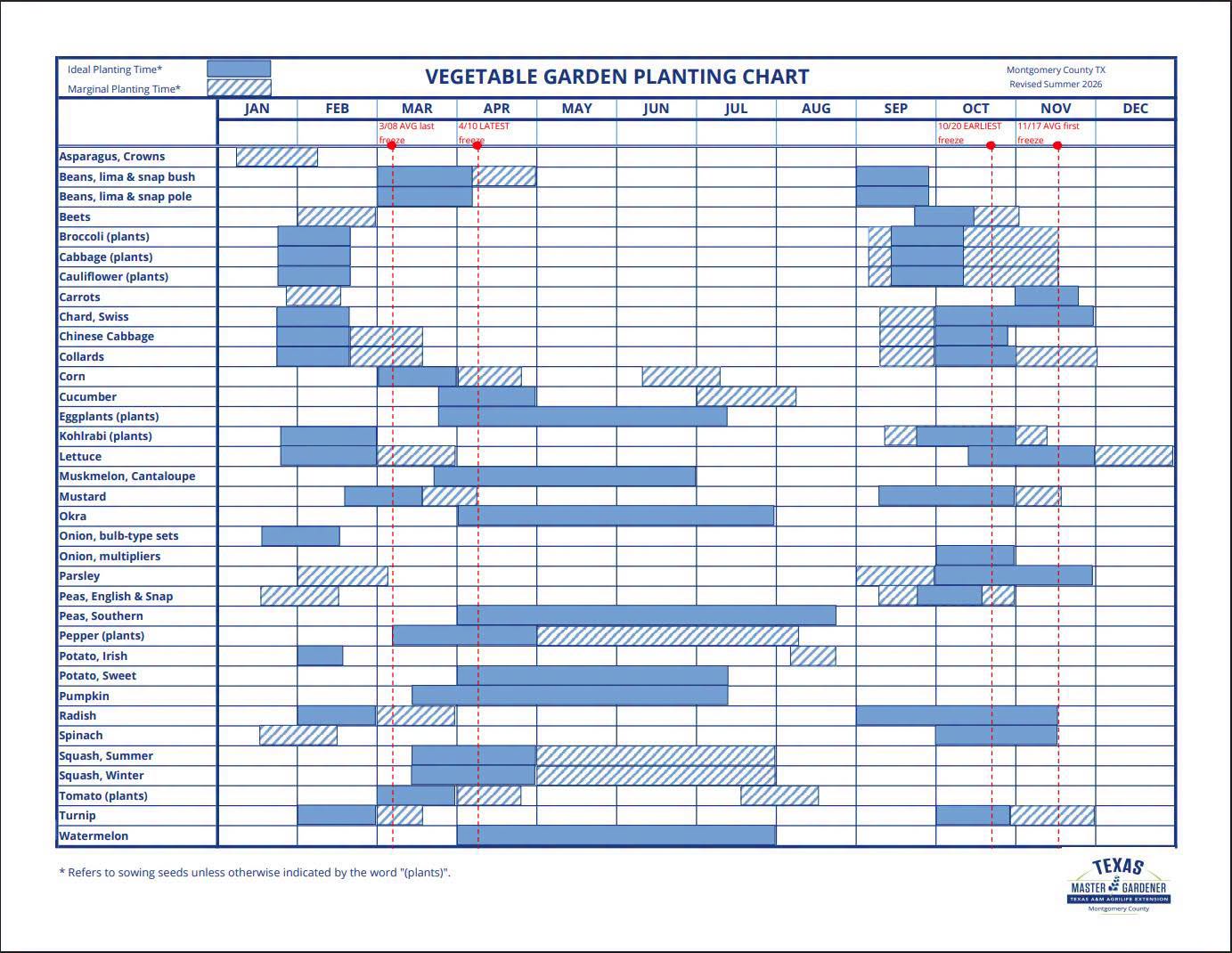 Click to enlarge. (Source: Montgomery County Master Gardeners Association)
Montgomery County Freeze Dates Help Put the Calendar in Perspective
One of the most useful additions to the revised chart is its inclusion of freeze information specifically for Montgomery County.
The guide identifies March 8 as the average last freeze, with April 10 listed as the latest freeze. On the other side of the growing season, it marks October 20 as the earliest freeze and November 17 as the average first freeze.
Those dates are not guarantees — Texas weather rarely follows a calendar perfectly — but they give home gardeners a useful frame of reference when deciding whether a crop has enough time to mature.
That becomes particularly important in the fall. A vegetable planted in September may need to establish itself during lingering heat before cooler nights arrive, while crops planted later in autumn may need to tolerate the possibility of an unusually early cold snap.
The chart also notes that its planting periods generally refer to sowing seeds unless a crop is specifically labeled “plants.” Gardeners should pay attention to that distinction when shopping for seeds or transplants.
Why Fall Vegetable Gardening Can Be Worth the Effort
Spring gets much of the attention in backyard gardening, but fall can offer its own rewards in Southeast Texas.
Cool-season vegetables such as broccoli, cabbage, cauliflower, mustard greens and radishes can take advantage of temperatures that become more comfortable as the season advances. And for families, a second planting season can turn gardening into something more than a spring project.
Children can help plant radish or pea seeds. Neighbors can trade extra seedlings. A few pots on a patio can become an experiment in growing herbs or greens. Even a modest harvest can make a home-cooked meal feel a little more connected to the place where it was prepared.
For people in Granger Pines who have never planted a fall garden, the Montgomery County chart also offers a manageable way to start: choose one or two vegetables whose planting windows line up with the coming weeks rather than trying to grow everything at once.

From the Garden to the Kitchen: A Few Easy Harvest Ideas
Part of the fun of planting vegetables now is imagining what could be on the table later.
Fresh green beans can be quickly sautéed with olive oil or butter, garlic, black pepper and a squeeze of lemon for an easy side dish.
A harvest of broccoli or cauliflower can become a simple sheet-pan dinner when roasted with olive oil and seasonings alongside chicken, sausage or another family favorite.
Homegrown cabbage works well in a crisp slaw with carrots and a light vinegar dressing, or it can be sautéed with onion as a warm side dish.
For gardeners trying mustard greens or collards, the leaves can be slowly cooked with onion, garlic and broth or chopped into soups and stews.
And radishes do not have to stay in the salad bowl. Sliced raw radishes can add crunch to tacos and sandwiches, while roasted radishes become milder and slightly sweet — an easy way to use a harvest that comes in all at once.
A Garden Calendar Designed for Montgomery County
Generic planting advice found online can be useful, but gardeners know how much location matters. What works on the same date in North Texas, Central Texas or another part of the country may not line up with Montgomery County's temperatures and freeze patterns.
That local focus is what makes the Montgomery County Master Gardener Association's updated guide particularly practical. It gives residents a month-by-month visual reference for dozens of vegetables, from asparagus and beans to tomatoes, squash, turnips and watermelon.
The chart also makes clear that gardening does not simply stop when summer does. Planting opportunities shift throughout the year, with another substantial group of vegetables appearing during fall and winter.
For anyone considering a September vegetable garden in Montgomery County, the simplest first step may be to look at the chart, check which planting windows are approaching and choose something the household will actually enjoy eating.
Need a little help getting started or have questions about what to plant? The Montgomery County Master Gardeners will host a Seed Harvesting, Propagation, and Planting gardening class and workshop from 9 a.m. to noon Saturday, Sept. 12, 2026, at 9020 Airport Road in Conroe. The session offers another local resource for gardeners looking to build their skills before the fall planting season gets fully underway.
A packet of seeds and a little space may be enough to turn the coming cooler months into another growing season.
Stay tuned to My Neighborhood News for more seasonal tips, local resources and community updates that help residents make the most of life close to home.

 Tiffany Krenek has been on the My Neighborhood News team since August 2021. She is passionate about curating and sharing content that enriches the lives of our readers in a personal, meaningful way. A loving mother and wife, Tiffany and her family live in the West Houston/Cypress region.
Local business spotlight
Grow your business
where trust already lives.
Let’s introduce your business to the neighbors nearby.
Have a local favorite?
Let’s make an introduction.
Leave your email and our team will reach out with ways to promote your business.
Give a local favorite a little love.
Know a business your neighbors should discover? Tell us who they are.
We couldn’t send that just yet. Please try again.