







Fort Bend County Reports 83% Drop in Mosquito Activity; What Fulshear Residents Should Know
Fort Bend County’s recent aerial mosquito control operation appears to have provided substantial relief following weeks of unusually intense mosquito activity across the county.
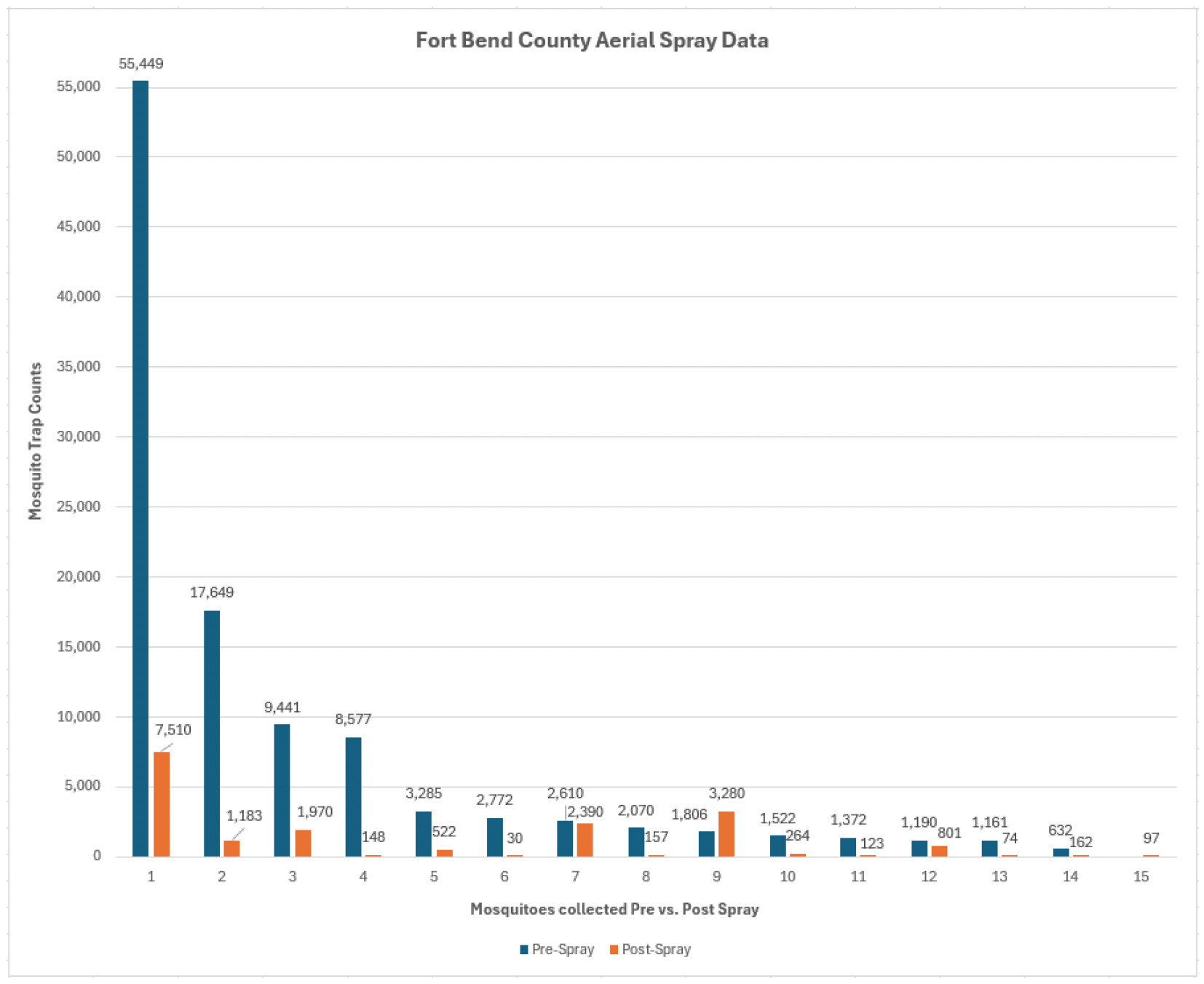
Fort Bend County Health & Human Services announced July 22 that mosquito surveillance showed an overall 83% reduction in activity following the aerial treatment. Trap counts across the targeted areas fell from 109,536 mosquitoes before treatment to 18,711 afterward.
For residents of Fulshear, the results are encouraging after heavy rainfall and widespread standing water created ideal mosquito-breeding conditions earlier this summer. However, county health officials emphasized that mosquito season is far from over—and the risk of mosquito-borne illness cannot be eliminated through a single treatment.
Most Targeted Areas Saw Major Reductions
The aerial spraying operation was deployed after Fort Bend County declared a local public health emergency in June amid mosquito populations that officials described as extraordinarily high.
As previously reported by My Neighborhood News, county surveillance teams had recorded trap counts reaching thousands of mosquitoes in individual collection periods, while resident complaints had climbed well beyond levels reported following Hurricane Beryl. Fort Bend County subsequently scheduled aerial spraying in its most heavily affected areas to supplement ongoing ground-based mosquito control efforts.
According to the county’s latest findings, 12 of the 15 targeted treatment areas experienced mosquito reductions greater than 75%. One area recorded an increase in mosquito activity and is now undergoing additional surveillance to determine whether further action is needed.
“These results demonstrate that our aerial mosquito control operation was highly effective in rapidly reducing mosquito populations across the targeted areas,” said Dr. Letosha Gale-Lowe, Fort Bend County’s local health authority and director of Fort Bend County Health & Human Services.
She added that continued surveillance and community participation remain important because mosquito populations can quickly return.
 (Source: Fort Bend County Health & Human Services)
Why Mosquito Activity Could Increase Again
Although the results represent meaningful progress, residents should not assume that the summer mosquito problem has ended.
Additional rainfall can create new breeding areas in buckets, gutters, flowerpots, birdbaths, toys, drainage areas and other places that hold even small amounts of water. New adult mosquitoes can also emerge after treatment or move into treated neighborhoods from surrounding areas.
West Nile virus remains another concern. The virus circulates naturally between mosquitoes and birds, meaning it may persist or reappear as weather and environmental conditions change. Reducing mosquito populations can lower the risk of transmission, but it cannot remove the risk completely.
Fort Bend County uses an Integrated Pest Management approach that includes year-round trapping, laboratory testing, larval control, targeted treatment of adult mosquitoes and public education. Surveillance results help officials determine where additional mosquito control resources may be necessary.
What Fulshear Residents Can Do at Home
Countywide spraying can address mosquitoes across broad areas, but residents and businesses also play an important role in preventing populations from rebuilding.
Fort Bend County Health & Human Services recommends continuing to follow the 4 Ds of mosquito safety:
- Dusk and Dawn: Limit time outdoors when mosquitoes are most active.
- Drain: Empty standing water around homes, yards and businesses.
- Dress: Wear lightweight long sleeves and lightweight long pants when practical.
- Defend: Apply an EPA-approved insect repellent containing DEET, picaridin or oil of lemon eucalyptus.
Residents should also keep swimming pools properly maintained, clear clogged gutters, replace birdbath water regularly and check that doors and windows have secure screens.
A quick walk around the property after each rainfall can make a difference. Mosquitoes do not need a large puddle to breed; water collecting in a plant saucer, children’s toy, uncovered container or folded tarp may be enough to support mosquito development.

Continued Monitoring Is Planned
Fort Bend County Environmental Health will continue monitoring traps and mosquito activity throughout the season. Additional control measures may be used when surveillance indicates they are necessary.
For Fulshear residents, the 83% reduction is welcome news and suggests that the county’s expanded response had a measurable impact. At the same time, continued rainfall and warm summer temperatures mean mosquito prevention will remain a shared responsibility in the weeks ahead.
Residents are encouraged to monitor official Fort Bend County communications and My Neighborhood News for additional mosquito surveillance findings, treatment notices and public health updates affecting their community.

 Tiffany Krenek has been on the My Neighborhood News team since August 2021. She is passionate about curating and sharing content that enriches the lives of our readers in a personal, meaningful way. A loving mother and wife, Tiffany and her family live in the West Houston/Cypress region.
Local business spotlight
Your next loyal customer could be a neighbor.
Let’s introduce your business to the neighbors nearby.
Have a local favorite?
Let’s make an introduction.
Leave your email and our team will reach out with ways to promote your business.
Give a local favorite a little love.
Know a business your neighbors should discover? Tell us who they are.
We couldn’t send that just yet. Please try again.