








Fort Bend County Budget Talks Put Roads, Public Health and Public Safety in Focus: What Cinco Ranch I Residents Need to Know
For families in Cinco Ranch I, some of the biggest decisions in Fort Bend County government are taking shape long before a final budget reaches the voting stage.
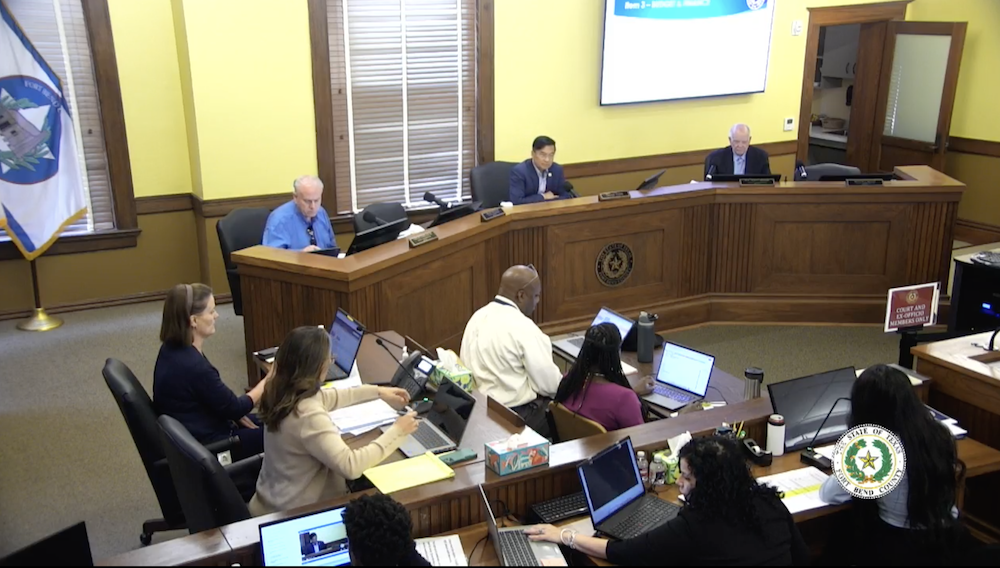
During a May 13 special meeting of Fort Bend County Commissioners Court, department leaders spent hours walking county officials through FY2027 budget needs tied to services residents encounter every day — roads, public health, mosquito control, animal services, technology, courts and other county operations.
No final budget decisions were made during the workshop. Instead, the discussion gave commissioners an opportunity to question department leaders, weigh competing priorities and better understand where population growth, inflation and rising demand are putting pressure on county resources.
The recurring theme was straightforward: Fort Bend County is growing, and maintaining existing service levels is becoming more expensive.
Public health leaders plan for grant funding changes
Fort Bend County Health and Human Services asked commissioners to consider moving two currently grant-supported positions into county funding through a phased approach as federal Public Health Infrastructure Grant funding moves toward its scheduled end in November 2027.
The positions include a mental health program manager and community health education specialist supporting mental health referrals, chronic disease prevention, screenings, outreach and health education.
County officials were told the phased transition would allow Fort Bend County to continue using available grant money while reducing the immediate financial impact on local taxpayers.
Public health officials also discussed increased responsibilities surrounding disease surveillance. Epidemiology staff told the court the department remains active throughout the year and has seen increases in some vaccine-preventable diseases.
“We’re activated year round,” one epidemiology official told commissioners while describing the county’s role in disease investigations, contact tracing and coordination with other health agencies.
The discussion matters to Cinco Ranch I because the county’s public health system is often working behind the scenes — monitoring outbreaks, coordinating responses and identifying health threats before they become larger community problems.
Mosquito control says staffing affects how quickly crews can respond
Mosquito control was another public health concern brought before the court.
The county began building a larger mosquito control program in FY2024 with a long-term plan calling for 18 full-time positions. The department currently operates with 10, according to the workshop presentation.
Staff members are responsible for trapping mosquitoes, identifying species, testing for West Nile virus, treating standing water, responding to complaints and coordinating disease-related responses.
The county has identified 40 of the 56 mosquito species known to exist in Fort Bend County, and some traps have approached 1,000 mosquitoes apiece, officials said.
When commissioners asked what delaying additional staffing would mean, Environmental Health Director Michael Schaffer said the practical result would be less spraying and a continued need to prioritize the most pressing locations.
“We wouldn’t be able to spray as much as we really need to,” Schaffer said.
With mosquito complaints increasing during warmer months, staffing decisions could directly influence how quickly neighborhoods receive surveillance and treatment.
Animal Services describes an overcrowded shelter and rising medical costs
One of the workshop’s more personal discussions centered on Fort Bend County Animal Services.
Officials said vaccine, medication and veterinary supply costs have risen while the shelter continues to receive sick, injured and abandoned animals. The department requested an additional veterinary technician to support its veterinarian and existing medical staff.
The need was illustrated by a recent intake of 14 kittens reportedly dumped in a kennel along a roadside. Staff said some arrived overheated and sick.
The shelter also reported being over capacity and recently highlighted 10 of its longest-resident animals, some of which had been housed there for at least six months, in hopes of attracting nonprofit rescue partners.
“We’re trying to help the animals out on the street,” the department’s representative told commissioners while explaining that the campaign was intended to draw attention to the need for rescue assistance.
County leaders also discussed the broader difficulty animal shelters and rescue organizations are experiencing as large dogs remain harder to place and foster networks face their own capacity challenges.
The nonprofit Fort Bend PAWS was highlighted as another source of assistance that can help cover unexpected shelter needs without requiring every emergency expense to come directly from county taxpayers.
Illegal dumping complaints climb as neighborhoods grow
Growth is also showing up in less welcome ways.
Fort Bend County Environmental Health requested another environmental crimes officer after reporting that complaints have increased roughly 20% during the past two years.
The unit investigates illegal dumping, abandoned or junk vehicles, improper debris disposal and other nuisance-related violations affecting neighborhoods and public spaces.
Officials said crews recently removed 258 tires from one problem location. They also reported removing approximately 13 million pounds of structural material and debris last year.
Mobile cameras are being moved among dumping hotspots in an effort to identify offenders.
For residents, the issue reaches beyond appearance. Illegal dumping can affect drainage, attract pests, damage waterways and reduce quality of life in surrounding neighborhoods.

Aging roads collide with rapid development
Few portions of the workshop illustrated Fort Bend County’s growth pressures as clearly as the Road and Bridge Department.
The department reported taking responsibility for more than 100 miles of new roadway last year as subdivisions and development continue expanding.
At the same time, the county is maintaining roads that were originally built decades ago for far lighter traffic.
“Lot of the roads that are out there, they were built for the farmers and ranchers, utilized for a small community,” the Road and Bridge representative told commissioners.
Today, some of those same roads can see hundreds of heavy dump trucks and concrete trucks as new developments are constructed.
Material costs are rising as well. Officials said asphalt that cost about $75 per ton last year is now around $88 per ton. A contracted roadway project that once cost roughly $850,000 per mile was contrasted with a recent bid of approximately $1.5 million for nearly two miles.
Fort Bend County is also maintaining 113 traffic signals, dealing with concrete repairs, mowing new medians, striping roads and replacing or rebuilding bridges.
The discussion is particularly relevant for homeowners in Cinco Ranch I, where the condition of roads, sidewalks, bridges and nearby infrastructure can affect daily commutes, neighborhood access, safety and perceptions of long-term community investment.
Technology costs rise as county services become more digital
Fort Bend County Information Technology told commissioners that remaining flat financially is difficult because of contractual obligations and increasing technology costs.
The department said technology subscription costs can rise roughly 3% to 5% annually under contract and potentially more outside established agreements.
Staffing was also discussed. The department reported 101 IT employees supporting a county workforce of roughly 3,500 and handling 38,844 support tickets during the previous 12 months.
Cybersecurity remains another priority, with county employees pursuing grants that can sometimes require local matching dollars.
IT leaders also stressed the need to periodically replace county computers because outdated hardware and software can create performance and cybersecurity risks.
Courts seek staffing, technology and faster case processing
Several court-related departments brought staffing and modernization requests before commissioners.
The District Clerk’s Office requested additional employees for passport processing, collections and customer service. The office reported processing 31,077 passport applications during fiscal year 2025 and said early FY2026 activity indicated demand remained strong.
The District Clerk also discussed an artificial intelligence-based document processing system designed to organize files and redact legally protected information. Commissioners emphasized that countywide AI policies and IT safeguards would need to be addressed before implementation.
In the 387th District Court, officials described online scheduling and docket management changes aimed at reducing delays and administrative work.
Another family district court requested an associate judge, with the presiding judge arguing that protective orders, temporary restraining orders and other urgent family matters cannot always wait weeks for courtroom availability.
Court Administration separately requested salary adjustments for positions responsible for court operations and language-access services.
The discussions reflect a growing challenge across county government: population growth does not simply add residents. It adds calls, court cases, technology requests, passport applications and other service demands.
Child care property tax exemption sparks debate
Commissioners also discussed whether Fort Bend County should consider a property tax exemption available to qualifying child care facilities.
Texas voters approved Proposition 2 in 2023, allowing eligible local governments to exempt between 50% and 100% of the appraised value of qualifying child care properties under certain conditions.
Supporters of the concept argued that reducing property tax expenses could help child care operators facing rising food, staffing and operational costs stay open.
Others questioned whether the savings would be substantial enough to justify the loss of county property tax revenue.
No action was taken, leaving the proposal open for further analysis as commissioners develop the county budget.
What happens next for Fort Bend County taxpayers
The May 13 session was a budget workshop, not a final vote. Department requests presented during the meeting still must compete with other county priorities before the FY2027 budget is finalized.
That distinction is important.
A requested position, program or spending increase discussed during a workshop is not necessarily guaranteed funding. Commissioners use the process to determine which expenses are essential, which can be delayed and where outside grants or other funding sources might reduce the burden on local taxpayers.
Still, the meeting offered residents an unusually detailed look at the pressures behind the numbers.
Fort Bend County is simultaneously maintaining older infrastructure, absorbing new development, preparing for public health threats, responding to environmental concerns, caring for animals, strengthening cybersecurity and handling growing demands on its justice system.
The decisions ahead will determine not only how much the county spends, but how effectively those everyday services keep pace with one of the region’s growing communities.
Stay tuned to My Neighborhood News for continuing coverage of Fort Bend County Commissioners Court, the FY2027 county budget and decisions affecting local neighborhoods.

 Tiffany Krenek has been on the My Neighborhood News team since August 2021. She is passionate about curating and sharing content that enriches the lives of our readers in a personal, meaningful way. A loving mother and wife, Tiffany and her family live in the West Houston/Cypress region.
Local business spotlight
Grow your business
where trust already lives.
Let’s introduce your business to the neighbors nearby.
Have a local favorite?
Let’s make an introduction.
Leave your email and our team will reach out with ways to promote your business.
Give a local favorite a little love.
Know a business your neighbors should discover? Tell us who they are.
We couldn’t send that just yet. Please try again.