








E-Bike Concerns Reach Magnolia Springs as Community Leaders Reinforce Rules for Courts, Green Spaces and Common Areas
Electric bikes have given many young people a new level of freedom, making it easier to reach a friend’s house, neighborhood park or nearby school. In Magnolia Springs, however, that independence is increasingly colliding with concerns about speed, pedestrian safety and the protection of shared amenities.
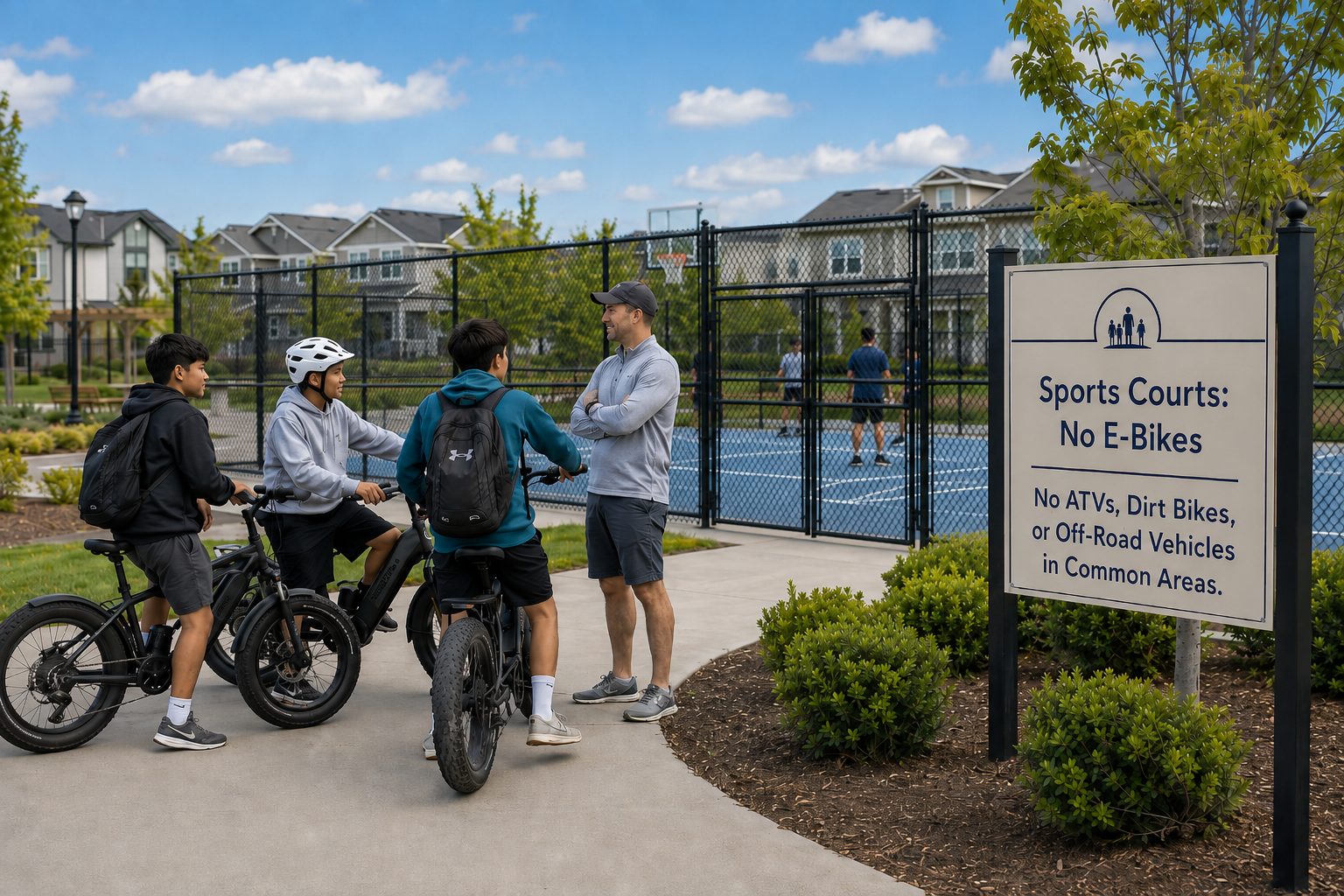
Residents recently received a community reminder that e-bikes are not permitted on the sports courts. The notice also reinforced that ATVs, dirt bikes and other off-road vehicles are prohibited in the reserves, green spaces and all common areas of Magnolia Springs.
It reflects a much larger conversation unfolding across Harris County, Fort Bend County, Montgomery County, Waller County and the Greater Houston area. Parents, law enforcement officers, school administrators and community associations are trying to establish clearer boundaries as traditional bicycles, legal e-bikes and high-powered electric motorcycles increasingly share neighborhood streets, sidewalks, trails and gathering places.
Why the Magnolia Springs E-Bike Reminder Matters
Sports courts, landscaped reserves and neighborhood green spaces were not designed to function as motorized riding areas.
A fast-moving e-bike or electric dirt bike can create an immediate hazard when children are playing basketball, residents are walking dogs or families are using a trail or open space. Even when a rider believes the area is empty, pedestrians can enter unexpectedly, and the quiet operation of an electric motor may give others little warning that a vehicle is approaching.
Repeated motorized use can also damage grass, irrigation systems, planting beds, trails and court surfaces. Those repairs ultimately affect the community as a whole because shared amenities are supported through association assessments and maintained for residents’ collective use.
For that reason, the reminder is about more than telling young riders where they cannot go. It is an effort to preserve the spaces that help shape daily life in Magnolia Springs while reducing the possibility of a collision or injury close to home.

Not Every Vehicle Called an E-Bike Is Legally an E-Bike
One source of confusion is that the term “e-bike” is often used broadly to describe several very different vehicles.
Under Texas law, a legal electric bicycle must have fully operable pedals and an electric motor of no more than 750 watts. Class 1 e-bikes provide assistance only while the rider is pedaling and stop assisting at 20 mph. Class 2 models may use a throttle but also stop providing assistance at 20 mph. Class 3 e-bikes provide pedal assistance up to 28 mph, and Texas requires Class 3 operators to be at least 15 years old.
Vehicles without functional pedals, models with motors exceeding 750 watts and electric dirt bikes capable of traveling beyond legal e-bike speeds may instead be treated as motorcycles or off-road vehicles. Depending on their design and use, operating those vehicles on public roads may require registration, insurance and a Class M motorcycle license.
That distinction has become especially important as motorcycle-style electric vehicles are marketed to families under names that can make them appear similar to ordinary bicycles.
Parents considering an electric bike for a child or teenager should review the manufacturer’s motor rating, maximum assisted speed, pedal configuration and legal classification rather than relying only on a product name or sales description.
Neighborhood Concerns Are Part of a Regional Trend
The renewed attention in Magnolia Springs is not occurring in isolation.
Harris County Precinct 5 Constable Terry Allbritton, Harris County Precinct 4 Constable Mark Herman and Fort Bend County Precinct 1 Constable Chad Norvell recently asked multiple Houston-area school districts to prohibit high-powered electric motorcycles from school property. Their concerns focused on underage riders, vehicles reaching speeds above 30 mph and unregistered motorcycle-style devices being operated around campuses, sidewalks and congested school zones.
Law enforcement officials have emphasized that legal battery-assisted bicycles are different from electric dirt bikes and e-motorcycles that do not satisfy Texas e-bike requirements. That difference may not always be apparent to drivers, pedestrians or even the families purchasing the vehicles.
The concern becomes more pronounced when young riders enter intersections or travel near parked vehicles. A driver may see what appears to be a bicycle without realizing that it is approaching at 25, 30 or even 40 mph.
Elsewhere in the region, community leaders and school districts have also taken action. Conroe ISD expanded restrictions on riding e-bikes and e-scooters across district campuses, requiring students to dismount and walk the devices on school property. In The Woodlands area, fire officials reported 37 incidents involving e-bikes or e-scooters, including two major injuries; most involved teenagers, vehicles at intersections or riders who were not wearing helmets.
Those incidents do not mean every electric bicycle is dangerous. They do show why communities are increasingly separating responsible transportation from riding that places children, pedestrians or shared property at risk.

Why Sports Courts and Green Spaces Create Added Risks
A neighborhood street gives riders and motorists at least some expectation that vehicles may be present. A sports court, reserve or landscaped common area creates a different environment.
Children may run after a ball without looking. A resident may step from a trail onto a court. Dogs may pull unexpectedly across a rider’s path. Trees, fences, playground equipment and landscaping can also limit visibility.
Electric motors add another challenge because they can accelerate faster than many traditional bicycles. A young rider who is comfortable balancing a bicycle may not yet have the judgment, reaction time or braking experience needed to control a heavier electric vehicle around pedestrians.
Off-road vehicles such as ATVs and dirt bikes present additional concerns. Their weight, tire design and power can damage turf, compact soil and disturb natural or landscaped areas. They may also create noise and visibility issues that conflict with the intended use of neighborhood reserves and common spaces.
A Conversation for Parents and Young Riders
The community notice specifically asked parents to speak with their children about the rules.
That conversation can begin with a simple distinction: owning an e-bike does not mean it may be ridden everywhere.
Families should review the rules for Magnolia Springs, the laws governing nearby public streets and sidewalks, and any policies enforced by local schools. Parents should also confirm the vehicle’s wattage and maximum speed, inspect its brakes, tires, lights and reflectors, and make sure the rider uses a properly fitted helmet.
It may also help for a parent to travel a child’s usual route with them before permitting independent riding. Blind driveways, curved streets, school traffic, parked vehicles and busy intersections can look very different from the seat of an e-bike than they do from inside a car.
Young riders should be reminded to slow down around pedestrians, stop at intersections, avoid using phones or headphones while moving and never weave between parked or stopped vehicles. Carrying additional passengers on a vehicle not designed for them can further affect balance and stopping distance.
Most importantly, children and teenagers should understand that community rules apply even when an area appears empty or when friends are riding there without permission.
Balancing Independence With Shared Responsibility
E-bikes can be useful for recreation and transportation, and for many families they offer young people a welcome sense of independence. The growing community debate is not necessarily about eliminating that freedom.
It is about matching the vehicle, rider and location.
A compliant e-bike ridden responsibly in an appropriate place is very different from a high-powered electric dirt bike speeding across a sports court or through a landscaped reserve. Clear rules help residents understand that distinction before property is damaged or someone is hurt.
For Magnolia Springs, the recent reminder places responsibility on both riders and parents. Keeping motorized vehicles away from sports courts, reserves, green spaces and common areas helps protect neighborhood investments while allowing those shared spaces to remain welcoming for children, walkers, families and other residents.

What Happens Next
Residents can expect e-bike and electric vehicle safety to remain an active topic as the new school year begins and more young riders travel through neighborhoods and toward campuses.
Community associations may continue issuing reminders when violations occur, while law enforcement agencies and school districts consider education, enforcement and campus policies aimed at high-powered electric motorcycles.
For families in Magnolia Springs, the most practical step is to understand exactly what a child is riding, where it may legally and safely be operated, and which community spaces are off-limits.
A conversation at home today could protect a neighborhood amenity—and prevent a far more serious conversation after an accident.
Stay tuned to My Neighborhood News for continuing coverage of e-bike safety, neighborhood rules and local issues affecting families throughout the community.

 Johnny Krenek has been connected to community news since childhood, growing up alongside the family business his parents founded—Krenek Printing. Today, he serves as Vice President and lead developer for My Neighborhood News, where he drives the digital experience and supports the team across a variety of technical and operational roles. He is passionate about building tools that help connect neighbors and strengthen communities.
Local business spotlight
Grow your business
where trust already lives.
Let’s introduce your business to the neighbors nearby.
Have a local favorite?
Let’s make an introduction.
Leave your email and our team will reach out with ways to promote your business.
Give a local favorite a little love.
Know a business your neighbors should discover? Tell us who they are.
We couldn’t send that just yet. Please try again.