







Waller County Approves 2027 Budget With Focus on Roads, Law Enforcement and Growth Pressures
For Waller County residents, the 2027 budget approved this week reaches well beyond a set of government spreadsheets. It will help determine how the county maintains roads, staffs law enforcement, operates the jail, processes vehicle registrations, manages development and keeps up with the day-to-day services being stretched as more families and businesses move into the area.
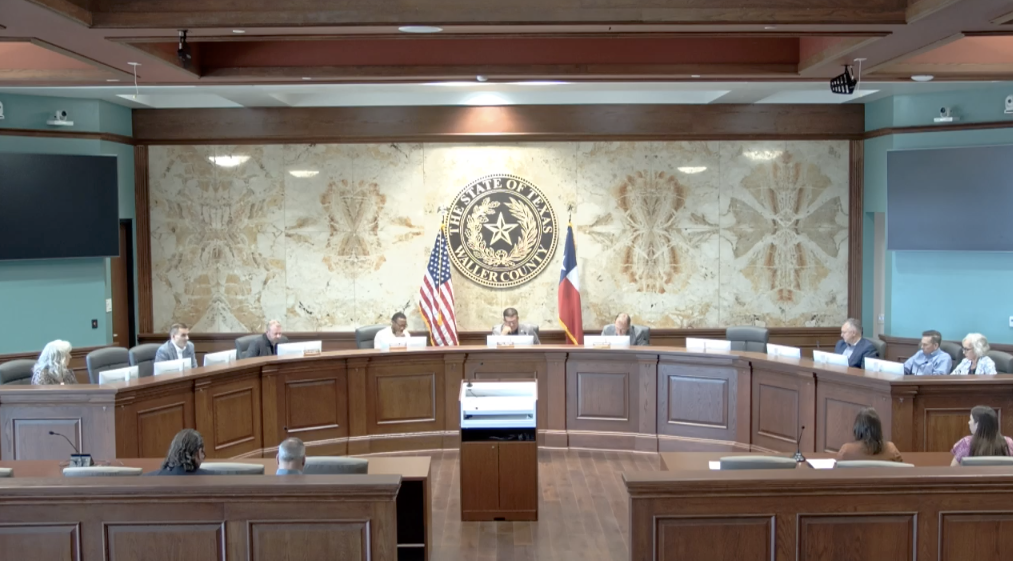
Waller County Commissioners Court approved the fiscal year 2027 budget, with 23 amendments, following a public hearing on Tuesday, Sept. 8, at the Waller County Courthouse in Hempstead.
County officials repeatedly returned to one challenge during the discussion: Waller County is growing, and the demand for public services is growing with it.
“We’re just trying to keep up with the growth,” one member of the budget committee told the court, pointing to increasing workloads in law enforcement as well as offices residents may encounter when registering a vehicle, obtaining public records or handling other county business.
The approved budget places particular attention on law enforcement and roads while also making changes across numerous county departments. The county’s property tax rate, however, is a separate decision and had not yet been adopted at the Sept. 8 meeting.
Property Tax Revenue Expected to Rise as Waller County Grows
The proposed fiscal year 2027 budget filed with the Waller County Clerk on Aug. 14 states that the budget would raise $10,365,022 more in property tax revenue than the previous year’s budget, an increase of 13.91%.
A significant portion is connected to new development. According to the county budget document, $5,458,291 in property tax revenue is expected from new property added to the tax roll this year.
That distinction is important for homeowners following the Waller County tax rate and county budget process. An increase in total property tax revenue does not necessarily mean an individual property owner’s tax bill will rise by the same percentage. A resident’s actual county tax bill depends on the adopted tax rate and the taxable value of the individual property.
The proposed budget listed a fiscal year 2027 property tax rate of $0.558466 per $100 of taxable value, compared with $0.556187 per $100 for 2025-26. It also listed a no-new-revenue rate of $0.5114941 and a voter-approval rate of $0.571180.
Commissioners had not taken final action on the tax rate when they approved the budget Sept. 8. County officials said the tax rate would be considered separately the following week.
Roads and Bridges Remain a Major Budget Priority
Transportation infrastructure remains one of the clearest places where residents can see the effects of Waller County’s continued development.
The originally proposed Road and Bridge budget shows significant spending planned for maintenance, construction, engineering and equipment, including millions of dollars for road materials and contracts.
For Road and Bridge Maintenance and Construction, the proposed budget included approximately $15.64 million, up from about $14.04 million in the certified 2026 budget.
Among the proposed allocations were $3 million for road materials and contracts, $4 million for road materials, $1.15 million for bridge replacement, $1.225 million for professional consulting and floodplain management, and $420,000 for mowing and spraying.
Several of those numbers were subsequently affected by amendments adopted Tuesday.
County officials said they were able to reduce the 2027 construction equipment allocation by $550,000 because some equipment purchases could be completed during the current fiscal year rather than carried into the next budget.
The county also reworked staffing within Road and Bridge to create an assistant county engineer position while eliminating an open permit manager position, a change officials said could be made without increasing the department’s overall staffing budget for that move.
For residents navigating county roads in fast-developing areas, those investments reflect the less visible side of growth: every new subdivision, business corridor and additional vehicle places more pressure on the road system the county must maintain.
Law Enforcement Pay and Staffing Receive Attention
Public safety also received considerable attention during the budget discussion.
One amendment adjusts the Waller County sheriff’s salary to $124,199, along with additional staff salary and benefit adjustments. The budget amendments also add $8,300 for a copier and printer at the jail, increase Animal Control personnel costs and provide $45,000 for a Chevrolet Silverado 1500 needed for law enforcement vehicle operations.
County leaders said Waller County is continuing a two-year effort to improve law enforcement compensation in an increasingly competitive regional employment market.
The four Waller County constables were also part of the discussion.
Their salaries had initially been proposed at $73,000, but officials said the constables raised concerns that planned law enforcement pay adjustments could leave some chief deputies earning more than the elected constables overseeing their offices.
The issue went before a grievance committee, which unanimously recommended setting the constables’ salaries at $80,000. The amended budget incorporates that change.
Each constable’s office is also expected to have funding for two full-time employees along with money for part-time staffing.
County Judge Carbett “Trey” J. Duhon III said the concern raised by the constables was “a point very well taken.”

County Saves Nearly $765,000 on Employee Health Insurance
One of the largest downward adjustments came from employee medical insurance.
County officials said changing insurance providers produced two reductions totaling $764,540 — $107,830 in one adjustment and $656,710 in another.
Duhon described the result as “a significant savings for taxpayers,” while saying the county also believed the new plan would improve coverage for employees.
Those savings helped offset increased spending elsewhere as the county worked through more than $12 million in departmental spending requests during the budget process, according to discussion at the meeting.
Not every request made it into the final spending plan.
Growth Is Reaching Nearly Every County Office
Much of the conversation Tuesday centered on departments residents may rarely think about until they need them.
As Waller County adds homes and residents, demand rises not only for patrol deputies and road crews but also for the tax office, county clerk, courts, permitting operations, prosecutors, animal control and other departments.
“Our workloads have doubled in the last five years just on the number of cases they see,” a budget committee member said while discussing law enforcement and the broader effects of growth.
The same speaker noted that the pressure extends across county government, from residents needing vehicle registration services to those requesting birth certificates, death certificates and other records.
“Those are just some of the growing pains,” the official said.
The budget includes adjustments affecting Juvenile Probation following action by the Juvenile Board, salary changes in Justice of the Peace Precinct 2, changes within the District Attorney’s Office and smaller adjustments across several other departments.
County Says Budget Does Not Rely on Fund Balance for Operations
During the broader budget discussion, Duhon emphasized that Waller County was not using its accumulated fund balance to plug a gap between recurring revenues and operating expenses.
“This budget doesn’t do any of that. It is a balanced budget,” Duhon said, adding that the spending plan “focuses on law enforcement, focuses on road and bridge.”
County reserves have instead been available for infrastructure and county facilities, he said.
That approach could become increasingly significant as Waller County continues to develop. A growing population can broaden the tax base, particularly when new homes and commercial property are added, but it also creates demand for more employees, roads, public safety resources and government facilities.
The proposed budget document lists Waller County’s total debt obligations secured by property taxes at $16,021,154.
What Happens Next for Waller County Taxpayers
The Sept. 8 vote settles the county budget, but residents following Waller County property taxes, the 2026 tax rate and the fiscal year 2027 county budget still have another important step to watch.
Commissioners are expected to separately consider the county property tax rate. That vote will help determine how the budget translates into the county portion of property tax bills.
For homeowners, businesses and families across Waller County, the larger story is becoming familiar: rapid development is bringing new tax value into the county while simultaneously creating demand for more roads, officers, employees and public infrastructure.
How county leaders balance those pressures — and what that means for local property taxpayers and county services — will remain an important issue as Waller County continues to grow.
Stay tuned to My Neighborhood News for updates on the Waller County tax rate, county government decisions, road projects, development and other issues affecting local residents.

 Tiffany Krenek has been on the My Neighborhood News team since August 2021. She is passionate about curating and sharing content that enriches the lives of our readers in a personal, meaningful way. A loving mother and wife, Tiffany and her family live in the West Houston/Cypress region.
Local business spotlight
Grow your business
where trust already lives.
Let’s introduce your business to the neighbors nearby.
Have a local favorite?
Let’s make an introduction.
Leave your email and our team will reach out with ways to promote your business.
Give a local favorite a little love.
Know a business your neighbors should discover? Tell us who they are.
We couldn’t send that just yet. Please try again.