







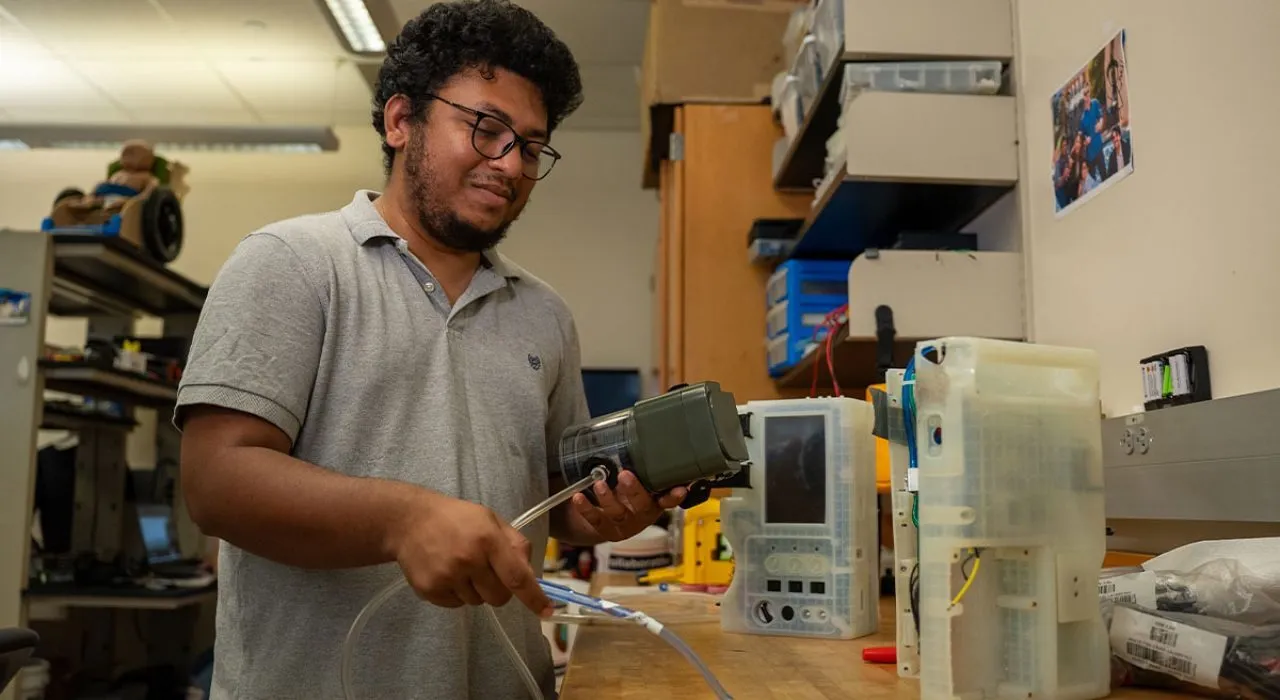
UT San Antonio Researchers Develop Smaller Battlefield Suction Device Designed to Help Save Lives
For wounded service members, the first few minutes after an injury can determine whether they survive long enough to reach a hospital. A team of UT San Antonio researchers is working to give combat medics a smaller, more practical tool for clearing blocked airways when every second matters.
Clinicians, engineers, researchers and students at UT San Antonio have developed three portable suction devices designed for different military medical environments, including a flashlight-sized model that can fit in a medic’s pocket.
The devices are intended to remove blood, vomit and other material that can prevent an injured person from breathing. While the technology was created with battlefield medicine in mind, its development also highlights San Antonio’s growing role in military health research, emergency medicine and medical device innovation.
Addressing a Critical Gap in Combat Casualty Care
Combat medics often rely on the MARCH framework when assessing wounded service members. The acronym stands for Massive hemorrhage, Airway, Respirations, Circulation and Hypothermia or head injury, helping providers determine which life-threatening conditions must be treated first.
Airway management remains a significant challenge. According to information provided by UT San Antonio, compromised airways contribute to more than 10% of combat fatalities, and more than half of opportunities to secure a wounded service member’s airway may be missed before the patient reaches a hospital.
“We all think that we save lives in the hospital, but the reality is, the people that save the lives are the ones closest to the point of injury,” said Robert De Lorenzo, MD, MSCI, MSM, FACEP, vice chair of research in the Department of Emergency Medicine at the Joe R. and Teresa Lozano Long School of Medicine.
De Lorenzo has worked for more than a decade with R. Lyle Hood, PhD, associate professor of mechanical engineering in the Klesse College of Engineering and Integrated Design. Their shared goal has been to create reliable airway suction equipment that can function in the difficult, unpredictable conditions combat medics face.
The researchers recently partnered with UT San Antonio’s Medical Design Innovations Lab and Post-Doctoral Research Fellow Connor Evans, PhD, to expand that work.
“We’re finding with a lot of these casualties there’s usually some airway trauma as well,” Evans said. “The patient’s airway needs to be stabilized right there on the battlefield and then the patient needs to be moved very quickly to a field hospital or to a higher echelon of care.”
Three Devices Designed for Different Emergency Settings
The UT San Antonio team developed three suction devices intended to support treatment from the point of injury through medical evacuation.
The largest, known as the Suction Combat Ready Advance Multi-Functional Machine, or SCRAMM, can operate three suction lines at the same time. It is lighter than earlier equipment while remaining powerful enough to support injured service members during air evacuations.
The researchers also developed the Battlefield Ready Innovative Suction Kit, or BRISK. De Lorenzo and Hood began collaborating on that medium-sized device in 2016.
BRISK is lighter and more compact than SCRAMM. It was also designed to continue working if it is knocked over, reducing the risk of contamination or equipment failure during an emergency.
Feedback from combat medics, however, pointed the researchers toward an even smaller option.
“We went out and talked to field medics,” De Lorenzo said. “They told us ‘We’re not carrying it, unless it works really well and is really, really small.’”
That response shaped the team’s next challenge: creating a suction device with enough power to be useful but small enough that medics would realistically carry it into the field.
The researchers participated in NSF I-Corps, a National Science Foundation program that helps researchers explore how new technologies could be commercialized.
“What if we made the most cut-down, slimmest version we could?” Hood said.
SCEPTRE Fits in a Combat Medic’s Pocket
Students were asked to design a device that met two central requirements: it had to be small, and it had to work reliably.
The result was the first prototype of Suction Combat for Emergencies, Portable Technology for Responders, better known as SCEPTRE.
The device is about the size of a flashlight and was designed to fit in a combat medic’s hip pocket. That portability could allow medics to begin clearing a patient’s airway immediately rather than waiting for larger equipment to arrive.
Former graduate research assistant Eric Wiatrek designed the first SCEPTRE prototype. His previous military experience gave him firsthand knowledge of the weight, size and usability concerns medics consider before adding equipment to their packs.
Wiatrek now serves as a research fellow for the U.S. Army Institute of Surgical Research.
“No one believes that the current technology out there is worth the weight or size,” Wiatrek said. “If I gave [SCEPTRE]to anybody, they would figure out how to use it.”
According to Wiatrek, SCEPTRE’s simplified mechanics are one of its most important features. Fewer complicated components may reduce the possibility of failure or confusion during a high-pressure pre-hospital emergency.
A Decade of Work Across UT San Antonio
The suction technology represents years of collaboration among faculty members, postdoctoral researchers and students.
“Our line of suction units represents the work of five to 10 faculty and post-docs, 10-20 graduate students and 40+ undergraduate students over the last decade,” Hood said. “SCRAMM grew out of us showing BRISK to the U.S. Air Force, and SCEPTRE was our own idea. But these latter two benefitted incredibly from the expertise our group had built around BRISK.”
For the San Antonio community, the project is another example of how local research can move beyond university laboratories and potentially support military personnel, emergency responders and trauma patients in real-world settings.
San Antonio is closely connected to military medicine through its research institutions, military installations, health care systems and biomedical workforce. Projects such as SCEPTRE, BRISK and SCRAMM reinforce that connection by bringing together engineering, emergency medicine and the practical experience of field providers.
What Happens Next for the UT San Antonio Suction Devices
The research team’s next goal is to bring all three airway suction devices to market. Commercialization could make the equipment available for broader testing, training and eventual use in military trauma care.
Researchers also recognize that introducing new emergency medical equipment requires more than placing a device in a medic’s hands. Providers must understand how to use it and trust that it will perform under pressure.
“We saw this error of omission as a critical gap that needed to be filled with our suite of advanced suction devices, but more work needs to be done,” De Lorenzo said. “Simply providing better equipment is only half the battle as field providers also need to be trained to have confidence in the new equipment. This will be our challenge as we field these innovative devices.”
The research has already received recognition in San Antonio and across Texas. Hood received the Texas Innovation Award for helping translate academic research into practical applications. The team also earned the Innovation & Impact Award during UT San Antonio’s 2026 University Excellence Awards.
While additional development, commercialization and training remain ahead, the researchers’ work is centered on a straightforward idea: lifesaving equipment is most useful when it is dependable, easy to operate and close enough to reach when someone needs it.
Stay tuned to My Neighborhood News for updates on local research, innovation and developments shaping San Antonio’s future.

 Tiffany Krenek has been on the My Neighborhood News team since August 2021. She is passionate about curating and sharing content that enriches the lives of our readers in a personal, meaningful way. A loving mother and wife, Tiffany and her family live in the West Houston/Cypress region.