






Conroe ISD Back-to-School Safety: What Cielo Drivers Need to Know Before Aug. 12
The first day of school will quickly change the daily rhythm of Cielo.
Conroe Independent School District begins the 2026-2027 school year on Wednesday, Aug. 12. School buses will return to subdivision streets, students will gather near neighborhood corners and parents and teenage drivers will add thousands of trips to the morning and afternoon commute.
For residents, including those without children attending Conroe ISD, the safest response is simple: leave a little earlier, slow down around schools and bus stops, put away the phone and expect children to move unpredictably.
A student may step from behind a parked SUV, cross from the opposite side of a school bus or misjudge the speed of an approaching vehicle. A few extra seconds of patience can protect a child and spare a neighborhood family from a life-changing tragedy.
Conroe ISD Traffic Will Arrive in Several Waves
Conroe ISD does not use one uniform bell schedule across every campus. School hours vary by grade level and individual campus, making it important for families to confirm their child’s exact schedule through the district’s Back-to-School Central portal or campus website.
Many Conroe ISD high schools operate from 7:15 a.m. to 2:35 p.m. Grand Oaks High School, for example, lists a 7:15 a.m. to 2:35 p.m. class schedule.
That early schedule means high school buses, parent vehicles and teenage drivers may begin traveling through neighborhoods before 7 a.m., when visibility can still be limited.
Many elementary campuses operate from 7:55 a.m. to 3:10 p.m. The district’s Back-to-School Central page lists those hours for campuses including Anderson, Armstrong, Arnold, Austin, Bartlett, Birnham Woods, Bradley and Broadway elementary schools.
Intermediate, junior high, specialized and alternative campuses may follow different schedules. Individual class periods, block schedules and staggered release procedures are managed at the campus level.
For Cielo, that means school-related traffic will not be limited to a single rush. High school traffic may begin before sunrise, elementary arrivals will continue later in the morning, and buses and family vehicles will remain on area roads through the afternoon.
Families Should Confirm Their Exact Campus Hours
Parents should not assume that another school’s schedule applies to their child’s campus, even when both schools serve the same grade level.
Conroe ISD’s Back-to-School Central portal provides individual campus hours, school supply information, enrollment resources and transportation links. Families can also use their campus website for detailed period schedules, arrival procedures and dismissal instructions.
Knowing the correct time matters for more than avoiding a tardy arrival. It can prevent children from waiting outside a locked building, reduce unnecessary congestion and help families avoid rushing through school zones.
Residents should also remember that students may be present before formal class hours for breakfast, athletics, fine arts practices or other campus programs.
When Must Texas Drivers Stop for a School Bus?
Texas drivers must stop when approaching a school bus with flashing red lights or an extended stop arm.
Motorists should remain stopped until the bus begins moving, its lights stop flashing or the bus driver signals that traffic may proceed. TxDOT advises drivers to stop regardless of their direction of travel unless the school bus is on the opposite roadway of a divided highway.
The easiest rule to remember is:
Flashing yellow lights mean slow down and prepare to stop. Flashing red lights and an extended stop arm mean stop completely.
Yellow warning lights indicate that the school bus is preparing to load or unload students. Drivers should immediately reduce speed and be ready to stop.
Red lights and an extended stop arm mean the bus has stopped and children may be boarding, getting off or crossing the roadway. Motorists must wait until the red lights stop flashing, the stop arm is withdrawn and the bus begins moving before proceeding.
A driver should never pass simply because no child is immediately visible. A student may be crossing in front of the bus, approaching from the opposite side of the road or standing in an area hidden by the vehicle.
Does Traffic in Both Directions Have to Stop?
On an ordinary two-lane neighborhood road, drivers approaching a stopped school bus from both directions must stop when its red lights are flashing.
The same rule generally applies on an undivided multilane road. Vehicles behind the bus must stop, and traffic approaching from the opposite direction must also stop unless it is traveling on the separate roadway of a divided highway.
A painted center line or center turn lane should not be treated as a physical roadway separation.
That distinction can be especially important on the larger roads connecting Conroe, The Woodlands, Oak Ridge North, Shenandoah, Montgomery and communities throughout south Montgomery County.
Drivers should look for a genuine physical median, barrier or intervening space that creates separate roadways. When there is uncertainty, stopping is the safer decision.
Passing a Stopped School Bus Can Bring a Significant Fine
Ignoring a school bus stop arm is not only dangerous. It can also be costly.
TxDOT states that a first offense for illegally passing a stopped school bus may result in a fine of up to $1,250.
Texas recorded 2,480 crashes involving school buses in 2024. Those crashes resulted in 11 deaths and 93 serious injuries, with driver inattention and speed identified as the leading contributing factors.
The safest habit is to begin slowing as soon as a bus activates its yellow lights. Accelerating in an attempt to pass before the stop arm extends puts children and other drivers at risk.
What Federal School Bus Rules Cover
There is no single federal traffic law governing when every driver in the country must stop for a school bus. Those roadway rules are primarily established through state law.
Federal standards focus largely on how school buses are designed and equipped. School buses include features such as flashing warning lights, cross-view mirrors, stop arms, protective seating and rollover protection.
Every state prohibits motorists from passing a stopped school bus from behind when its red lights are flashing and the stop arm is extended. Requirements for vehicles approaching from the opposite direction may vary depending on the road and applicable state law.
In practical terms, federal standards help make the bus itself safer, while Texas law determines what drivers in Cielo must do when that bus stops.

Children Face Their Greatest Risk Outside the Bus
School buses are among the safest vehicles on the road, but students remain vulnerable while waiting, boarding, getting off and walking between the stop and home.
NHTSA reports that less than 1% of traffic fatalities involve children riding in school transportation vehicles. Children face greater risk when approaching or leaving a bus.
Young students can be difficult to see behind parked vehicles, mailboxes, landscaping, fences and trash containers. They may also assume that a driver sees them simply because they can see the vehicle.
Motorists should scan the entire area around a school bus rather than focusing only on the bus itself.
A backpack, bicycle wheel or pair of shoes visible beneath a parked vehicle may be the first indication that a child is approaching the street.
Bus Stop Safety Begins Before the Bus Arrives
Parents can reduce first-day stress by visiting the assigned stop with their children before Aug. 12.
Students should know where to wait, which direction the bus will approach and whether they will need to cross a road. NHTSA recommends that children arrive at least five minutes before the scheduled pickup and wait approximately 10 feet, or five large steps, from the curb.
Children should wait until the bus comes to a complete stop, the door opens and the driver indicates that it is safe to board.
Students should never walk behind a school bus. When crossing in front, they should move at least 10 feet ahead of the vehicle, make eye contact with the bus driver and wait for the driver’s signal before entering the road.
A child who drops a phone, book or water bottle near the bus should tell the driver instead of bending down to retrieve it. The driver may not be able to see a student standing close to the vehicle.
Drivers Should Watch Beyond the Bus
A stopped bus is only one part of the scene.
Children may approach from driveways, sidewalks, apartment buildings, neighborhood parks or the opposite side of the road. Some students may be focused on friends or electronic devices rather than nearby traffic.
Even when a bus’s warning lights are not flashing, drivers should remain alert during school arrival and dismissal periods. NHTSA advises motorists to watch for children while backing out of driveways and traveling through neighborhoods, school zones and bus-stop areas.
Residents should also consider whether parked vehicles, landscaping or trash containers near their homes are blocking the view of children waiting at an active stop.
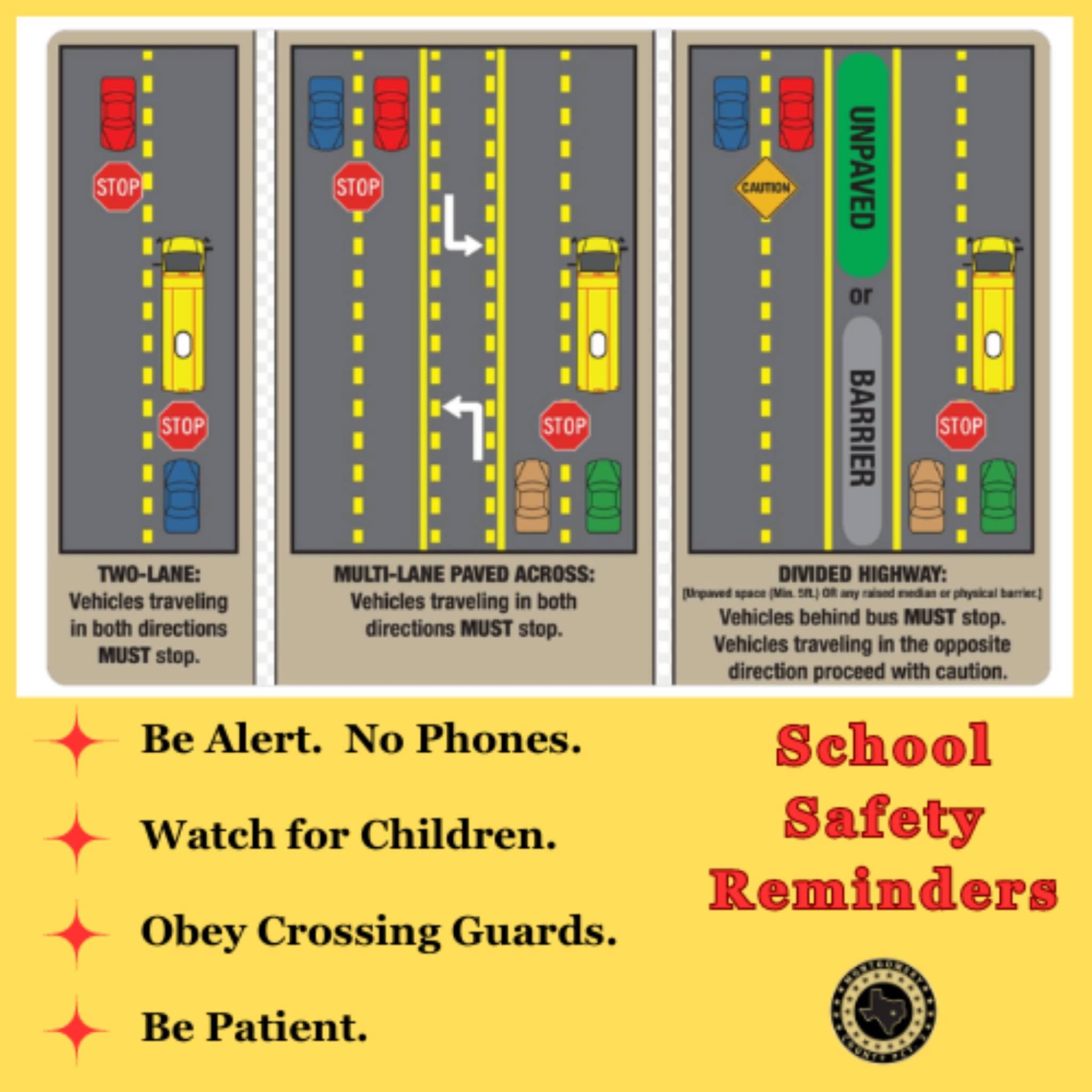 (Source: Commissioner Charlie Riley - Montgomery County Precinct 2)
Walking and Biking Students Need Room to Be Seen
Students walking or biking to school may be traveling during low-light morning conditions, particularly those attending high schools that begin at 7:15 a.m.
Children should use sidewalks and marked crossings whenever possible. Before entering the street, they should look left, right and left again while also watching for turning vehicles.
Phones and earbuds should remain put away while students are crossing. Bright clothing, reflective materials and bicycle lights can make children easier to see in darker conditions.
NHTSA advises pedestrians to remain alert, cross at intersections or crosswalks whenever possible and wear bright or reflective materials when visibility is limited.
Drivers waiting in school traffic should keep sidewalks, crosswalks and curb ramps clear. Blocking a pedestrian route can force a child into moving traffic or conceal the student from another driver.
Parents Can Help Reduce Campus Congestion
School arrival and dismissal lines are often slowest during the opening weeks as families learn campus traffic patterns and students adjust to new routines.
Parents should follow the official campus route rather than stopping in a travel lane or creating an unofficial unloading point. Children should exit on the curb side whenever possible and should not be directed to run between parked or idling vehicles.
Drivers should avoid blocking neighborhood driveways, intersections, sidewalks and crosswalks while waiting for dismissal. Those areas may be needed by residents, pedestrians, school buses or emergency vehicles.
Leaving home five or 10 minutes earlier can reduce the pressure that leads to speeding, abrupt lane changes, unsafe U-turns or hurried drop-offs.
Teenage Drivers Need an Early-Morning Safety Reminder
For some Conroe ISD high school students, Aug. 12 will be one of their first days driving to school without an adult in the vehicle.
Teenage drivers may be traveling before sunrise, navigating crowded parking lots and sharing the road with buses, parent vehicles and classmates on foot.
They should review their route before leaving, allow additional travel time and maintain extra following distance. Traffic can stop suddenly when a school bus activates its lights, a crossing guard enters the roadway or a parent slows for a campus driveway.
Parents can help by discussing where their student should park, which entrance to use and what to do when running late. Arriving after the bell is safer than speeding, texting or attempting a dangerous turn.
Teen drivers should also remember that younger students and school buses will remain on area roads long after high schools dismiss at 2:35 p.m.
Conroe ISD Families Must Register for Transportation
School enrollment and transportation registration are separate processes in Conroe ISD.
Families who did not request bus service during initial student registration can register through the district’s Transportation Portal. Parents need the student’s identification number and date of birth to complete the request. Processing may take up to five business days, depending on demand.
Requests for an alternate stop may also take up to five business days to process. Families remain responsible for getting students to and from school until transportation service has been activated.
Parents should complete the process before the first day rather than assuming that a previous route assignment will automatically continue.

How to Find a Conroe ISD Bus Route
The Conroe ISD Transportation Portal allows parents to find a student’s bus route and determine the school assigned to a home address.
To locate a bus route, families select the student-eligibility option and enter the child’s student identification number and date of birth. School zoning can be checked separately by entering the home address.
Conroe ISD Transportation can be reached at 936-709-7940. The district also operates transportation centers serving the Conroe, Caney Creek, Oak Ridge and The Woodlands areas.
Families should confirm their assigned route and stop before the first day and should not rely solely on information from the previous school year.
Conroe ISD Uses SMART Tag for Bus Riders
Conroe ISD uses the SMART Tag system to increase the safety and security of students using district transportation.
Students tap their identification cards on a reader when entering and leaving the bus. The system records when and where a child boards and exits and helps the driver confirm that the student is using the correct route and stop.
Registered parents and guardians can use the SMART Tag Parent App to review bus activity and receive notifications. Examples include confirmation that a child boarded the correct route or exited at the assigned stop.
The student card contains only a unique identification number rather than personal information. District-approved personnel and registered guardians have access to the associated records.
Families should make sure children have their district-issued identification card and understand how to scan when boarding and exiting.
First-Week Bus Delays Are Possible
Bus routes may take longer during the opening days as drivers adjust to traffic, construction, new riders and updated stop assignments.
Students may also need extra time to learn boarding procedures, locate their buses and scan their identification cards. Campuses may hold buses briefly to make sure children are sent to the correct route.
Residents should avoid assuming that a bus stopped for an extended time is creating an unnecessary delay. Drivers may be confirming a student’s stop or waiting until children have safely cleared the roadway.
A delayed school bus is never an invitation to pass.
A Safer School Year Begins on Neighborhood Streets
Back-to-school safety does not begin at the campus entrance. It begins in driveways, apartment parking lots, subdivision streets and the places where children wait for their buses.
For Cielo, the return of Conroe ISD means more traffic beginning before 7 a.m. and continuing throughout afternoon dismissal.
The most helpful actions are straightforward: leave earlier, reduce speed, put away the phone, watch for children near parked vehicles, keep sidewalks and crosswalks clear and stop completely for school buses.
The first few mornings may move more slowly than residents would prefer. That extra patience helps neighborhood students arrive ready to learn and return safely to the families waiting for them.
Stay tuned to My Neighborhood News for additional Conroe ISD updates, transportation information and community safety reminders throughout the 2026-2027 school year.

 Tiffany Krenek has been on the My Neighborhood News team since August 2021. She is passionate about curating and sharing content that enriches the lives of our readers in a personal, meaningful way. A loving mother and wife, Tiffany and her family live in the West Houston/Cypress region.
Local business spotlight
Grow your business
where trust already lives.
Let’s introduce your business to the neighbors nearby.
Have a local favorite?
Let’s make an introduction.
Leave your email and our team will reach out with ways to promote your business.
Give a local favorite a little love.
Know a business your neighbors should discover? Tell us who they are.
We couldn’t send that just yet. Please try again.