







Amazon Plans Multibillion-Dollar Austin Robotics Plant With Up to 500 Jobs, Local STEM Partnerships
For Austin families, Amazon’s newly announced multibillion-dollar robotics manufacturing facility is about more than another major technology investment. The project could create hundreds of manufacturing and engineering jobs while bringing new attention to a question that matters across Central Texas: how local students and workers can prepare for the increasingly technical careers being created around them.
Amazon announced Aug. 19 that it plans to establish the new manufacturing operation in Austin, where the company says it will produce robotics systems used alongside employees to handle repetitive tasks and heavy lifting. The facility is expected to create between 300 and 500 manufacturing and engineering jobs, adding another advanced-manufacturing employer to a region already known for technology, semiconductor production and engineering.
The company also said it plans to work with Austin Independent School District and Del Valle Independent School District through Amazon Future Engineer, connecting the economic development announcement with computer science and STEM education for local students.
For families in Austin and the fast-growing communities east and southeast of the city, that education component may prove to be one of the project's most significant long-term pieces.
Amazon Expands Its Austin Footprint With Robotics Manufacturing
Amazon already has a sizable presence in Central Texas. The company says it employs about 17,000 people in Austinand approximately 86,000 across Texas, while its investment in the state has surpassed $100 billion since 2010.
The new Austin robotics facility would expand that presence into advanced manufacturing, producing technology used within Amazon operations.
Gov. Greg Abbott described the announcement as another sign of Texas' growing role in technology and manufacturing.
“Texas is the new frontier for innovation,” Abbott said. “We congratulate Amazon on their expanded investment in Texas. With the best business climate in the nation, easy access to global markets, and a deep pipeline of skilled talent, Texas offers advanced manufacturers and technology leaders unmatched resources to innovate and expand.”
Amazon said Austin's engineering workforce, university relationships and broader technology ecosystem were among the reasons for placing the investment here. Reporting following the announcement has identified the planned location as the large Dog's Head redevelopment area in southeast Austin, a part of the city positioned for substantial new development near Austin-Bergstrom International Airport.
That location adds another layer to the story for residents watching southeast Austin's continued transformation. A major advanced-manufacturing operation can bring direct jobs, but it can also influence future transportation needs, supporting businesses, workforce programs and development around it.
No Economic Incentives Requested, Austin Mayor Says
One detail likely to draw attention from Austin taxpayers is the financing behind Amazon's decision.
Austin Mayor Kirk Watson said Amazon did not request economic incentives or public money for the facility itself, while also pointing to the additional property-tax revenue the project could eventually generate for the city.
"Amazon chose Austin for this big deal because of our world class innovation ecosystem, our position as a global leader in advanced manufacturing, and the talent pipeline we’ve developed that focuses on giving more Austinites the opportunity to access better career pathways. Amazon asked for no economic incentives, no public money,” Watson said. “This development will create hundreds of family sustaining careers and demonstrates Amazon’s commitment to Austin’s long-term sustained success. It will also immediately start adding to Austin's tax base, which will help pay for necessary city services. Austin continues to be a city where companies choose to invest, grow, and innovate."
For residents, that distinction matters. Economic development projects often prompt questions about tax incentives and public subsidies, making the city's statement that Amazon did not seek those incentives for this facility a notable part of the announcement.

Austin ISD and Del Valle ISD Students Could See New STEM Opportunities
The potential impact reaches beyond workers who will eventually apply for jobs at the plant.
Amazon said it plans to partner with Austin ISD and Del Valle ISD through Amazon Future Engineer, a program designed to broaden access to computer science education for K-12 students, particularly those from underserved communities.
More than 85,000 Texas students have participated in Amazon Future Engineer programs to date, according to the company.
For local students, the connection creates a clearer line between classroom STEM education and the kinds of careers being developed close to home. Robotics manufacturing requires more than engineers designing machines. Modern facilities can involve technicians, maintenance specialists, software professionals, manufacturing workers, automation specialists and employees trained to troubleshoot increasingly sophisticated equipment.
That makes workforce preparation particularly relevant for Del Valle and other southeast Austin communities where major employers and development projects have been reshaping the economic landscape.
Amazon Vice President of Worldwide Economic Development Holly Sullivan said the area's workforce and educational institutions contributed to the decision.
"Austin's talented workforce, world-class universities, and strong community partnerships make it the ideal home for this facility," Sullivan said. "We're proud to deepen our commitment to this city and the state of Texas."
Amazon's University of Texas Partnership Adds Another Piece to the Talent Pipeline
The company's school district partnerships will not start from scratch.
Since 2023, Amazon has worked with the University of Texas at Austin through the Amazon Science Hub, supporting research involving machine learning and robotics. The collaboration has included fellowships, capstone projects and apprenticeships intended to prepare participants for careers in those fields.
Taken together, the university relationship and planned K-12 partnerships illustrate a broader workforce strategy: introducing younger students to computer science, creating opportunities for higher education and research, and developing workers who may eventually fill engineering and advanced-manufacturing roles.
That pipeline matters as Austin competes not only to attract major employers but also to make sure residents have realistic pathways into the jobs those companies create.
Robotics Are Changing Both the Work and the Jobs
Amazon's investment also reflects a larger shift taking place inside warehouses and manufacturing operations.
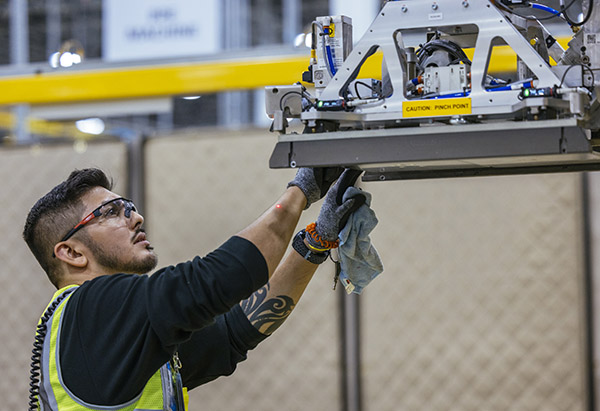
The robotics systems planned for production in Austin are designed to work alongside employees, particularly on repetitive activities and jobs requiring heavy lifting. Amazon says that over the past six years, robotics systems have contributed to a more than 43% decline in its global rate of recordable injuries — injuries requiring more than basic first aid — and a more than 70% decline in lost-time injuries, which are serious enough to require employees to miss work.
Those figures are company-reported and apply across Amazon's global operations rather than specifically to the planned Austin facility.
At the same time, automation is changing the skills companies need. As robots take on certain physical tasks, employers increasingly need people who can build, operate, repair, program and maintain those systems.
Amazon has been developing training programs around that transition for years.
Its Career Choice program, launched in 2012, prepays educational costs for employees pursuing degrees and credentials in high-demand fields, including robotics. Amazon says more than 700,000 employees worldwide have participated. In Texas, approximately 14,500 employees have used Career Choice through 35 participating higher education institutions, including Austin Community College.
The company has also introduced Future Ready, a multibillion-dollar education and reskilling initiative intended to expand training opportunities for employees and community members.
For Central Texas workers considering careers in advanced manufacturing, robotics, engineering or automation, those programs help illustrate how rapidly the definition of a manufacturing job is changing.

Amazon's Austin Investment Also Builds on Local Community Work
Amazon's relationship with the Austin area extends beyond employment and education.
The company has worked with organizations including the Central Texas Food Bank, Mobile Loaves and Fishes and Foundation Communities, supporting efforts involving food insecurity, disaster recovery and other community needs.
Amazon said it intends to expand that work as its presence in Austin grows.
The company has also emphasized that robotics investment and job creation are not mutually exclusive. Amazon says it has created more than 1 million U.S. jobs during the roughly decade-long period in which it has expanded the use and development of robotics across its operations.
What Happens Next for Amazon's Austin Robotics Facility?
Many details residents will eventually want to know — including a full construction schedule, opening date, specific job requirements and when hiring will begin — were not included in the Aug. 19 announcement.
For now, the confirmed scope is substantial: a multibillion-dollar Austin manufacturing investment, 300 to 500 expected manufacturing and engineering jobs, production of Amazon robotics systems and planned STEM partnerships with Austin ISD and Del Valle ISD. Texas officials independently confirmed the job range and investment announcement this week.
The larger story will unfold over time.
For Austin, particularly the rapidly changing areas east and southeast of the city's traditional employment centers, the project represents another step in the region's evolution from a city known primarily for software and technology into a broader hub for advanced manufacturing, robotics, engineering and artificial intelligence-related industries.
For local families, however, the most meaningful measure may eventually be simpler: whether students growing up near these new investments can gain the education and skills needed to take part in them.
Stay tuned to My Neighborhood News for updates on Amazon's Austin robotics manufacturing facility, local hiring, and construction progress as additional details are announced.

 Tiffany Krenek has been on the My Neighborhood News team since August 2021. She is passionate about curating and sharing content that enriches the lives of our readers in a personal, meaningful way. A loving mother and wife, Tiffany and her family live in the West Houston/Cypress region.