







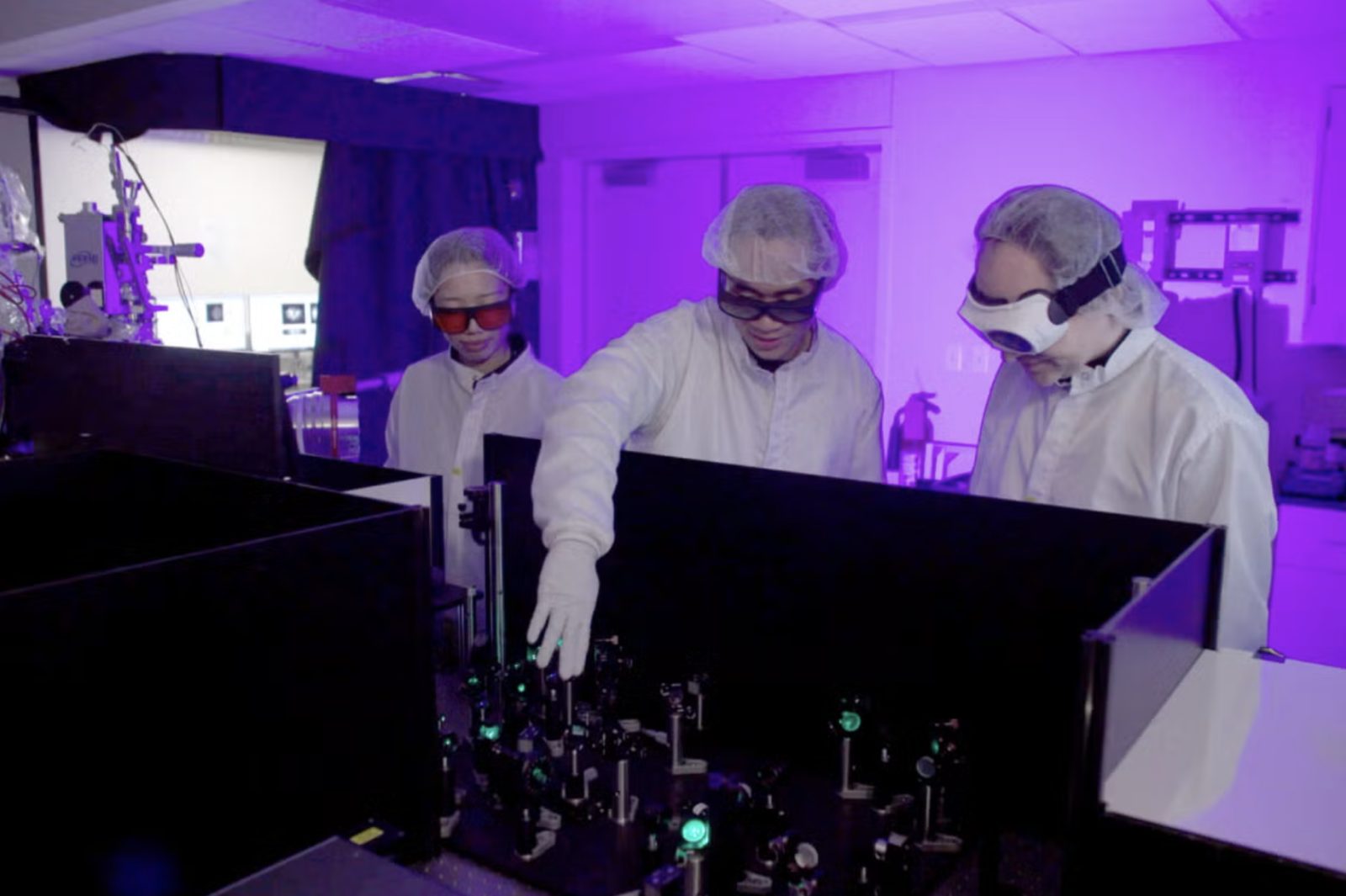
UT Austin’s Quantum Research Push Could Help Shape the Future of Computing, Energy and Medicine
For many Austin residents, “quantum science” may sound like something far removed from daily life. But some of the most important technologies people already depend on — smartphones, GPS, medical imaging, computer chips and modern electronics — are rooted in quantum mechanics.
Now, The University of Texas at Austin is working on the next chapter.
Inside Welch Hall, the university’s largest academic building, advanced quantum research facilities are coming online, including the Love, Tito’s Quantum Materials Characterization Laboratory, which opened in 2024, and a new underground research facility already under construction. Across campus, UT researchers are studying quantum materials, quantum computing, quantum sensing and the behavior of atoms and electrons at the smallest scales.
The work may sound highly technical, but its possible outcomes are easy to understand: more powerful computing, better medical tools, cleaner energy technologies, stronger semiconductor manufacturing and new ways to move and protect information. For Austin, it also strengthens the city’s position as a major research and technology hub at a time when Texas is investing heavily in semiconductors, advanced computing and next-generation science.
A Longhorn Legacy in Quantum Science
UT Austin’s quantum story is not new. It stretches back decades, including the work of renowned physicist John A. Wheeler, whose influence helped place the university on the quantum discovery map.
Wheeler advanced understanding around quantum demolition, a type of measurement in quantum mechanics that produces information about a system but can also disrupt or destroy the quantum state being measured. His circle of graduate and postdoctoral students went on to make major contributions of their own.
Among them was theoretical physicist David Deutsch, who helped pioneer the field of quantum computing by outlining mathematical principles for a universal quantum computer. Another was Wojciech Zurek, who earned his Ph.D. from UT in 1979 and developed the theory of decoherence in quantum mechanics, a challenge that remains central to making quantum computers useful.
Benjamin Schumacher, who earned his Ph.D. from UT in 1990, is also part of that history. He introduced the term “qubit,” now widely used to describe a unit of quantum information.
“Schumacher worked out more than just a clever name [qubit]; he proved a theorem about how qubits could be used to quantify the quantum information sent through a communication channel,” Sciences News reported.
That history matters because today’s quantum push at UT is not a sudden pivot. It is the continuation of a research identity that has been built over generations.
The ‘Magic Angle’ Discovery That Reached Labs Around the World
One of UT Austin’s most influential modern contributions came from Allan MacDonald, the Sid W. Richardson Foundation Regents Chair in Physics.
In 2011, MacDonald and postdoctoral researcher Rafi Bistritzer published research exploring what happens when two sheets of graphene — each made of a single layer of carbon atoms — are stacked with a slight rotational offset. Using supercomputers at UT’s Texas Advanced Computing Center, they found that at a 1.1-degree twist, electrons slow dramatically and begin behaving in unusual ways.
That discovery helped launch the field known as twistronics, where scientists study how rotating ultrathin layers of materials can create new properties, including superconductivity and magnetism.
In 2018, researchers at the Massachusetts Institute of Technology confirmed that graphene arranged at MacDonald’s “magic angle” can superconduct at less extreme temperatures than many existing superconductors require. The discovery opened new possibilities for quantum computing, energy efficiency and advanced materials research.
MacDonald shared the 2020 Wolf Prize in Physics with Bistritzer and MIT experimental physicist Pablo Jarillo-Herrero. Earlier this year, MacDonald and Jarillo-Herrero were awarded the Frontiers of Knowledge Award, one of the major international honors in physics.
MacDonald said the field has moved well beyond the original 1.1-degree discovery. Scientists can now intentionally twist two sheets of material at a range of angles, giving researchers more control over how electrons behave inside two-dimensional materials.
That control offers “a new and very powerful way” of changing the properties of electrons inside 2D materials and how those properties interact with light, MacDonald said.
The practical possibilities are wide-ranging, including improvements in fiber-optic data transfer, quantum computing and energy-related technologies.
Scott Aaronson and the Boundaries of Quantum Computing
While some UT researchers are focused on materials and lab-based experiments, computer scientist Scott Aaronson is helping define what quantum computers may actually be able to do.
Aaronson, UT’s David J. Bruton Jr. Centennial Professor of Computer Science, is a leading expert in quantum supremacy, the idea that a quantum device can solve a problem that a traditional computer cannot solve in a reasonable amount of time. His work has helped clarify both the promise and the limits of quantum computing.
In 2020, Aaronson received the ACM Prize in Computing for groundbreaking contributions to quantum computing. In April 2026, he was elected to the National Academy of Sciences, one of the country’s highest scientific honors.
Aaronson and his research group are not focused on building a research-grade quantum computer, which can cost tens of millions of dollars. Their work is more theoretical, asking a question that matters to scientists, companies and governments alike: What can a quantum computer do, and what can it not do?
“Most of what we do is theory,” said Aaronson, “but if we have any experiment that is worth doing, which sometimes we do, we can call up whoever on Earth has the best hardware to … run our experiment.”
That kind of work is important because quantum computing is often surrounded by hype. UT’s role is not only to imagine what may be possible, but also to help define what is realistic.
Texas Quantum Institute Connects Research, Industry and the State’s Tech Future
The Texas Quantum Institute, known as TQI, serves as an umbrella organization for UT Austin’s quantum research. Physics professor Elaine Li, who holds the Jack S. Josey – Welch Foundation Chair in Science, co-directs the institute with Xiuling Li, the Truchard Foundation Endowed Chair in Electrical and Computer Engineering.
Their work is part of a larger effort to connect quantum research across campus, strengthen partnerships and help position Texas as a leader in quantum technology.
The university has taken several major steps in recent years. In 2023, quantum technologies company Infleqtion signed a memorandum of understanding with the Texas Institute for Electronics to develop qNexus, a center of excellence for quantum manufacturing. In late 2025, Gov. Greg Abbott announced a $4.8 million Texas Semiconductor Innovation Fund grant for the Texas Quantum Institute to establish QLab, a quantum-enhanced semiconductor metrology facility in Austin.
“Metrology has been identified by the U.S. Department of Commerce as the key enabling technology for the semiconductor industry,” Li said.
QLab is expected to be managed by TQI in collaboration with UT-MRSEC, the Microelectronics Research Center and the Texas Materials Institute. Its focus on quantum-enhanced semiconductor metrology connects UT’s quantum research directly to one of Texas’ most important economic priorities: strengthening the semiconductor supply chain.
What This Could Mean for Austin
For Austin families, students and local businesses, UT’s quantum ecosystem is more than a science story. It is part of the city’s broader identity as a place where research, education, technology and economic development increasingly overlap.
Quantum science could influence industries that already shape Central Texas, from semiconductors and software to health care, clean energy and advanced manufacturing. It could also create opportunities for students who are preparing for careers that may not fully exist yet.
That is why the work underway at Welch Hall, the Texas Quantum Institute and UT’s affiliated research centers matters beyond the Forty Acres. These facilities and faculty are helping build the foundation for technologies that may one day become ordinary parts of daily life — just as semiconductors, GPS and MRI technology did before them.
“We like to say we’re at the onset of the second quantum revolution,” Elaine Li added. “The first quantum revolution happened last century, and that’s made a lot of technology possible. The second quantum revolution may do even more.”
What Happens Next
As UT Austin expands its quantum research infrastructure, the next phase will likely involve more collaboration among scientists, engineers, industry partners and state-backed technology initiatives.
The new underground facility, QLab, the Love, Tito’s Quantum Materials Characterization Laboratory and the broader Texas Quantum Institute all point in the same direction: UT is working to turn deep scientific research into a stronger innovation pipeline for Austin and Texas.
For residents, the takeaway is simple. Some of the most complex work happening in Austin today could help shape the technologies people rely on tomorrow.
My Neighborhood News will continue following major research, business and development updates shaping Austin and Central Texas.

 Tiffany Krenek has been on the My Neighborhood News team since August 2021. She is passionate about curating and sharing content that enriches the lives of our readers in a personal, meaningful way. A loving mother and wife, Tiffany and her family live in the West Houston/Cypress region.