







Horizon Supercomputer Opens to Early Researchers in Round Rock, Expanding Scientific Computing at UT Austin
Understanding how a flash flood might move through a Central Texas watershed or how the electricity grid might respond to extreme winter weather requires more than observations alone. Researchers need computing systems capable of exploring many possible scenarios. A new supercomputer at the Texas Advanced Computing Center (TACC), part of The University of Texas at Austin, is beginning to provide that capability.
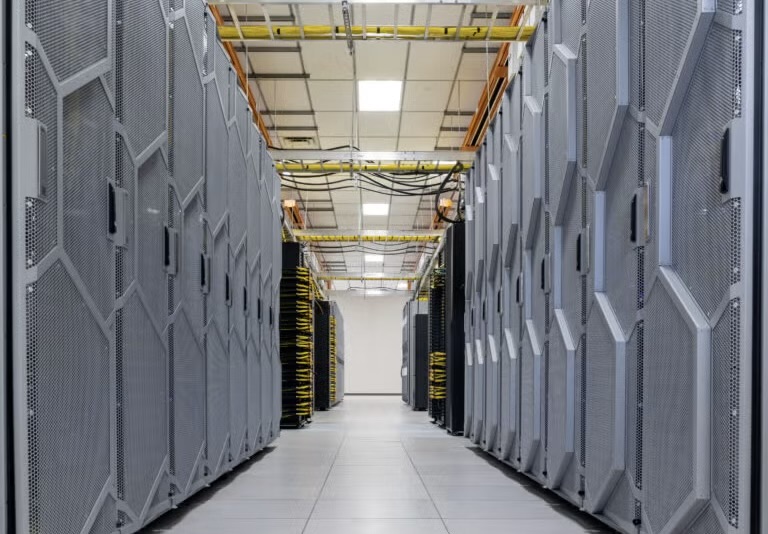
UT announced November 17 that Horizon had opened to early research users. Located in a new data center in Round Rock, the National Science Foundation-funded system is the centerpiece of its Leadership-Class Computing Facility. The project brings together advanced computing hardware and research support infrastructure.
What Horizon Can Help Scientists Investigate
The first phase includes 4,000 graphics processing units, or GPUs. These processors allow many calculations to take place simultaneously, making them useful for training artificial intelligence models and running complex scientific simulations. Researchers can combine those approaches to explore questions that would be impractical to investigate solely through physical experiments.

Potential applications include modeling earthquake behavior, investigating materials with unusual properties, analyzing biological information and simulating astronomical phenomena. For Texas residents, examples identified by UT include watershed flood simulations and testing electricity grid resilience. These are research possibilities, not announcements of completed discoveries or immediate changes to local public services.

A Phased Rollout, Not Full Production
According to UT, Horizon placed 24th worldwide on the November 2026 TOP500 supercomputer rankings, achieving 132 petaflops in the High-Performance Linpack benchmark. That result measures sustained computational performance, rather than the speed of every scientific task. UT identifies Horizon as the highest-ranked academic supercomputer in the United States on that list.
The second phase, which adds central processing unit capacity, is planned for early 2027. TACC's November 25 user guide continues to identify the system as open to early users and notes that certain data transfer services will become available when full production begins.
How Researchers Can Access the Facility
Research teams can consult the Horizon user guide for allocation pathways and current operational information. Access depends on eligibility and research allocations, rather than unrestricted public use. The project also incorporates training, software, storage and partnerships to help scientists make effective use of its resources.
More information is available in the UT announcement.

 Johnny Krenek has been connected to community news since childhood, growing up alongside the family business his parents founded—Krenek Printing. Today, he serves as Vice President and lead developer for My Neighborhood News, where he drives the digital experience and supports the team across a variety of technical and operational roles. He is passionate about building tools that help connect neighbors and strengthen communities.