







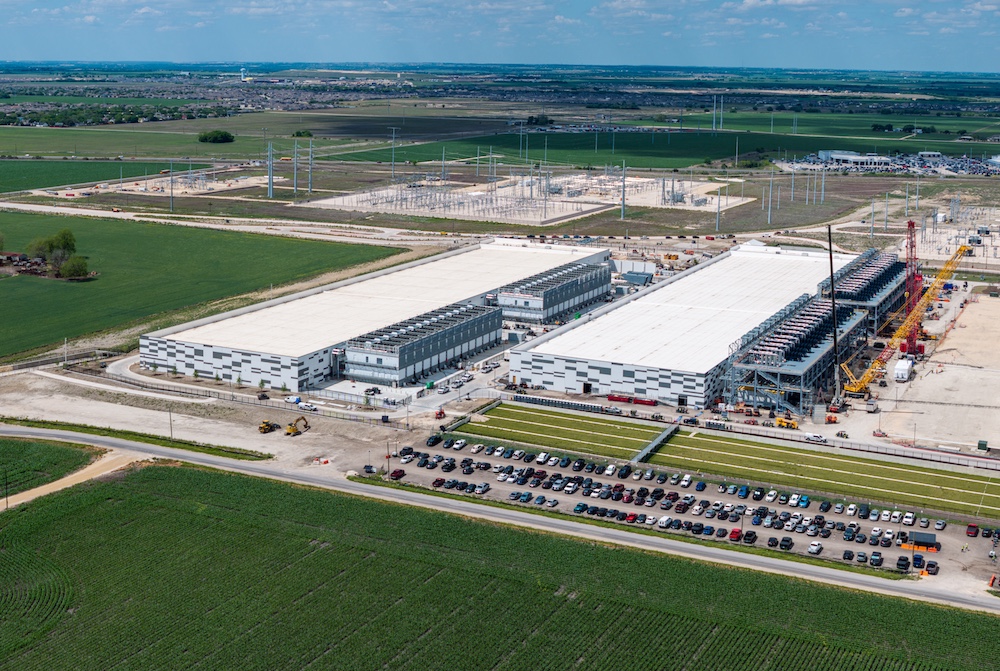
Governor Abbott Orders Statewide Audit of Texas Data Centers Before New Grid Connections Advance
Texas’ growing data-center industry is about to face a more detailed state review aimed at balancing economic investment and technological growth with electric-grid reliability, water planning, infrastructure costs and the concerns of nearby communities.
Gov. Greg Abbott on Aug. 3 directed the Public Utility Commission of Texas and the Electric Reliability Council of Texas to conduct a comprehensive verification and audit of every data-center project advancing through ERCOT’s interconnection process. The review must be completed before an additional project is approved to move forward.
Projects that do not provide the required information or fail to comply with state law and PUCT and ERCOT requirements must be denied a connection to the Texas power grid.
“Our top priority is to protect Texans’ safety and quality of life,” Abbott said in announcing the directive.
For residents, local officials and developers, the audit is expected to bring greater attention to several practical questions surrounding Texas data-center development: How much electricity and water will an individual facility require? Who will pay for the infrastructure needed to serve it? What economic benefits could it bring? And what steps will the operator take to address noise, lighting, traffic or other effects that may extend beyond the property?
The order does not prohibit data-center construction or suggest that every proposed facility will create the same challenges. Instead, it establishes a statewide review intended to determine whether individual projects are prepared to support their infrastructure needs and address local conditions before receiving permission to connect to the grid.
Texas Data-Center Requests Reflect a Rapidly Expanding Industry
The size of the development pipeline helps explain why state leaders are seeking more detailed information.
According to Abbott’s Aug. 3 directive, ERCOT was considering approximately 474 gigawatts of requests to connect to the Texas grid. That amount is more than five times ERCOT’s record peak electricity demand, and approximately 90% of the new power requests are associated with data centers.
Those figures represent proposed electricity requests, not power already being consumed. They also should not be interpreted as a forecast that every project in the queue will be built.
Developers may evaluate more than one location, revise their plans or withdraw proposals before construction begins. Interconnection queues can therefore be significantly larger than the amount of demand that ultimately reaches the grid.
Even with that distinction, ERCOT’s public updates show that interest in developing large electrical loads in Texas has increased quickly. As of March 26, ERCOT was tracking approximately 410 gigawatts of large-load interconnection requests, about 87% of which were associated with data centers. ERCOT reported that the queue had grown by 178 gigawatts since the end of 2025 and that it received 198 new large-load requests during the first quarter of 2026.
The figures measure proposed electrical demand rather than the number of individual buildings, but they offer one indication of the scale of potential Texas data-center development.
The Texas Comptroller also maintains lists of qualifying data centers and qualifying large data-center projects registered through state tax programs, reflecting an industry presence that reaches multiple regions of Texas.
Data centers support services that residents, businesses and public institutions use every day, including cloud storage, online banking, artificial intelligence, medical records, streaming platforms, telecommunications and business software.
Supporters say the facilities can bring major private investment, construction activity, taxable property, digital infrastructure and, in some cases, new energy development. Industry representatives also point to improvements in computing and cooling efficiency that may allow newer facilities to perform more work with fewer resources than earlier generations of technology.
The state’s concern centers on whether the combined pace of proposed growth can be managed without affecting electric reliability or shifting an unfair share of infrastructure costs to existing customers.
“That unprecedented load growth could endanger the reliability and stability of the Texas electric grid,” Abbott wrote in his directive.
What the Texas Data-Center Audit Will Examine
Under the Aug. 3 order, the PUCT and ERCOT must obtain detailed information from each data-center project before it can advance through the grid-connection process.
The audit will examine whether developers are funding their own projects or receiving state and local tax incentives, grants, abatements or other public financial assistance.
Regulators must also determine whether a project plans to provide some of its own electricity or rely primarily on the ERCOT grid. Developers will be expected to disclose projected annual and peak electricity use, plans for on-site generation and measures intended to reduce grid demand.
Some data-center operators are exploring on-site natural gas generation, renewable power, battery storage or agreements that allow them to reduce consumption when the grid is under stress. The costs, benefits and environmental effects of those approaches can differ considerably, making project-specific information important to the state’s review.
Water use will receive similar attention. Projects must provide projected annual and peak water consumption, identify expected water sources and explain whether they will use air-cooled, closed-loop or another water-efficient cooling system.
The state will also seek information on noise mitigation, light controls, setbacks, traffic improvements, emergency-response coordination and other measures designed to protect neighboring property owners. Each project must additionally identify its ownership and controlling interests.
The scope of the review recognizes that a data center proposed in an established industrial district may have different effects from one planned near homes, schools, farms or areas with limited water infrastructure.

June Directive Focused on Residential Electric Costs
The new audit follows Abbott’s June 10 directive calling on state utility regulators to ensure that data centers pay for the electric infrastructure required to serve them rather than transferring those expenses to residential customers.
That earlier letter instructed the PUCT to require data centers to cover their infrastructure costs and called for actions intended to reduce residential transmission expenses. It also directed the PUCT and ERCOT to review their existing authority to protect Texans, private property and natural resources.
“Data centers must operate in ways that reduce costs for residential electricity customers, do not drain water needed for our communities, and take into consideration the needs of our neighborhoods,” Abbott said in connection with the June directive.
The letter also recognized the economic growth and business investment occurring in Texas. Abbott described the state as a destination for technological development while arguing that expansion should not place undue costs on residents or local communities.
Together, the June and August directives place electric rates, water availability, economic contributions and neighborhood compatibility at the center of the state’s developing data-center policy.
Water Needs Can Vary Widely by Facility
Electricity is only one part of the data-center discussion.
Servers generate heat and require continuous cooling, but the amount of water used by a facility can vary widely depending on its size, computing workload, location, temperature, energy source and cooling technology.
A 2026 Houston Advanced Research Center analysis estimated that Texas data centers currently account for approximately 25 billion gallons of direct and indirect annual water use. Researchers estimated that the industry could account for between 0.5% and 2.7% of Texas’ total annual water use by 2030, depending on the pace of construction and the technologies adopted.
Those projections involve uncertainty because operators do not always publicly report detailed water information, future facilities may use different cooling systems and not every announced or proposed project will be completed.
The statewide percentage also does not necessarily describe what an individual community may experience. A large facility connected to a well-supplied regional system may have a different effect from one proposed in a smaller community or a part of Texas facing long-term water constraints.
Research published in 2026 also examined how peak data-center water withdrawals could affect public water systems on particularly hot days. The findings suggest that local capacity concerns may arise under certain conditions, especially where several large facilities are concentrated in the same service area.
Cooling technology is an important part of that calculation. Closed-loop systems recirculate water and can reduce ongoing consumption. Air-cooled systems may use less water but can require more electricity during hot weather. Other hybrid systems attempt to balance water and energy performance.
No single cooling design is necessarily the best choice in every part of Texas. The audit’s reporting requirement is intended to allow regulators to evaluate the technology, water source and projected demand of each project individually.
Infrastructure Costs Are Central to the State Review
A large data center may require substations, transmission lines, transformers and other equipment before it can begin operating. Determining who should pay for that infrastructure has become one of the most important policy questions for Texas homeowners, small businesses, utilities and developers.
Abbott’s June directive instructed the PUCT to ensure data centers pay for the electric infrastructure associated with their interconnections. The letter said residential ratepayers should not be burdened with development expenses created by large new loads.
Data-center developers may argue that their facilities ultimately expand the tax base, support new generation and provide utilities with large, consistent customers. State regulators, meanwhile, must consider whether infrastructure built for an individual project will also benefit the wider system and how financial responsibility should be divided when benefits are shared.
Abbott has said he intends to work with the Texas Legislature during its next session to codify requirements addressing infrastructure costs, electric capacity and annual electricity and water reporting.
The proposed legislative agenda outlined in the June letter also includes water-efficient cooling technologies, a review of certain data-center tax incentives and community protections such as setbacks and noise-reduction measures.
For residents, the practical question is not simply whether a project receives an incentive. It is whether the public benefit—including jobs, tax revenue, infrastructure investment and broader economic activity—reasonably supports the assistance provided.

Neighborhood Effects Depend on Location and Design
Data centers often employ fewer workers after construction than manufacturing plants with similarly large buildings, but their physical operations can still affect nearby properties.
Cooling equipment, electrical systems and backup generators may operate around the clock. Depending on a facility’s design and distance from surrounding properties, residents may raise questions about low-frequency noise, nighttime lighting, construction traffic, emergency generators or the appearance of large industrial structures.
Those concerns are not uniform across every project. Setbacks, sound barriers, equipment placement, landscaping, operating limits and building materials can reduce impacts. Locating a facility within an established industrial or commercial area may also limit conflicts with residential properties.
Some projects are considering on-site natural gas generation to supplement or replace electricity from the grid. A Texas Tribune and Floodlight investigation reported that proposed data centers could add new sources of air emissions through turbines, engines and backup generators.
The emissions associated with those facilities would depend on the type of equipment, the number of operating hours, the fuel used, pollution controls and applicable state and federal permits. Backup generators used only during outages would present a different operating profile from gas turbines designed to provide continuous power.
Projects relying on renewable electricity, battery storage or other power arrangements would have different environmental profiles. The audit’s ownership, generation and equipment disclosures are intended to help regulators distinguish among those approaches.
Economic Benefits Will Also Be Part of the Evaluation
Texas has attracted data-center development because of its available land, business environment, growing technology sector, energy resources and position within the national economy.
New facilities can generate construction jobs, increase taxable property values and strengthen the digital infrastructure used by businesses, hospitals, universities, governments and residents.
In some communities, a data center may broaden the property-tax base without creating the same demand for schools and other population-based services that accompanies a large residential development. Projects can also lead to road, utility and energy improvements that may have benefits beyond the facility itself.
The size of those benefits varies. Residents and local officials may want to know how many permanent jobs a facility will create, the wages associated with those positions, what incentives it will receive and whether the developer will fund necessary infrastructure.
They may also want to understand whether the facility will purchase power from new generation sources, participate in demand-response programs or contribute equipment that strengthens the local electric system.
The statewide audit could help provide more consistent information before regulators decide whether a project is ready to connect to the Texas grid.
What Happens Next for Texas Data-Center Projects
The Aug. 3 directive does not establish a public deadline for completing the statewide audit. Until projects satisfy the verification requirements, however, additional data centers advancing through ERCOT’s interconnection process are not to be approved to move forward.
The PUCT and ERCOT will need to determine how the review will be conducted, which records developers must submit and how compliance will be evaluated.
The process may also give Texas lawmakers more information as they consider broader data-center legislation during the next regular legislative session. Subjects identified by Abbott include electricity and water reporting, water-efficient cooling, infrastructure payments, tax incentives, on-site generation and protections for neighboring communities.
For Texans living near a proposed data-center site, the directive offers a framework for asking specific questions before construction begins: How much electricity and water will the facility use? What technology will it employ? Who will pay for new infrastructure? How many jobs and how much tax revenue are projected? What will neighboring properties hear or see? And how will the project respond during an electric-grid or public-safety emergency?
The audit will not determine that all projects are beneficial or that all projects are harmful. Its stated purpose is to provide regulators with enough information to evaluate each proposal on its individual design, location, resource demands, economic contributions and potential effects on the surrounding community.
As Texas continues to attract investment in artificial intelligence, cloud computing and other digital technologies, the central policy question will be how to support that growth while maintaining reliable infrastructure and protecting the interests of existing residents.
Residents can stay tuned to My Neighborhood News for updates as the PUCT, ERCOT and Texas lawmakers develop the next phase of data-center oversight.

 Tiffany Krenek has been on the My Neighborhood News team since August 2021. She is passionate about curating and sharing content that enriches the lives of our readers in a personal, meaningful way. A loving mother and wife, Tiffany and her family live in the West Houston/Cypress region.