







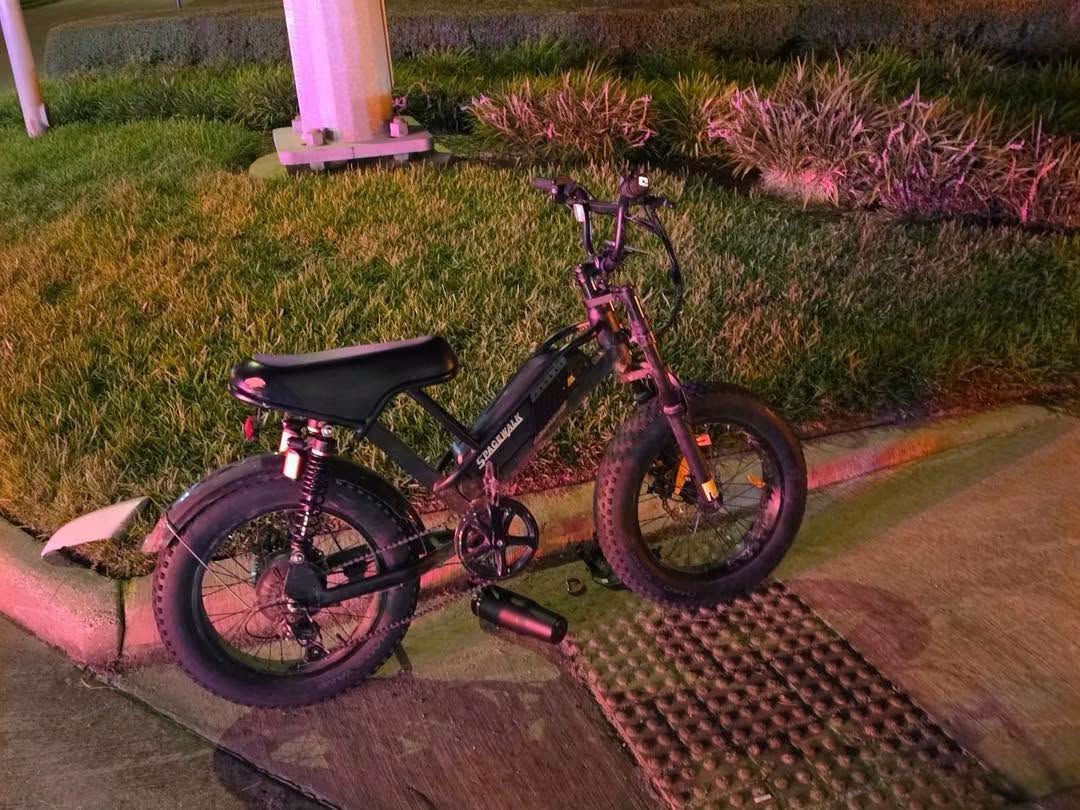
What Is Your Child Really Riding? A Sydney Harbour Parent’s Guide to E-Bikes, E-Scooters and Electric Dirt Bikes
For many families, an e-bike or electric scooter can look like a simple upgrade from the bicycle generations of children grew up riding. It can mean independence, a quicker trip to a friend’s house or an easier way to get around the neighborhood.
But the machines now showing up on sidewalks, neighborhood streets and routes to school are not all the same. Some are legally classified as electric bicycles. Others function more like motor vehicles. That distinction matters, especially when young riders are sharing space with cars.
For parents in Sydney Harbour, the issue has become harder to ignore as several crashes involving children and teens have occurred across the Houston area in recent weeks and months.
Recent Houston-Area Crashes Put New Focus on Young Riders
On Sept. 20, a 13-year-old boy riding an e-bike was struck by a vehicle along West Lake Houston Parkway in the Atascocita area, according to Harris County Precinct 4. ABC13 reported that the teen was treated by EMS and was later recovering at home. The driver remained at the scene and cooperated with investigators.
Just nine days earlier, an 11-year-old Katy ISD student died after being struck by a vehicle while riding an electric scooter at Roesner Road and Elk Ridge Lane in Fort Bend County. The child was taken to a hospital but later died from the injuries, according to the Fort Bend County Sheriff’s Office.
In late August, a 9-year-old child was hospitalized after being struck by a vehicle while riding an electric dirt bike in Harris County. Precinct 4 said the crash happened in the 200 block of Pinto Point Drive.
That crash came shortly after two other young electric scooter riders were struck by vehicles in Harris County within days of one another. A 10-year-old girl was seriously injured after investigators said she entered an intersection while riding an electric scooter, and a 14-year-old rider was hit in The Woodlands area. Both children were taken to hospitals.
There have also been fatal crashes involving motorized bikes that were not legally classified as e-bikes. In May, a 17-year-old Klein Collins High School student died after crashing a gasoline-powered mini-bike while traveling to school. Authorities initially described the vehicle as an e-bike, but investigators later said it was a gasoline-powered motorized bicycle without pedals.
In January, another young teen died in east Harris County after crashing an unauthorized gas-powered mini-bike while deputies were attempting to stop him for traffic violations, according to the Harris County Sheriff’s Office.
Those incidents are not identical, and authorities do not always classify bikes, e-bikes, scooters and motorized bikes consistently in crash data. That makes it difficult to calculate a precise local accident rate. Still, the recent pattern has prompted increasing attention from law enforcement agencies, schools and trauma specialists.
ABC13 reported in September that national research has not found clear evidence that e-bike riders crash more frequently than traditional bicycle riders. However, the research found that e-bike crashes tend to produce more serious injuries, including head, neck and facial injuries and traumatic brain injuries. Emergency department visits involving e-bike crashes more than doubled nationally between 2022 and 2024, according to the research reviewed by the station.

Texas Law Makes an Important Distinction
One of the biggest questions for parents is also one of the simplest: Is the vehicle actually an e-bike under Texas law?
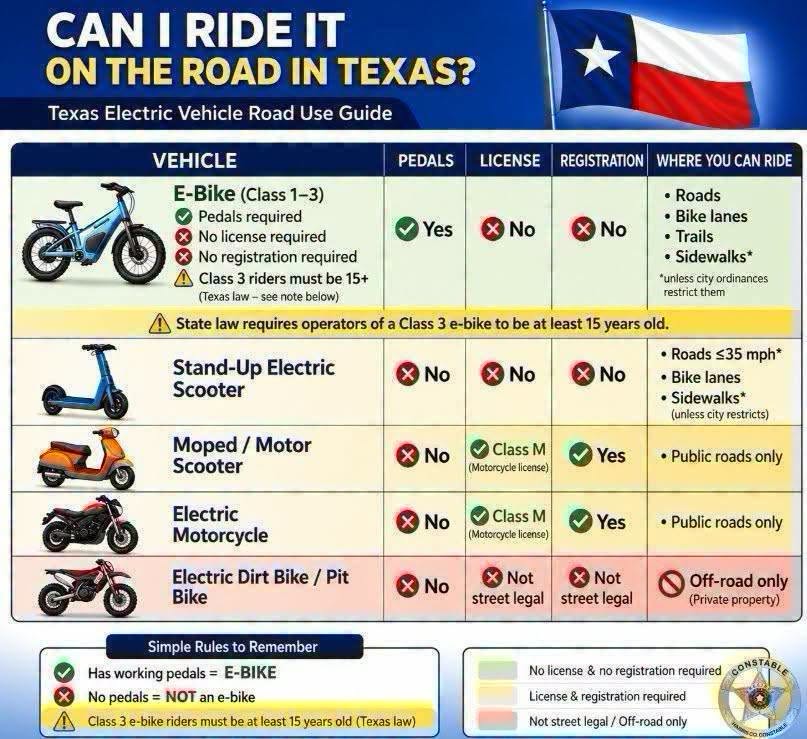
Texas defines an electric bicycle as a bicycle with fully operable pedals, an electric motor producing fewer than 750 watts and a top assisted speed of no more than 28 mph.
Texas recognizes three classes.
Class 1 e-bikes provide motor assistance only while the rider is pedaling and stop providing assistance at 20 mph.
Class 2 e-bikes can use the motor to propel the bicycle without pedaling but also have a maximum assisted speed of 20 mph.
Class 3 e-bikes provide assistance while the rider pedals and operate at assisted speeds above 20 mph but below 28 mph. Under Texas law, a person must be at least 15 years old to operate a Class 3 e-bike.
That means an electric dirt bike, pit bike or other high-powered motorized vehicle without fully operable pedals may not qualify as an electric bicycle at all, even if it is marketed online with language that makes it sound similar.
That is the concern Harris County Precinct 4 Constable Mark Herman raised in a recent back-to-school safety reminder.
“Parents, know what your child is riding and talk with them about safe and legal riding. Drivers, slow down and expect young riders—especially before and after school. A few extra seconds behind the wheel can help prevent a tragedy," said Constable Mark Herman.
The Conversation Parents May Need to Have
For families in Sydney Harbour, the safest conversation may begin before a child ever turns the throttle or presses the power button.
Parents can start by looking at the manufacturer label together. Texas requires e-bike manufacturers and sellers to label an electric bicycle with its class, top assisted speed and motor wattage. That can help families determine whether the machine is actually a Class 1, Class 2 or Class 3 e-bike.
The conversation does not have to be framed as simply taking something away. It can be about helping a child understand that a machine capable of traveling 20 to nearly 30 mph requires a different level of judgment than a traditional bicycle.
Parents can walk through practical scenarios: What happens if a vehicle backs out of a driveway? Where should the rider stop before entering an intersection? What if the child is approaching a blind corner? Is the rider comfortable braking quickly without losing control?
Trauma prevention specialists interviewed by KPRC have also encouraged families to consider whether a child is physically and emotionally mature enough to control the device. They recommend properly fitted helmets, avoiding phones and headphones while riding, never carrying an additional passenger and making sure children understand intersections and traffic before riding independently.
A parent may also want to ride alongside a child several times before allowing independent trips. Watching how the child handles turns, braking, traffic and unexpected distractions can reveal more than simply asking whether they know the rules.
 (Source: Harris County Constable Precinct 4)
A Helmet Should Be Part of Every Ride
Even when a helmet is not required in every circumstance by state law, injury prevention experts consistently recommend one.
The risks rise quickly when speed increases. A child traveling 20 mph has far less time to react to a vehicle entering an intersection, a dog running into the roadway or a driver backing from a driveway than a child pedaling slowly down the block.
Parents should make sure the helmet fits correctly, is designed for the type of riding involved and is actually fastened before the child leaves home.
That final point sounds obvious, but parents know how quickly a helmet can migrate from a child’s head to a handlebar once the rider is out of sight.
Where Can Kids Ride More Safely?
Removing cars from the equation whenever possible can significantly reduce one of the largest hazards facing young riders.
Families can look for controlled environments such as neighborhood parks with designated bicycle areas, closed-loop bike paths, paved recreational trails where electric bicycles are permitted, private property with the owner’s permission, bike parks designed for riding skills and other low-traffic recreational areas.
Not every trail allows electric bicycles, and cities, counties, homeowners associations and park operators may adopt their own rules. Families should check posted regulations before riding.
For electric dirt bikes or other vehicles that do not qualify as legal e-bikes, private property or designated off-road riding facilities may be the appropriate option rather than neighborhood streets.
A large empty parking lot may also appear safer, but families should first obtain permission from the property owner and make sure the area is truly closed to vehicle traffic.
For younger riders, one of the best settings may simply be a controlled space where a parent can remain nearby while the child practices accelerating, braking, signaling and looking over a shoulder without drifting into traffic.

Drivers Share Responsibility Too
The safety conversation is not only for parents and riders.
Children on bicycles, scooters and e-bikes can be difficult to see, particularly near parked vehicles, driveways and intersections. Precinct 4 is asking drivers to reduce speed in residential areas, avoid phone distractions, check carefully before turning or backing out and leave additional space around young riders.
The school-day routine can create especially unpredictable conditions. Children may be riding before sunrise, traveling during afternoon traffic or moving between sidewalks, crosswalks and streets while drivers are simultaneously navigating school zones and neighborhood congestion.
Expecting a child to make a mistake can give a driver the extra second needed to avoid a collision.
Before Buying an E-Bike, Look Beyond the Product Name
One challenge for parents is that online listings often use broad terms such as “e-bike,” “electric bike,” “electric motorcycle” and “dirt e-bike” interchangeably.
Texas law does not.
Before purchasing one for a child, families can check four basic things: whether it has functional pedals, the motor wattage, the maximum assisted speed and the manufacturer’s classification label.
Parents should also consider the child’s age, size and experience rather than relying solely on the age range advertised by the seller.
Bike Houston Executive Director Joe Cutrufo told ABC13 that local bicycle shops can also help families understand what they are purchasing. He noted that online shoppers may not always realize exactly what type of machine they are getting.
What Sydney Harbour Families Can Do Now
No single rule can eliminate every risk, and legal e-bikes can provide children, teens and adults with useful transportation and recreation.
The more immediate question is whether the rider understands the machine beneath them.
For parents, that may mean checking the specifications tonight instead of assuming a vehicle marketed as an e-bike falls under Texas bicycle law. It may mean setting boundaries about which roads are off limits, requiring a helmet every time or finding a lower-traffic place where a child can ride without mixing with fast-moving vehicles.
For drivers, it may mean slowing down a little earlier when entering a neighborhood and looking twice before pulling from a driveway.
Those small choices matter because the young riders families see on neighborhood streets may be navigating traffic, speed and situations they are not yet fully prepared to handle safely.
My Neighborhood News will continue following e-bike, electric scooter and neighborhood traffic safety developments affecting local families.

 Tiffany Krenek has been on the My Neighborhood News team since August 2021. She is passionate about curating and sharing content that enriches the lives of our readers in a personal, meaningful way. A loving mother and wife, Tiffany and her family live in the West Houston/Cypress region.
Local business spotlight
Grow your business
where trust already lives.
Let’s introduce your business to the neighbors nearby.
Have a local favorite?
Let’s make an introduction.
Leave your email and our team will reach out with ways to promote your business.
Give a local favorite a little love.
Know a business your neighbors should discover? Tell us who they are.
We couldn’t send that just yet. Please try again.