








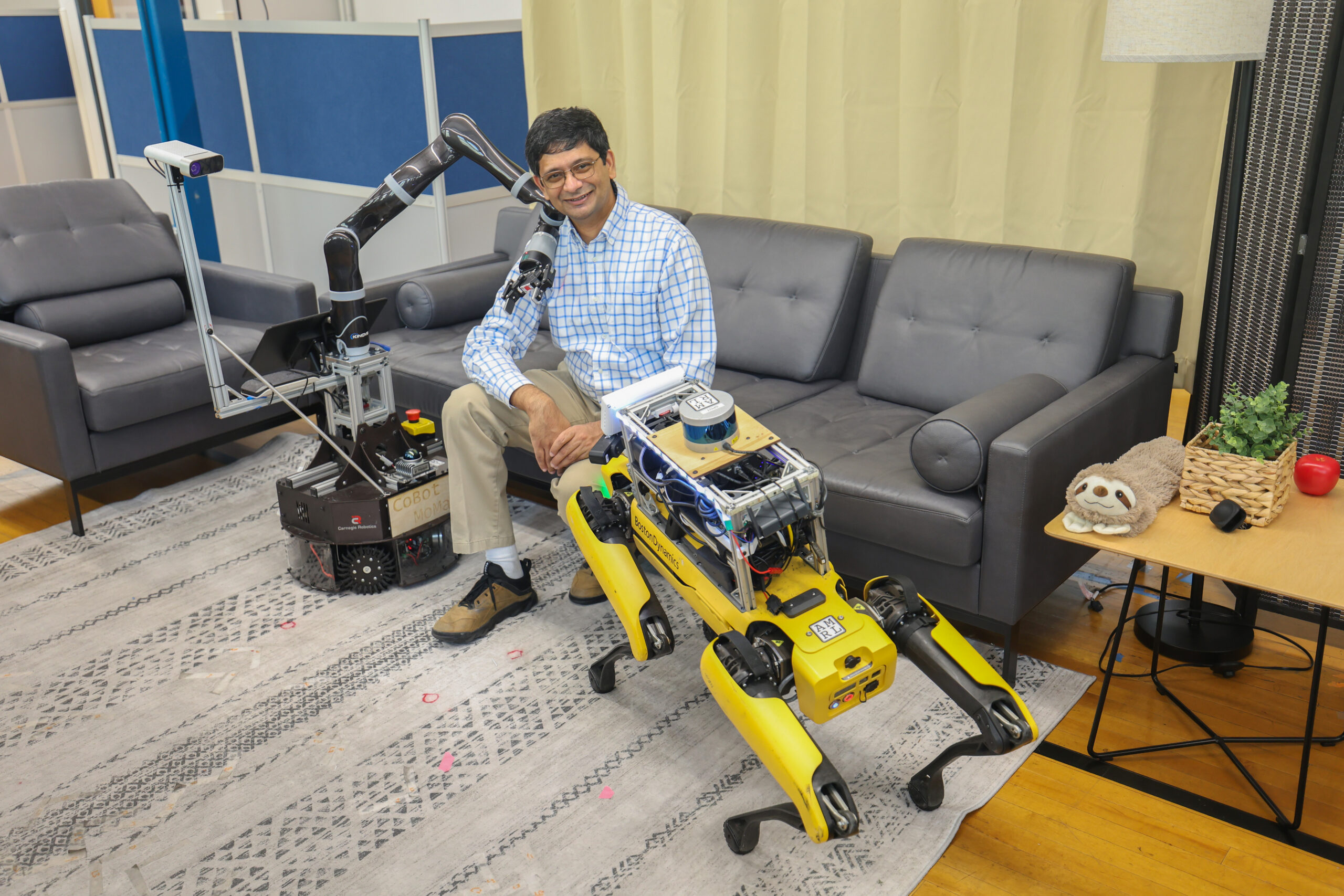
UT Austin Wins $30 Million NSF Award to Lead National Center Studying How Humans and Robots Can Adapt to Each Other
The next chapter of robotics research at The University of Texas at Austin will not be focused only on making machines faster, smarter or more capable. It will ask a more personal question: What happens when robots become part of everyday human life?
UT Austin has been selected to lead the new Center for Human and Robot Co-Adaptation, a five-year, $30 million National Science Foundation Science and Technology Center that will study how people and robots learn from one another over time in homes, hospitals, assisted-living communities, workplaces and other real-world environments.
For Austin, already a growing center for artificial intelligence, robotics, semiconductor research and advanced computing, the award brings another major national research initiative to the city. It also puts UT researchers at the center of work that could eventually influence how assistive robots help older adults, patients, caregivers, families and workers in daily life.
“UT is in a strong position to lead this new frontier of science,” UT President Jim Davis said. “Our researchers are already at the cutting-edge of robotics and AI, supported by generations of investment and a shared commitment to improving human lives. We are proud to unite leading researchers and industry partners from across our nation to advance this important work.”
UT Austin will lead researchers from six universities
The Center for Human and Robot Co-Adaptation will bring together 39 researchers from six universities, spanning artificial intelligence, robotics, cognitive science, social science and related fields.
In addition to The University of Texas at Austin, participating universities include the Massachusetts Institute of Technology, Yale University, Indiana University Bloomington, the University of Utah and Tufts University.
The center will also work with a prominent group of robotics and technology companies, including Amazon, Apptronik, Diligent Robotics, Google DeepMind, Hello Robot, MassRobotics, NVIDIA and Robust AI.
The project is one of three new NSF Science and Technology Centers announced in August. The National Science Foundation is investing a combined $90 million over five years in the three centers, which will focus on robotics, biotechnology and scientific turbulence. Each center is expected to receive approximately $6 million annually during the initial five-year period, with an opportunity to compete for additional years of support.
What is human-robot co-adaptation?
Most robots today are designed to complete particular tasks under relatively predictable conditions. UT Austin researchers want to study something more complicated: whether humans and robots can gradually adjust to each other as circumstances, preferences and physical abilities change.
That field is being described as human-robot co-adaptation.
The idea goes beyond teaching a household robot how to set a table. Researchers want to understand whether that robot could eventually learn when the table normally needs to be set, recognize that a particular meal requires different utensils and adjust its behavior based on the habits of the people around it.
“The next leap in robotics is not just getting robots to perform more tasks,” said Joydeep Biswas, an associate professor of computer science at UT Austin who will direct the center. “It is enabling robots to understand the people around them: their needs, preferences, values and constraints, while recognizing that people also adapt their behavior when they integrate robots into their environment.”
The same concept could have more consequential applications in health care and rehabilitation.
An assistive robot, for example, might learn that a patient has limited mobility and adjust how it positions an object so the person can independently reach it. As the patient becomes more familiar with the robot, that person might also discover new ways to ask for assistance.
Rather than requiring people to continually adjust themselves to technology, researchers want to understand how technology can learn to adjust as well.

Robots will be tested in real human environments
One of the most significant differences between the new center and many traditional robotics programs will be where the research happens.
Researchers will draw on the Human Environment with Robots, or HERO, Facility Network, which includes real-world and realistic environments across participating institutions.
Those settings will include houses, dormitories, cafés, a public museum, a rehabilitation hospital, elder-care communities and assisted-living residences.
That means researchers will be able to study situations that are difficult to reproduce inside a conventional robotics laboratory: unpredictable schedules, changing physical environments, personal preferences and the unwritten social expectations people navigate every day.
Community participation is also expected to become part of the research process. According to UT, residents and other participants will have opportunities to influence how, where and when robots are deployed. An internal ethics board will oversee the research and develop procedures for informed consent and opting out.
The focus on consent and community involvement could prove particularly important as artificial intelligence and humanoid robotics move into increasingly personal settings.
Austin's supercomputing resources will help create virtual test environments
Some experiments will take place digitally before robots ever enter a dorm room, hospital or senior living community.
UT Austin's Texas Advanced Computing Center, or TACC, will support simulations, machine learning, data storage and digital twins of participating HERO sites.
Digital twins are virtual representations of real environments that allow researchers to model different situations and test robotic behavior before deploying machines around people.
TACC gives the project access to some of the country's most advanced academic computing infrastructure, strengthening a connection between two fields in which Austin has invested heavily: high-performance computing and artificial intelligence.
The center also grew from Good Systems, UT Austin's interdisciplinary research initiative focused on developing artificial intelligence technologies that are ethical and beneficial to society.
Faculty participating in the new center will come from UT's School of Computing, College of Liberal Arts, Cockrell School of Engineering, Moody College of Communication and Texas Advanced Computing Center.
“Creating robots that can meaningfully improve people's lives requires both deep technical expertise and a genuine understanding of people and society,” said Peter Stone, head of the UT School of Computing and a member of the Good Systems executive team. “This center reflects the central purpose of Good Systems and our new School of Computing: to unite people across disciplines to tackle ambitious challenges no one field can solve alone.”
Apptronik brings the story back to Austin
The center also strengthens a robotics ecosystem that has been developing around UT Austin for years.
Among its industry collaborators is Austin-based Apptronik, which was spun out of UT Austin's Human Centered Robotics Lab in 2016 and has since become one of the more closely watched companies developing humanoid robots.
Researchers plan to use Apptronik's physical robotics designs and computing models while examining how humanoid robots could safely operate in human environments.
“Apptronik got its start at UT Austin's Human Centered Robotics Lab, and many of our core principles today are rooted in the research started here,” Apptronik co-founder and CTO Nick Paine said. “Building robots that can actually work alongside people in everyday environments requires deep research into how humans and machines adapt to one another. We're proud to see UT receive this NSF award and excited to see the work that comes out of the new Center for Human and Robot Co-Adaptation.”
NVIDIA will also contribute accelerated computing, simulation, robotics platforms and foundation models that researchers can use to train and evaluate robotic systems.
Other participating companies bring expertise ranging from household robots and autonomous systems to hospital robotics and artificial intelligence.

Why the UT Austin robotics center could matter beyond the laboratory
The research is ultimately aimed at a future in which robots may become more common in places where people already live and work.
NSF said the center will study technologies that could support independent living, health care and other human-centered services, while helping robots better understand individual preferences and changing environments.
That could become particularly relevant as researchers and technology companies explore ways for assistive robots to support aging populations, people with disabilities, hospital staff and caregivers.
But successfully placing robots into homes and health care settings will require more than engineering.
Machines will need to navigate privacy, trust, personal boundaries, changing abilities and the subtle social conventions that humans often understand without consciously thinking about them.
That is why the new center will combine technical robotics research with behavioral and social science rather than treating human interaction as an afterthought.
Robotics education will extend to students and high schools
The center's work will also reach beyond university research labs.
UT plans to create open-source artificial intelligence and robotics curricula, expand undergraduate research opportunities and work with high school teachers through a program called Co-Adaptive Robotics for All Learners, or CORAL.
The goal is to make robotics education easier for schools and communities with different levels of equipment, funding and technical expertise to adopt.
“Success would mean creating robotics education that is easy to teach, reproduce and adapt from university classrooms to high schools and communities with very different resources,” Biswas said. “As we establish a new field of human-robot co-adaptation, we also want to leave a legacy of making robotics and human-technology education more accessible to all.”
What happens next
Over the center's initial five years, researchers will begin developing and testing the technologies, behavioral models and ethical frameworks needed to understand long-term relationships between people and robots.
The work will unfold as robotics itself is entering a period of rapid change. Advances in generative AI, computer vision, robotic manipulation and humanoid machines are making it increasingly realistic for robots to operate outside highly controlled industrial settings.
Whether people ultimately welcome those machines into their homes, hospitals and communities may depend on whether the technology can learn something humans already know well: living together requires adaptation on both sides.
For Austin residents, the NSF award means some of the research shaping that future will be taking place close to home — with UT Austin researchers, students, technology companies and community participants helping determine not simply what robots can do, but how they should fit into people's lives.
Stay tuned to My Neighborhood News for more updates on UT Austin research, artificial intelligence, robotics and other developments shaping Central Texas.

 Tiffany Krenek has been on the My Neighborhood News team since August 2021. She is passionate about curating and sharing content that enriches the lives of our readers in a personal, meaningful way. A loving mother and wife, Tiffany and her family live in the West Houston/Cypress region.
Local business spotlight
Grow your business
where trust already lives.
Let’s introduce your business to the neighbors nearby.
Have a local favorite?
Let’s make an introduction.
Leave your email and our team will reach out with ways to promote your business.
Give a local favorite a little love.
Know a business your neighbors should discover? Tell us who they are.
We couldn’t send that just yet. Please try again.