







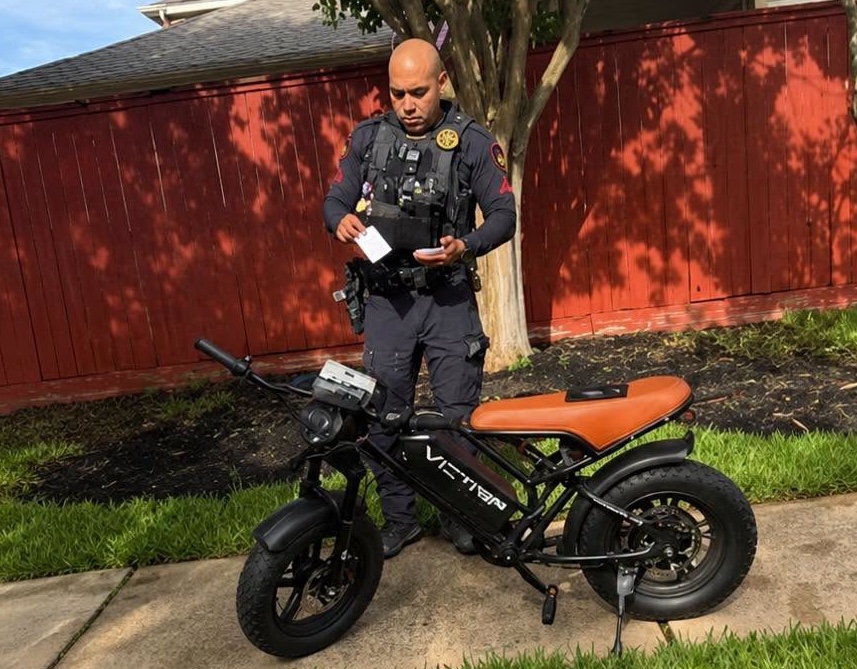
Local Law Enforcement Escalates E-Bike Warning as Youth Crashes, Illegal Riding and School Concerns Grow
Electric bikes and scooters have become a familiar sight in neighborhoods across the Houston area, giving children and teenagers a convenient way to visit friends, reach nearby parks or simply enjoy more independence. But as faster, motorcycle-style electric vehicles become more common, local law enforcement officials say the risks are becoming harder to ignore.
Deputies and residents continue to report concerns involving underage or unlicensed riders, high speeds, unsafe operation near vehicles and confusion about which electric vehicles are legally permitted on streets, sidewalks and bicycle paths.
For families in Eagle Landing, which is served by the Harris County Precinct 4 Constable’s Office, a recent juvenile crash and a broader push involving seven area school districts offer a timely reason to review what young people are riding—and whether those vehicles belong on public roads at all.
An 11-Year-Old’s Crash Highlights the Risk
On June 6, deputies with Constable Mark Herman’s Office responded to the Cypress Ridge subdivision after an 11-year-old was involved in an e-bike crash.
According to the Precinct 4 Constable’s Office, a preliminary investigation found that the child attempted to travel around a vehicle stopped at an intersection and collided head-on with an oncoming vehicle. Emergency personnel treated the juvenile at the scene, and the investigation remained ongoing at the time of the agency’s announcement.
The crash illustrates how quickly an ordinary neighborhood ride can turn serious. A stopped vehicle may block a rider’s view of approaching traffic, while the speed and acceleration of an electric bicycle can leave both the rider and an oncoming driver with little time to react.
Precinct 4 officials used the incident to remind parents and young riders to follow traffic laws and use caution on public roadways.
Constables Ask School Districts to Ban E-Motorcycles
The local conversation expanded further ahead of the 2026–2027 school year.
ABC13 reported July 20 that Fort Bend County Precinct 1 Constable Chad Norvell, Harris County Precinct 5 Constable Terry Albritton and Harris County Precinct 4 Constable Mark Herman sent letters to seven school districts asking them to ban high-powered e-motorcycles from school property.
The districts contacted reportedly included Katy ISD, Spring ISD and Klein ISD.
The constables’ concerns center on electric motorcycles and similar devices capable of traveling faster than 30 mph. Unlike compliant electric bicycles, these vehicles may lack operable pedals, exceed Texas e-bike speed or motor limits and require a motorcycle license, registration and insurance before they can legally be used on public roads.
They are also not generally permitted on sidewalks.
That distinction is important because terms such as “e-bike,” “electric dirt bike” and “e-motorcycle” are often used interchangeably, even though Texas law treats the vehicles differently.
School Districts Begin Responding
ABC13 contacted the seven districts that reportedly received letters from the constables.
Spring ISD told ABC13 that district officials would review the request, while Klein ISD said it plans to continue working with local law enforcement partners to support student and staff safety on school campuses.
Cy-Fair ISD shared a letter sent to parents in June in which the superintendent strongly discouraged students from riding e-motorcycles on school property.
Katy ISD said high-speed, unregistered electric motorcycles and similar devices are already prohibited from being ridden on district campuses while school is in session.
The district also noted that its police department had communicated with the constable about the concerns and that it continues to coordinate with the numerous law enforcement agencies serving its Harris, Fort Bend and Waller county attendance area. Outside school property, e-bike and motor vehicle use remains subject to Texas law and applicable local ordinances, with enforcement handled by local authorities.
The school-district outreach signals that the issue is no longer limited to isolated neighborhood complaints. Law enforcement agencies are now asking districts to address how high-powered electric motorcycles are brought to and operated near campuses before more students return for the fall semester.

Fulshear Reviews Its Electric Scooter Rules
Local governments are also reconsidering how electric scooters should be regulated.
ABC13 reported that the Fulshear City Council was preparing to discuss an e-scooter ordinance adopted in fall 2025. The ordinance requires riders to use sidewalks and stop at crosswalks. Parents of minors who violate the rules may face a $500 citation, although officers reportedly had issued only one ticket as of the July 20 report.
Fulshear City Councilmember Randy Connor said officers have encountered young riders who fail to stop when approached about possible violations. He indicated that city leaders were weighing several responses, including stronger enforcement of sidewalk speed limits, moving e-scooters from sidewalks to streets or banning them altogether.
Connor also noted that each option presents safety tradeoffs, particularly because shifting scooters into roadways would place young riders closer to vehicle traffic. He said school-based restrictions could also be considered as local officials look for ways to reduce unsafe riding near campuses, with safety remaining the central concern.
What Counts as a Legal E-Bike in Texas?
Texas law divides electric bicycles into three categories:
-
A Class 1 e-bike provides assistance only while the rider is pedaling and stops assisting at 20 mph.
-
A Class 2 e-bike may use a throttle but also stops providing assistance at 20 mph.
-
A Class 3 e-bike provides assistance while the rider pedals and can reach an assisted speed of up to 28 mph.
State law requires an operator of a Class 3 e-bike to be at least 15 years old.
A legal electric bicycle must have fully operable pedals and an electric motor rated at no more than 750 watts. When it meets those requirements, it generally does not require a driver’s license, vehicle registration or motor vehicle insurance.
Compliant e-bikes may generally be ridden in many of the same places as traditional bicycles, subject to state law and local rules.
When an Electric Bike Is Really an E-Motorcycle
Electric dirt bikes, pit bikes and motorcycle-style vehicles may not qualify as e-bikes simply because they run on batteries.
Warning signs that a vehicle may fall outside the Texas definition of an electric bicycle include:
- No fully operable pedals
- A motor exceeding 750 watts
- Speeds greater than 28 mph
- A design intended primarily for off-road riding
- Motorcycle-style construction and performance
Some vehicles from brands such as Surron, Talaria and certain Razor dirt-bike lines may be classified as electric motorcycles or off-road vehicles rather than bicycles, depending on the model and equipment.
Operating one legally on a public road may require registration, insurance and a Class M motorcycle license. Off-road models that cannot meet those requirements should generally remain on private property or in authorized riding areas.
Families should check the manufacturer’s specifications and legal classification rather than relying on a seller’s description or the appearance of the vehicle.

Electric Scooter Rules Are Different
Stand-up electric scooters have their own rules under Texas law.
Motor-assisted scooters may generally be operated on roads with posted speed limits of 35 mph or less, although they may cross faster roads at intersections. HOAs, municipalities, and counties can impose additional restrictions on where and how scooters are used.
That means a scooter allowed in one community may face different rules in another. Sidewalk access, speed restrictions and enforcement policies can vary by location.
Families in Eagle Landing should review applicable neighborhood, county and municipal rules before allowing a child to ride beyond private property.
Why These Vehicles Can Challenge Young Riders
E-bikes and electric scooters can accelerate more quickly and travel faster than traditional bicycles. That difference affects stopping distance, reaction time and a child’s ability to judge approaching traffic.
Young riders may also lack the experience to anticipate that a vehicle could turn across their path, pull out of a driveway or approach from behind a stopped car.
Drivers face challenges of their own. A motorist may see what appears to be a bicycle without realizing it is approaching at 25 or 30 mph.
Intersections, school entrances, driveways, parked vehicles and neighborhood curves are particularly risky when riders move too quickly or enter traffic without a clear view.
A Practical Safety Check for Eagle Landing Families
Before a child or teenager rides independently, parents can confirm the vehicle’s legal classification, motor wattage and maximum speed. They should also inspect the brakes, tires, lights and reflectors and make sure the rider has a properly fitted helmet.
Families should establish clear rules against weaving around stopped vehicles, riding against traffic, carrying unauthorized passengers or using headphones and phones while moving.
It can also help to ride the planned route together. Parents can point out blind intersections, busy driveways, school traffic patterns and roads where vehicle speeds make riding especially hazardous.
Young riders should understand that a police officer signaling them to stop is not optional. Leaving the scene can turn a safety conversation into a more serious law-enforcement matter.
A Growing Community Issue, Not a Ban on Outdoor Fun
E-bikes and scooters can still provide recreation, transportation and independence for local families. The central issue is whether the vehicle is legal, whether the rider is prepared to control it and whether it is being operated in an appropriate place.
The increased attention from constables, school districts and local governments reflects a shared concern that rules have not kept pace with the speed and popularity of newer electric vehicles.
For Eagle Landing residents, the message is not that every e-bike is dangerous or illegal. It is that parents should know exactly what their children are riding before handing over the keys, approving a trip to school or allowing them onto a neighborhood street.
A few minutes spent reviewing speed, visibility and Texas e-bike laws could prevent an injury, a citation or a decision that changes a family’s life.
Stay tuned to My Neighborhood News for updates on local e-bike enforcement, school policies and community safety issues affecting area families.

 Tiffany Krenek has been on the My Neighborhood News team since August 2021. She is passionate about curating and sharing content that enriches the lives of our readers in a personal, meaningful way. A loving mother and wife, Tiffany and her family live in the West Houston/Cypress region.
Local business spotlight
Grow your business
where trust already lives.
Let’s introduce your business to the neighbors nearby.
Have a local favorite?
Let’s make an introduction.
Leave your email and our team will reach out with ways to promote your business.
Give a local favorite a little love.
Know a business your neighbors should discover? Tell us who they are.
We couldn’t send that just yet. Please try again.