







Houston Housing Market Slows as Mortgage Rates Rise, but Home Prices Hold Steady in September 2026
For Houston-area homeowners wondering what their property might sell for, or families trying to decide whether they can afford to buy, September's housing numbers offer a mixed picture. Homes are taking a little longer to sell, buyers have more properties to choose from, and higher mortgage rates are making monthly payments harder to manage. Yet despite slower sales, home prices across Greater Houston have remained relatively steady.
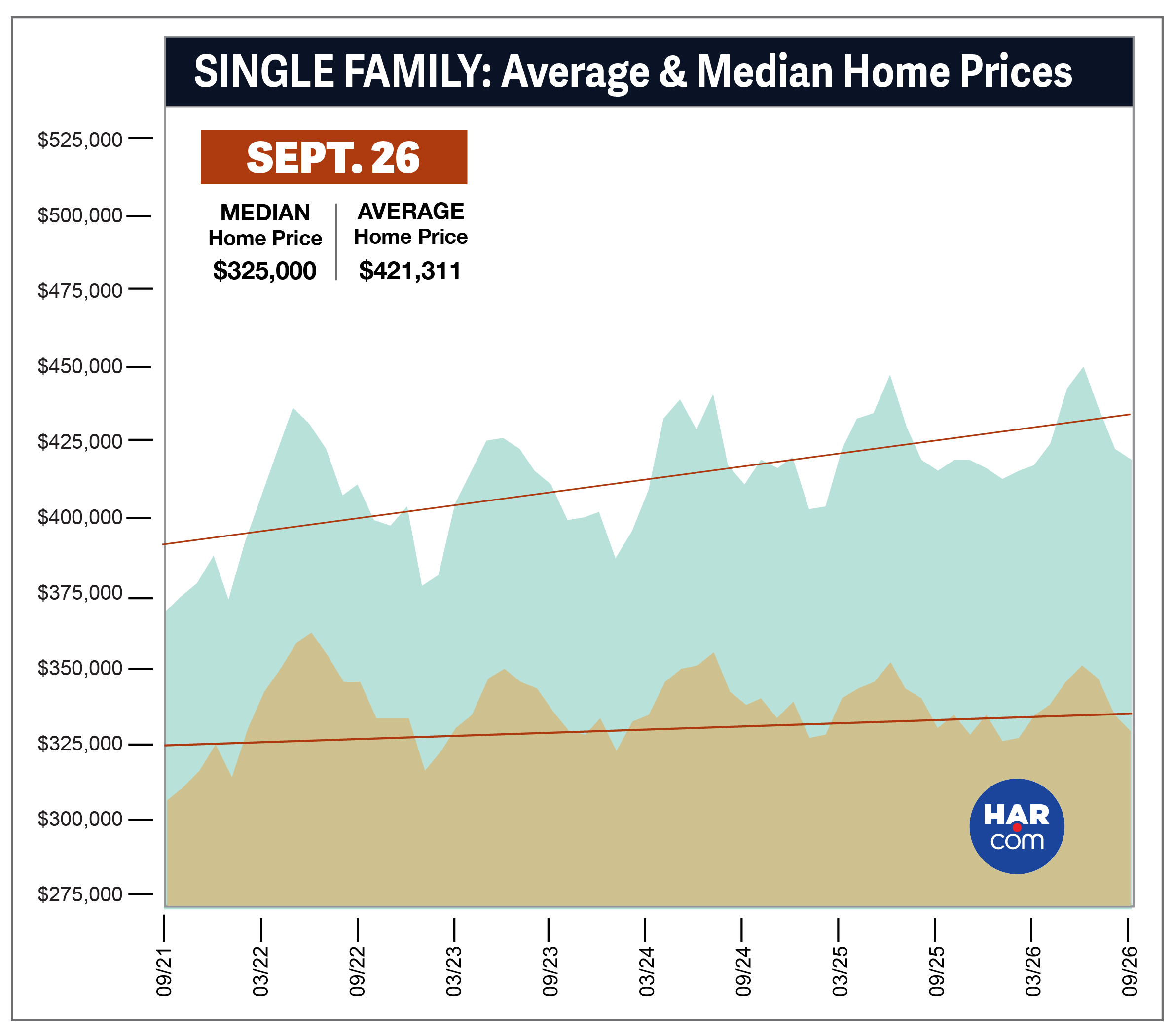
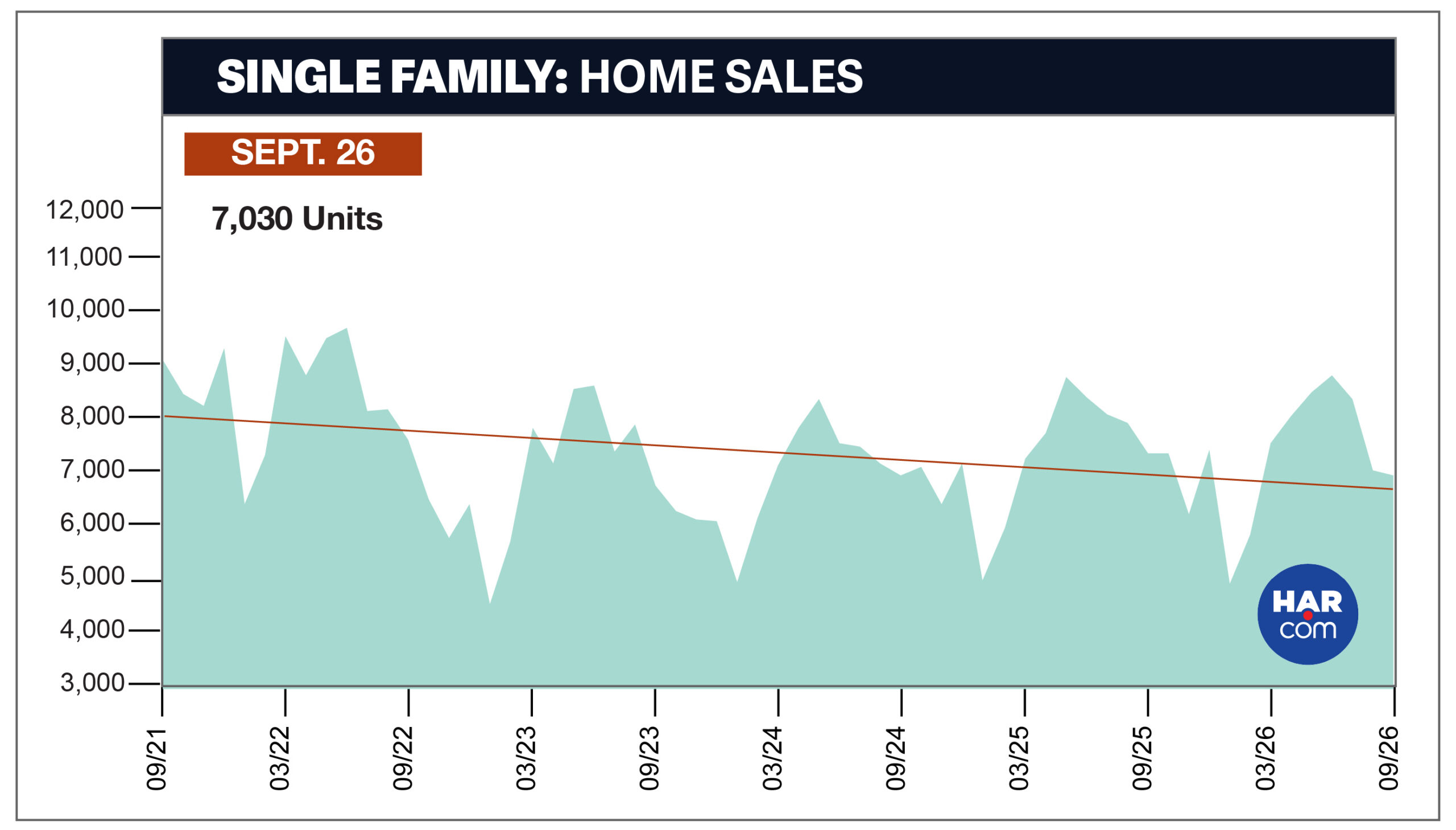
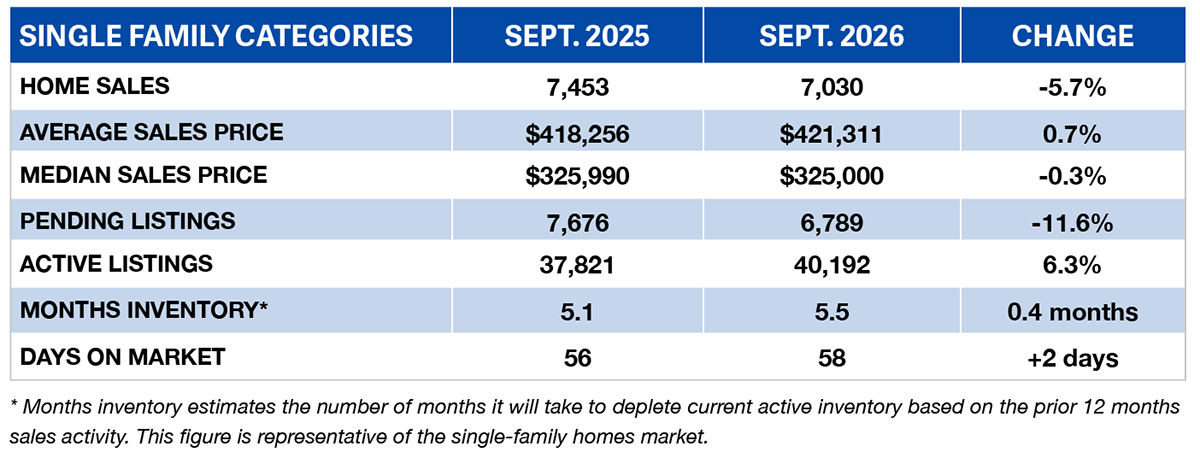
The latest report from the Houston Association of Realtors (HAR), released October 14, shows that 7,030 single-family homes sold across the Greater Houston area in September 2026, a 5.7% decline from the same month last year. Meanwhile, the median sales price was $325,000, just $990 below September 2025.
The changing market is particularly relevant for residents of Katy, Cypress, Sugar Land, Richmond, Pearland, The Woodlands, Spring and other Houston-area communities where decisions about buying, selling or staying put often come down to the same question: What will a home actually cost each month?
While higher borrowing costs are giving some buyers reason to wait, a growing selection of available homes means those who are ready to purchase may have more time to compare properties and negotiate than they did during the more competitive housing market of recent years.
Houston Home Prices Remain Steady Despite Fewer Sales
According to HAR's September 2026 Housing Market Update, the average price of a single-family home in Greater Houston increased slightly to $421,311, up 0.7% from $418,256 a year earlier.
The median price, which represents the midpoint of all homes sold, slipped just 0.3%, from $325,990 to $325,000.
Although fewer homes are changing hands, the region has not experienced a substantial overall decline in reported sales prices. Instead, the figures suggest buyers and sellers are adjusting to a market where affordability has become a greater consideration.
There were 40,192 active single-family listings across Greater Houston in September, a 6.3% increase from 37,821 a year earlier. Housing inventory also grew from 5.1 months to 5.5 months, compared with a national supply of 4.8 months reported by the National Association of Realtors.
Homes spent an average of 58 days on the market, two days longer than in September 2025. Pending sales, which measure homes under contract but not yet closed, declined 11.6% to 6,789.
For sellers, these figures make competitive pricing and property condition especially important. For buyers, the additional inventory can mean more opportunities to consider different neighborhoods, floor plans and price ranges before making a decision.
Higher Mortgage Rates Are Changing What Houston Buyers Can Afford
One of the biggest challenges facing Houston homebuyers is not necessarily the asking price of a house. It is the cost of financing it.
According to Freddie Mac mortgage data cited by HAR, conventional 30-year mortgage rates averaged 6.86% in September 2026, compared with 6.35% in September 2025.
For buyers purchasing a median-priced Houston home with a 20% down payment, HAR estimates that monthly principal and interest payments increased from $1,622.29 to $1,705.41, adding $83.12 per month, or approximately $997 in annual mortgage costs.
Those estimates do not include property taxes, homeowners insurance, mortgage insurance when applicable, or homeowners association fees. For many Houston-area families, those additional expenses can have a significant impact on the overall cost of homeownership.
Borrowing costs also climbed throughout September. Freddie Mac's weekly figures, as reported by HAR, rose from 6.71% early in the month to 7.03% during the final week. By the second week of October, the reported rate had reached 7.40%.
“Higher mortgage rates are making buyers look more closely at what they can comfortably afford,” said HAR Chair Theresa Hill of Compass RE Texas, LLC - Houston. “People are taking a little more time, weighing their options and focusing on long-term affordability. Stable prices and a broad selection of homes are helping keep opportunities within reach.”
The result is a housing market where a home that fit a family's budget earlier in the year may require a closer look today, even when the seller has not raised the asking price.

Houston's Economy Is Still Adding Jobs, but Growth Has Been Uneven
The slowdown in Houston home sales comes as the region's broader economy continues to add jobs, although employment gains have varied considerably across industries.
According to the Federal Reserve Bank of Dallas' September 2026 Houston Economic Indicators report, the Houston economy added approximately 18,000 jobs during the three months ending in July 2026, representing annualized employment growth of 2.1%.
Construction accounted for 6,500 of those jobs, while professional and business services added 7,800. The oil and gas sector also gained approximately 1,500 jobs during that three-month period.
However, the Dallas Fed found that employment growth over the full 12-month period ending in July was just 0.5%, with approximately 17,500 jobs added. Several industries experienced year-over-year job losses, including manufacturing, financial activities, leisure and hospitality, and oil and gas.
More recent figures from the U.S. Bureau of Labor Statistics show that the Houston-Pasadena-The Woodlands metropolitan area had approximately 44,700 more payroll jobs in August 2026 than in August 2025.
Houston's unemployment rate was 5.0% in August, compared with the national unadjusted rate of 4.3%.
The Dallas Fed and BLS figures cover different reporting periods and use different measurement approaches. They should not be added together, but both provide context for the region's employment conditions.
What Houston's Economic Conditions Mean for Homebuyers
Houston's employment growth helps explain why the region's economy can continue expanding even while portions of the housing market experience slower activity. However, job creation alone does not guarantee that households can comfortably afford today's mortgage payments.
The Dallas Fed reported that average hourly wages in Houston reached $36.51 in July, an increase of 3.0% from a year earlier. At the same time, its economic report identified rising business input costs and elevated fuel prices compared with the previous year.
Those conditions can influence household budgets, particularly for residents balancing mortgage or rent payments with groceries, transportation, insurance and other recurring expenses.
Housing affordability was already a concern before mortgage rates rose in September.
According to HAR's second-quarter 2026 Housing and Rental Affordability Report, approximately 40% of Greater Houston households could afford a median-priced home during that quarter. That represented an improvement from 36% a year earlier, largely reflecting more favorable mortgage rates and moderating home prices at the time.
The report estimated that households needed an annual income of at least $102,000 to purchase a median-priced Houston-area home in the second quarter.
Those findings provide additional perspective on September's market conditions. Even before the latest increase in borrowing costs, homeownership remained financially out of reach for many households across Greater Houston.
The economic data does not establish that employment trends or rising everyday expenses directly caused September's decline in home sales. It does, however, help explain why affordability and financial stability remain important considerations for buyers.
Which Houston Home Price Ranges Are Selling?
Not every segment of Greater Houston's housing market experienced the same slowdown in September.
Sales of homes priced between $250,000 and $499,999, one of the region's largest market segments, declined 5.7% to 3,878 transactions. Homes priced between $150,000 and $249,999 experienced an 8.4% decline, with 1,359 sales.
At the higher end of the market, homes priced between $500,000 and $999,999 recorded a slight 0.6% increase, with 1,189 sales. Properties priced at $1 million and above saw sales decline 8.2% to 304 transactions.
The two lowest price categories recorded increases. Homes priced below $100,000 rose 3.7% to 111 sales, while properties between $100,000 and $149,999 increased 5.6% to 188 transactions.
Although those lower-priced categories experienced percentage gains, they accounted for relatively few transactions compared with the region's middle-priced housing segments.
Existing single-family homes also showed a measure of stability. HAR reported 5,062 existing-home sales in September, essentially unchanged from a year earlier. The average existing-home price declined 1.1% to $427,110, while the median remained at $325,000.
Houston Townhome and Condo Sales See a Sharper Decline
While single-family home prices held relatively steady, Houston's townhome and condominium market experienced a more noticeable slowdown.
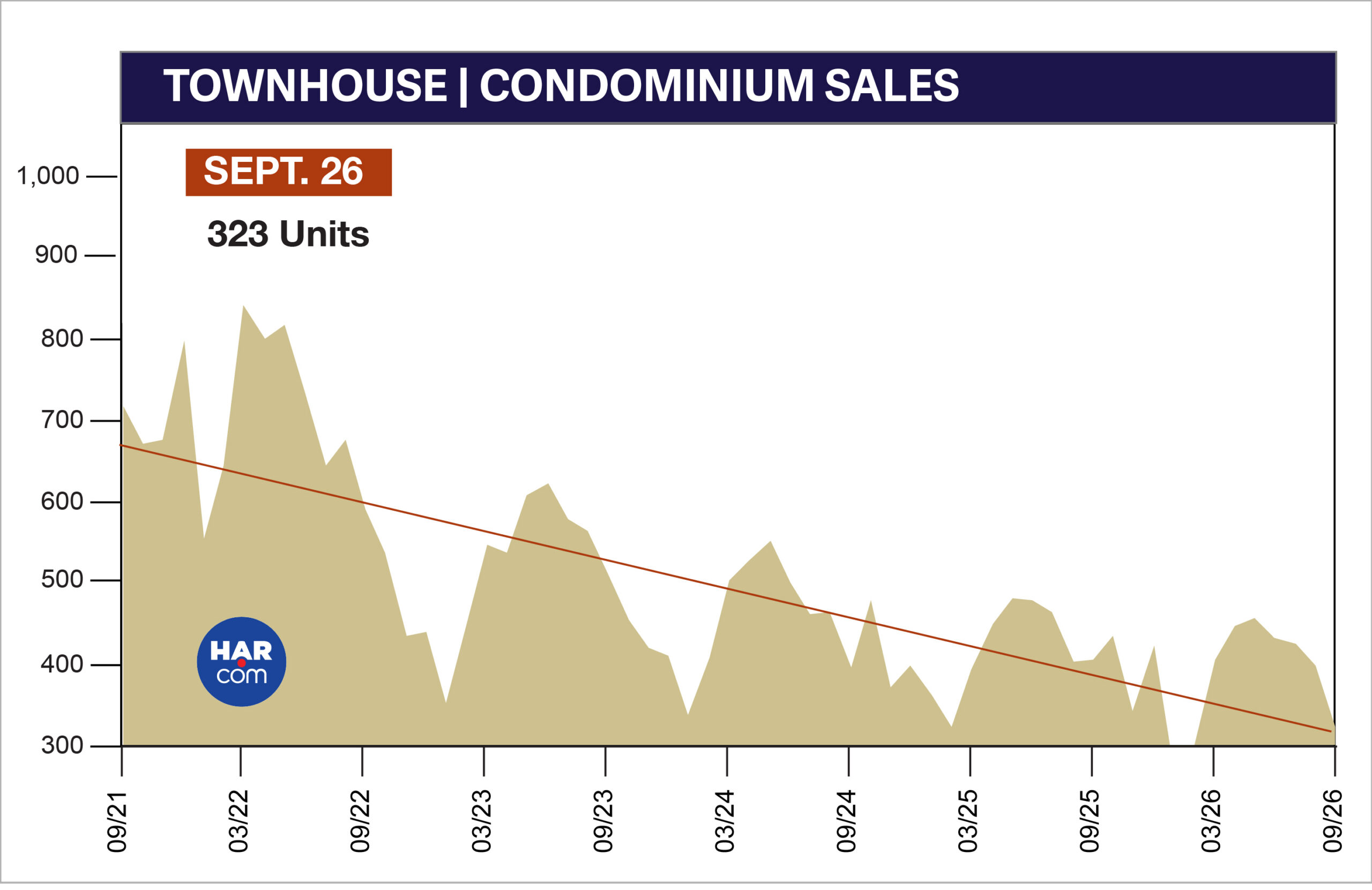
Sales of townhomes and condominiums fell 21.0% year over year, with 323 properties sold during September.
The average sales price declined 4.6% to $261,052, while the median dropped 9.1% to $209,000.
Buyers also had more properties to consider. Active listings increased 6.9% to 3,609, and available inventory expanded from 8.0 months to 9.3 months. Pending sales declined 15.9%, from 440 to 370.
For buyers considering a condominium or townhome in Houston, the increase in available inventory may provide additional negotiating opportunities. However, property-specific expenses, including HOA assessments, insurance obligations and maintenance responsibilities, remain important considerations when comparing attached housing with traditional single-family homes.
The figures also show why it is important to distinguish between different property types when discussing Houston real estate prices. Conditions in the condominium market are not necessarily representative of what homeowners are experiencing in suburban single-family neighborhoods.
Houston Real Estate Market Records $3.45 Billion in September Sales
Looking beyond single-family homes, HAR reported 8,181 property sales across all property types in September, a 6.4% decline from a year earlier.
Total sales volume reached $3.45 billion, down 2.1% year over year.
Active listings across all property types increased 5.0% to 62,002 available properties.
Taken together, these numbers show a market with fewer completed transactions but a larger supply of available properties. They also suggest that the slowdown is affecting more than one category of residential real estate.
What Does the September Housing Report Mean for Houston Homeowners and Buyers?
For homeowners in communities such as Katy, Cypress, Sugar Land, Richmond, Rosenberg, Spring and The Woodlands, September's report offers a reminder that the value of an individual property depends on more than regional averages.
A well-maintained home in a neighborhood with limited available inventory may face different market conditions than a similar property in an area where buyers can choose among numerous competing listings.
For residents preparing to sell, reviewing recent comparable sales, evaluating competing listings and understanding how long homes are taking to sell locally can help establish realistic expectations.
For prospective buyers, the combination of relatively stable prices and increased inventory may create opportunities to explore neighborhoods that previously had fewer available properties. Still, a larger selection of homes does not necessarily mean lower monthly payments, particularly when mortgage rates remain elevated.
Families considering a move should also account for property taxes, homeowners insurance, flood insurance where appropriate, HOA fees and potential maintenance expenses when comparing the full cost of homeownership.
Importantly, HAR's report covers the broader Greater Houston market. It does not provide neighborhood-specific price changes for every community, and regional trends should not be interpreted as evidence that home values have risen or fallen by the same amount in any particular subdivision.

How Does Houston's Housing Market Compare With the Rest of the Country?
Houston is not alone in experiencing slower housing activity.
According to the National Association of Realtors' September 2026 Existing-Home Sales report, existing-home sales nationwide increased 1.5% from August to September, although sales remained below year-earlier levels across all four regions of the country.
National housing inventory stood at 4.8 months, compared with 5.5 months for single-family homes in Greater Houston.
The difference suggests Houston-area buyers generally had a larger supply of available homes relative to recent sales activity than buyers nationally, although conditions vary significantly by city, neighborhood and price range.
Nationally, the median existing-home sales price reached $417,500 in September, according to NAR, compared with the $325,000 median reported by HAR for Greater Houston single-family homes.
These figures cover different property categories and geographic markets, so they are not directly equivalent. Nevertheless, they provide useful context for Houston's position within the broader U.S. housing market.
What Comes Next for Houston's Housing Market?
As Greater Houston moves further into the fall housing season, mortgage rates and pending sales will be important indicators to watch.
September's 11.6% decline in pending single-family listings could point to softer closing activity in the months ahead, although the eventual outcome will depend on buyer demand, financing conditions and the number of transactions that reach closing.
HAR is also scheduled to release its September 2026 Rental Market Update on Wednesday, October 21. Those findings may offer additional insight into how Houston-area households are weighing the costs of renting versus buying.
For now, the September numbers tell a fairly straightforward story. Houston's housing market has slowed, but home prices have not fallen substantially across the region. Buyers have more options, sellers face greater competition, and borrowing costs continue to play an important role in household decisions.
Whether residents are preparing to purchase their first home, considering a move to another Houston-area neighborhood or simply keeping an eye on their property's value, understanding both the housing market and the local economy can help them make more informed decisions.
Stay tuned to My Neighborhood News for additional updates on Greater Houston real estate trends, mortgage rates, housing affordability and developments affecting local neighborhoods.

 Tiffany Krenek has been on the My Neighborhood News team since August 2021. She is passionate about curating and sharing content that enriches the lives of our readers in a personal, meaningful way. A loving mother and wife, Tiffany and her family live in the West Houston/Cypress region.

Local business spotlight
Grow your business
where trust already lives.
Let’s introduce your business to the neighbors nearby.
Have a local favorite?
Let’s make an introduction.
Leave your email and our team will reach out with ways to promote your business.
Give a local favorite a little love.
Know a business your neighbors should discover? Tell us who they are.
We couldn’t send that just yet. Please try again.