







Houston-Area SNAP Enrollment Falls 18% as Food Pantries See Growing Demand
For many Houston-area families, the question is no longer whether they have a job. It is whether their paycheck can stretch far enough to cover the mortgage or rent, medical bills, utilities and a full week of groceries.
That pressure is showing up at food pantries across the region as participation in the Supplemental Nutrition Assistance Program, commonly known as SNAP, falls sharply.
About 155,000 fewer people in the nine-county Houston metropolitan area were approved to receive SNAP benefits in June 2026 than in June 2025, an 18% decline, according to Texas Health and Human Services data analyzed by John Brannen, a staff writer for Rice University’s Kinder Institute for Urban Research.
The regional decrease has brought SNAP enrollment to its lowest level since at least January 2022, while food pantry leaders say more residents are turning to charitable organizations for help.
Mission Bend Food Pantry Serving More Than Twice as Many People
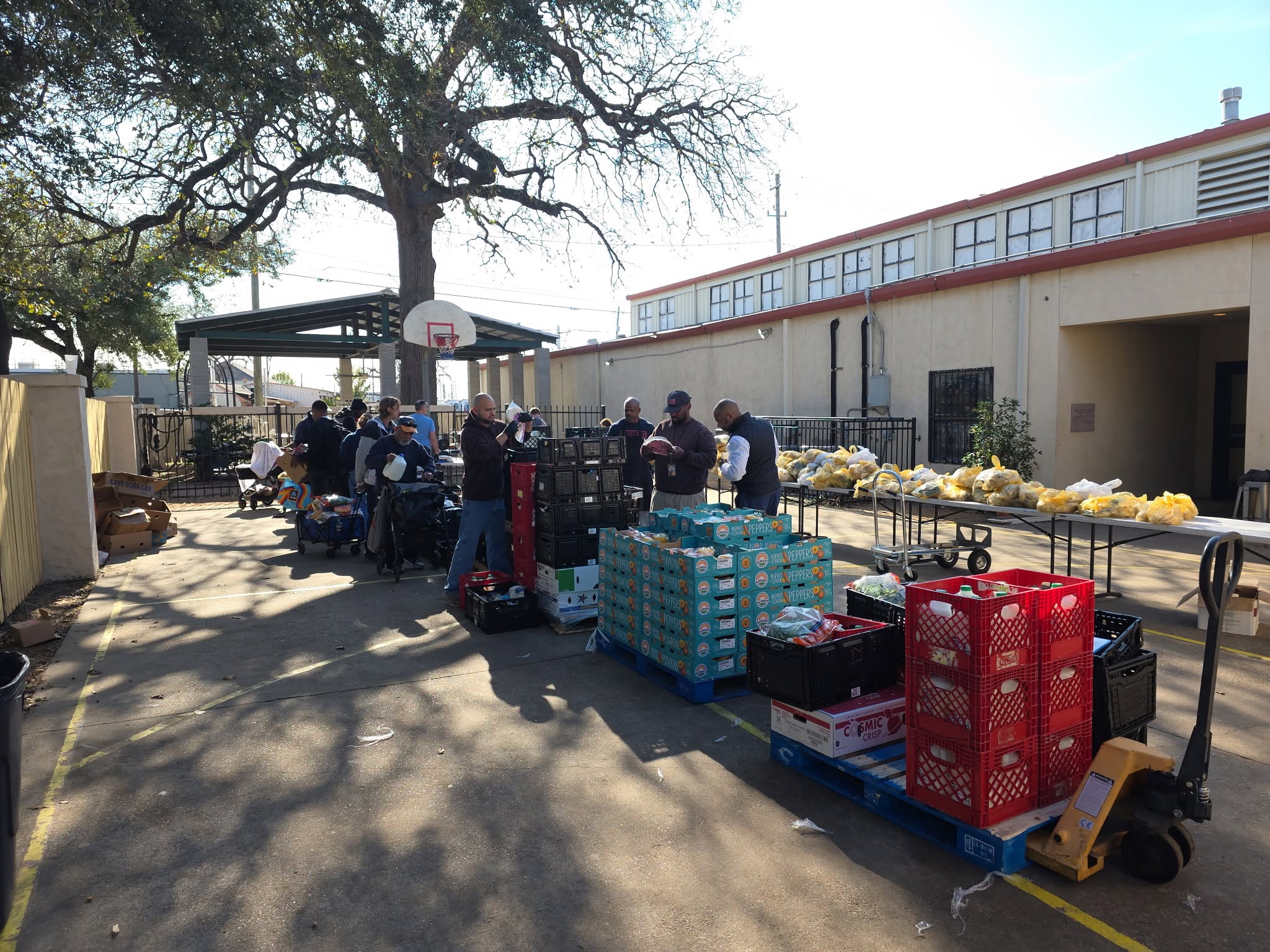
In west Houston, the Mission Bells food pantry at Christ the King Episcopal Church in Mission Bend is experiencing the busiest period in its 42-year history.
More than 550 people typically visit the pantry each week during its two distribution days, according to Mission Bells Director and Pantry Manager Vas Kenyen. That number has more than doubled during the past year.
“The need has increased significantly, even though people are gainfully employed,” Kenyen said. “Still, the money they’re making isn’t enough to meet housing, medical expenses and food. What happens is, after paying for the house and the medical bills and other necessities, there’s not enough left for food.”
The increase offers a window into a broader challenge across Houston and Harris County: employment does not always translate into financial stability, particularly when food prices compete with rising housing, health care, transportation and household expenses.
Mission Bells has been able to secure food through the Houston Food Bank and other community partners, but moving that food to the pantry and distributing it to a growing number of families has become increasingly difficult.
“We can find the food, but we don’t always know how to get it to our location,” Kenyen said. “That’s our main issue: finding enough volunteers.”
Houston SNAP Enrollment Reaches Four-Year Low
SNAP is the nation’s largest food assistance program, helping eligible households purchase groceries through monthly benefits. During the past year, approximately 1.5 million Texas households received an average of about $375 per month.
Across the nine counties in the Houston metro area, SNAP participation declines ranged from 14% in Galveston County to 23% in Austin County.
Total SNAP payments to Houston-area households fell from approximately $158 million in June 2025 to $125 million in June 2026.
Children accounted for slightly more than half of the overall decline. The number of Houston-area children approved for SNAP dropped from approximately 444,000 to 359,000, a 19% year-over-year decrease.
Enrollment among adults ages 18 to 64 fell 21%, while participation among adults age 65 and older remained nearly unchanged.
In June 2026, approximately 710,000 residents across the nine-county Houston region were receiving SNAP benefits, the lowest monthly total in the state’s publicly available records dating back to January 2022.

New SNAP Work Requirements Affect More Adults
The decline followed federal eligibility changes that took effect during the second half of 2025.
Under the revised regulations, able-bodied adults under age 65 who do not have dependents generally must complete at least 80 hours per month of employment, job training or volunteer service to maintain SNAP eligibility. The previous work requirement generally applied to adults younger than 55.
The rules also restrict eligibility for additional groups, including some refugees and asylum recipients who are not legal permanent residents. Adults caring for children ages 14 to 17 may also face work requirements that previously did not apply to them.
The changing requirements can be difficult for households to understand, particularly when a family’s eligibility depends on work hours, caregiving responsibilities, immigration status or other circumstances.
Brian Greene, president and CEO of the Houston Food Bank, said some residents who may still qualify are choosing not to apply or renew their benefits because they are uncertain about the rules or concerned about penalties if they fail to meet work requirements.
“The rate at which people are calling for charitable food assistance has increased dramatically, which would be somewhat consistent with people thinking, ‘I’m not going to be eligible. How am I going to get by?’” Greene said.
Nearly 40% of Houston and Harris County Households Faced Food Insecurity
The decline in SNAP participation is unfolding in a region where food insecurity was already widespread.
A Kinder Institute survey published in August 2025 found that 39% of households in Houston and Harris County experienced moderate or high food insecurity. The national household food insecurity rate cited in the report was 14%.
The findings were based on responses collected in April and May 2024 from more than 5,200 members of the Kinder Institute’s Greater Houston Community Panel. Participants answered questions about difficulties affording nutritious meals, reducing meal portions, skipping meals and experiencing hunger.
Researchers classified 21% of households as experiencing moderate food insecurity and 18% as experiencing high food insecurity. Among households facing high food insecurity, 94% reported that an adult or child had gone hungry.
Food insecurity refers to uncertain or unstable access to enough food, nutritious food or both. It can include buying less-balanced meals, reducing portion sizes, skipping meals or going without food because a household does not have enough money.
Sejal Mistry, a researcher with the Kinder Institute’s Center for Community and Public Health, said SNAP participation totals do not capture the full number of residents struggling to afford food.
“(SNAP) enrollment numbers tell us who's getting help, not necessarily who still needs it,” Mistry said.
“To understand what's really happening, we need to look at both the data and what families, food banks, the people who help families apply for SNAP and community organizations are seeing and experiencing every day,” she said. “Together, those perspectives give us a more complete picture.”
Food Insecurity Varies Widely Across Harris County Communities
The Kinder Institute’s 2025 food insecurity report documented substantial differences among neighborhoods, income groups and racial and ethnic populations.
More than half of Black residents surveyed, or 53%, reported living in food-insecure households. The rate was 47% among Hispanic residents, 24% among White residents and 17% among Asian residents.
High food insecurity affected 27% of Black residents and 21% of Hispanic residents, compared with 10% of White residents and 7% of Asian residents.
Hispanic women experienced the largest measured gender gap. Fifty-three percent reported household food insecurity, compared with 41% of Hispanic men.
Income was also closely connected to reliable food access. Among households earning less than $35,000 per year, 59% experienced food insecurity, including 29% classified as highly food insecure.
Food insecurity affected 39% of households earning between $35,000 and $74,999, 22% of households earning between $75,000 and $99,999 and 9% of households earning $100,000 or more.
The neighborhood-level findings showed that food insecurity is not distributed evenly across Harris County.
At least half of residents experienced moderate or high household food insecurity in seven of the 30 neighborhood areas studied. Many of those communities were located in northern Harris County, while Pasadena and Hobby in southeastern Harris County recorded a combined rate of 59%.
The Greenspoint and George Bush Intercontinental Airport area had the highest measured rate, with approximately 80% of households experiencing food insecurity.
Other communities with rates of at least 50% included Greater Spring and Aldine West at 58%, Greater East Little York at 57%, Aldine Northwest and Cypress Creek at 54%, Northside and Eastex at 54%, and Oak Forest at 50%.
By comparison, Greater Cypress South and Copperfield recorded a rate of 22%, Greater Waller and Katy recorded 39%, and Eldridge and West Oaks recorded 31%.

Houston Food Bank Spreading Available Food Across More Families
The Houston Food Bank has received additional financial support as demand has increased, but Greene said charitable donations cannot fully replace the scale of federal food benefits.
The organization must work within limits on how much food it can acquire, store, prepare and distribute. Despite increased demand, the amount of food distributed so far in 2026 has remained close to the previous year’s level.
“Philanthropy did go up for us, so we were able to do a bit more,” Greene said. “But when you ask what we do with surging demand, the main thing is we spread the food out thinner.”
That means a growing number of families may be sharing a supply of food that has not increased at the same pace as community need.
Local food pantries also rely heavily on volunteers to unload deliveries, organize groceries, manage traffic and distribute food safely. As demand grows, transportation capacity and volunteer availability can become as important as the food supply itself.
Food Insecurity Can Affect Physical Health and Medical Care
The consequences of unreliable food access extend beyond an empty refrigerator.
Kinder Institute research published in November 2025 found that residents of food-insecure households were more than twice as likely as those in food-secure households to rate their physical health as poor or fair.
Nearly half of residents without reliable food access reported that they had not received needed medical care for a physical condition during the previous year. Among food-secure households, that figure was 39%.
For families deciding between groceries, prescriptions, doctor visits and housing payments, preventive health care may become one more expense that is postponed.
“When families are in survival mode, it becomes much harder to prioritize preventive care and manage their health,” Mistry said. “We can’t expect people’s health to improve when they’re struggling to meet one of their most basic needs.”
What the SNAP Decline Means for Houston-Area Families
The decline in Houston SNAP enrollment does not necessarily mean fewer residents need food assistance. Instead, the data, pantry visits and community survey findings suggest some families may be losing benefits, deciding not to apply or struggling to navigate changing eligibility requirements.
For Houston and Harris County residents, the effects are likely to be felt in several places: longer lines at neighborhood food pantries, greater demand for volunteers, increased pressure on nonprofit organizations and more households making difficult choices between food, health care and housing.
The challenge is particularly significant for children. With approximately 85,000 fewer Houston-area children approved for SNAP than one year earlier, schools, churches, food banks and community organizations may increasingly encounter families looking for help.
Residents seeking assistance can contact the Houston Food Bank or a nearby community food pantry to learn about distribution schedules and available resources. Those interested in helping can support local organizations through food donations, financial contributions, transportation assistance or volunteer service.
John Brannen’s original reporting on the regional SNAP decline was published by Rice University’s Kinder Institute for Urban Research on July 27, 2026. The local food insecurity findings were produced by the Kinder Institute’s Center for Community and Public Health.
As eligibility rules and enrollment levels continue to change, My Neighborhood News will continue following how those changes affect Houston-area families, food pantries and the community organizations working to keep residents fed.

 Tiffany Krenek has been on the My Neighborhood News team since August 2021. She is passionate about curating and sharing content that enriches the lives of our readers in a personal, meaningful way. A loving mother and wife, Tiffany and her family live in the West Houston/Cypress region.
Local business spotlight
Grow your business
where trust already lives.
Let’s introduce your business to the neighbors nearby.
Have a local favorite?
Let’s make an introduction.
Leave your email and our team will reach out with ways to promote your business.
Give a local favorite a little love.
Know a business your neighbors should discover? Tell us who they are.
We couldn’t send that just yet. Please try again.